

On Monday, Parliament began a special session to discuss Vande Mataram, with Prime Minister Modi leading the discussion. Muslim and some opposition MPs spoke against mandatory recitation, arguing that its contents conflict with their religious beliefs.
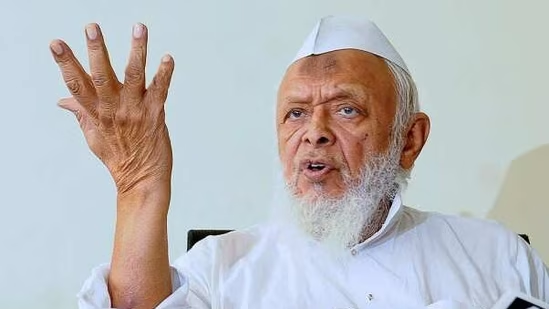
Maulana Arshad Madani, senior Islamic scholar and current Principal of Darul Uloom Deoband, clarified that while Muslims have no objection to others reciting or singing India’s national song Vande Mataram, they cannot participate due to religious beliefs.
In a tweet, Madani explained that the song’s content contradicts Islamic monotheism. “In its four verses, the homeland is likened to a deity and to Durga Mata, and words associated with worship are used,” he wrote. “The meaning of ‘Vande Mataram’ is essentially ‘Mother, I worship you,’ which goes against the religious beliefs of a Muslim.”
The statement comes amid renewed pressure in some states and Union Territories to mandate or strongly encourage recitation of Vande Mataram, especially in schools and public institutions, as part of patriotic events or the commemoration of the song’s 150‑year milestone.
On Monday, Parliament began a special session to discuss Vande Mataram, with Prime Minister Narendra Modi leading the discussion in the Lok Sabha. Muslim and some opposition MPs spoke against mandatory recitation, arguing that its contents conflict with their religious beliefs.
Vande Mataram was written 150 years ago by Bankim Chandra Chattopadhyay and translates to “Mother, I Bow to Thee.” In 1937, the Congress adopted a modified version as the national song, and in 1951, the Constituent Assembly, at the instance of then-President Rajendra Prasad, formally recognised it, while Jana Gana Mana was designated the national anthem.
Madani noted that the distinction between patriotism and religious worship. “Love for one’s country is one thing; worshipping it is another. Muslims do not need anyone’s certificate to prove their patriotism—their sacrifices in the freedom struggle are a shining chapter of history,” he wrote.
Highlighting constitutional protections, he noted that Article 25 guarantees freedom of religion and Article 19 secures freedom of expression. “No citizen can be forced to chant or sing a slogan that contradicts their faith,” he added.
He concluded by reiterating the central tenet of Islamic belief: “Muslims believe in one God; besides Allah, we accept no one as worthy of worship and bow before none. We would accept death, but never accept polytheism.”
The statement comes amid ongoing debates over compulsory recitation of Vande Mataram in schools and public institutions, raising questions about balancing national pride with religious freedom.