
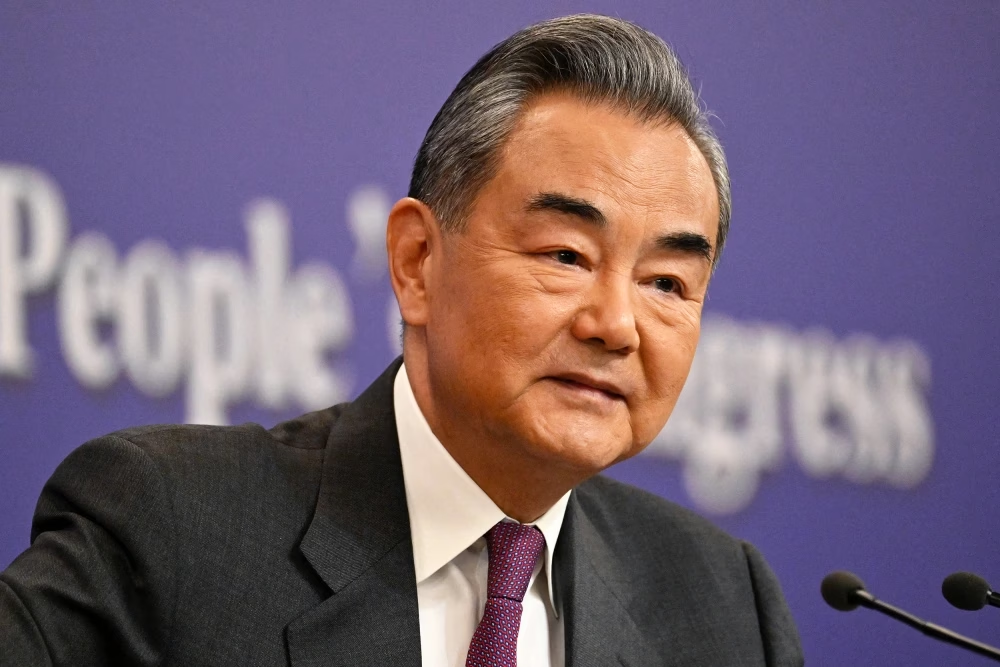

Chinese FM said ties between Beijing and New Delhi were improving, citing an invitation to Prime Minister Narendra Modi to attend an SCO summit in Tianjin in August.
China said it helped mediate tensions between India and Pakistan during their military confrontation in May, Chinese Foreign Minister Wang Yi said on Tuesday, a claim New Delhi has previously rejected.
Speaking at a conference on China’s foreign relations in Beijing, Wang said global instability had intensified this year, with conflicts occurring at a pace not seen in decades.
“This year, local wars and cross-border conflicts flared up more often than at any time since the end of WWII [World War II],” Wang said. “Geopolitical turbulence continued to spread.”
China had responded by adopting a balanced approach to diplomacy, he said, adding: “we have taken an objective and just stance, and focused on addressing both symptoms and root causes”.
“Following this Chinese approach to settling hotspot issues, we mediated in northern Myanmar, the Iranian nuclear issue, the tensions between Pakistan and India, the issues between Palestine and Israel, and the recent conflict between Cambodia and Thailand,” Wang said.
Wang also said ties between Beijing and New Delhi were improving, pointing to China’s invitation to Indian Prime Minister Narendra Modi to attend the Shanghai Cooperation Organisation summit in Tianjin in August.
India’s Ministry of External Affairs has not commented on Wang’s remarks. New Delhi has previously said the ceasefire with Pakistan was not the result of third-party mediation, stating that the halt in hostilities followed a call from Pakistan’s director-general of military operations to his Indian counterpart.
India has also repeatedly dismissed claims by US President Donald Trump that Washington brokered the ceasefire.
Fighting between the nuclear-armed neighbours escalated in May after India launched strikes, codenamed Operation Sindoor, on what it said were militant camps in Pakistan and Pakistan-administered Kashmir, following an April 22 attack in Pahalgam in Indian-administered Kashmir that killed 26 people.
Pakistan responded by shelling Indian villages along the Line of Control in Jammu and Kashmir, according to Indian authorities.
In July, the Indian Army said Pakistan had received real-time intelligence from China on Indian military deployments during the four-day conflict.
Lieutenant General Rahul R Singh, India’s deputy army chief for capability development and sustenance, said India had effectively faced multiple adversaries during the clashes, with Pakistan “leading the front”, China providing extensive support, and Turkey supplying drones “along with trained individuals who were there”.
The Indian Army has said that 81% of Pakistan’s military hardware acquired over the past five years was sourced from China. “[China] is able to test [its] weapons against various other weapon systems that are there, so it’s like a live lab available to them,” Singh said.