
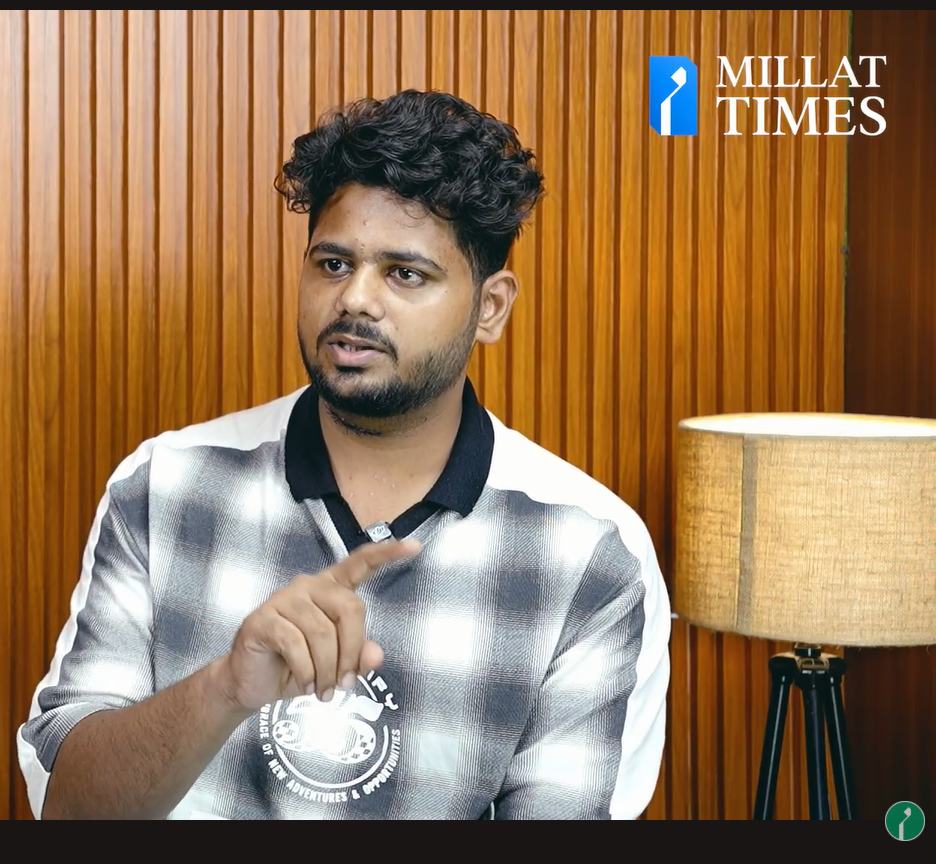




A young professional injured during the Jantar Mantar protest undergoes four surgeries and takes his fight against pellet guns to the Supreme Court
Nearly two weeks after a pellet tore through the left side of his face, Irshad Mansuri still remembers the sound before the pain.
“I thought he was only trying to scare people,” he says, recalling the moment an RAF personnel took a firing position near Jantar Mantar. “Within seconds, I heard a gunshot.”
On July 20, a large number of students and civil society members gathered near Jantar Mantar in New Delhi on the call of the Cockroach Janata Party who had been campaigning at the site since June 6 to protest alleged irregularities in the NEET examination. As the demonstrators attempted to march toward Parliament, personnel from the Delhi Police and the Rapid Action Force (RAF) stopped the procession. The situation escalated when police used barricades, carried out a lathi charge, and fired tear gas to disperse the crowd. During the crackdown, several protesters sustained injuries, and multiple individuals alleged that pellet guns had also been used. Among those injured during the police action was Irshad Mansuri.
Irshad Mansuri was among those injured during the police action.
The pellet struck the corner of his left eye before splintering into multiple fragments. Some pierced his chin, neck and right shoulder. Others lodged deep inside his face, leaving doctors to perform four surgeries to remove them and repair the damage.
Today, the 26-year-old account manager from Madhya Pradesh’s Jabalpur is recovering from those injuries while preparing for another battle. This one not on the streets but in the Supreme Court, where he has petitioned against the use of pellet guns on protesters.
On the morning of July 20, Mansuri joined a protest near Jantar Mantar before leaving for previously scheduled work appointments in Jhandewalan.
“I reached the protest around 9 a.m. and stayed until about 11:15,” he says. “After that I had official meetings from around 12:30 p.m. to 3:30 p.m.”
Once his work ended, he decided to return towards the protest site to understand how events had unfolded.
Walking from Rajiv Chowk metro station shortly before 4 p.m., he noticed something unusual.
“A large number of people were running back towards the Inner Circle,” he recalls. “I wondered why everyone was returning, so I continued walking ahead.”
As he approached, security personnel were dispersing the crowd.
“There was a lathi charge. Tear gas shells were being fired. Two or three shells landed very close to me. My eyes and face started burning, so I also began moving back with the crowd.”
Near a Pind Balluchi restaurant, he saw an RAF personnel raising what appeared to be a pellet-firing weapon.
“I assumed it was only to frighten people,” he says. “Then I heard the shot.”
The projectile hit near his left eye before breaking apart.
“The pellet struck the corner of my left eye, shattered into pieces and entered my skin,” he says. “It then ricocheted downward, hit my chin and fragmented again. Those fragments entered my chin, neck and right shoulder.”
Blood began flowing immediately from multiple wounds.
Although fully conscious, Mansuri says he struggled to understand the extent of his injuries.
“People around me came immediately to help. They pressed cloth against the wounds, stopped a scooter and rushed me to Lady Hardinge Hospital.”
Four surgeries
He reached the hospital at around 5 p.m., where doctors began emergency assessment before attempting surgery.
“They first gave me anesthesia and pain medication,” he recalls. “Between 5 p.m. and 10 p.m., they conducted CT scans, MRI, ultrasound and X-rays because they had to identify every pellet before operating.”
The scans revealed multiple embedded pellets and fragments.
According to Mansuri, one pellet had lodged in his neck, another had entered the muscle controlling movement of his left eye, while another rested inside a fluid-filled cavity in his face. Smaller fragments had also entered his lower jaw and right nasal cavity.
He consented to surgery the following day.
“In total, I underwent four surgeries; on my neck and throat, my eye, inside my mouth where my lower jaw was stitched, and inside my right nasal cavity.”
The physical pain was intense, but Mansuri says the uncertainty proved even harder.
“It was my first prolonged stay in a hospital. I remained on IV drips through a cannula. The pain was severe, and emotionally it was extremely difficult.”
The injury closest to his neck frightened him most.
“I kept thinking that if the pellet moved, it could cause internal bleeding or a stroke,” he says. “I was constantly wondering whether I would survive.”
That night he called his family in Madhya Pradesh.
“I told them I had been hit by a pellet gun. They didn’t even know what a pellet gun was.”
His parents wanted to travel to Delhi immediately, but he tried to reassure them.
“I told them not to come because I hoped I would recover within two or three days.”
During his hospitalization, one friend remained by his side.
“My school friend Aniket Rathore came as soon as I called him. He stayed with me for four or five days and looked after me throughout my treatment.”
Originally from a farming family in Madhya Pradesh, Mansuri moved to Gurgaon after completing his master’s degree and began working as an account manager.
He says his employer has supported his recovery by granting medical leave, and he hopes to return to work once doctors clear him.
On to the Supreme Court
Before July 20, Mansuri says he knew little about pellet guns.
“While I was recovering in hospital, I began reading about them,” he says. “I learned they had previously been used in Kashmir, Manipur and during the farmers’ protest.”
Those readings, he says, convinced him to pursue legal action.
He has since filed a petition before the Supreme Court seeking restrictions on the use of pellet guns against civilians participating in protests.
“I don’t want this to happen to anyone else,” he says. “Pellet guns should not be used against students, civilians or peaceful protesters who are not carrying weapons and are not involved in violence.”
He says he believes the judiciary can help prevent similar injuries in the future.
“I have complete faith in the Supreme Court. I hope it ensures these weapons are never used against peaceful protesters again.”
The scars from July 20 remain visible, and his recovery continues.
Yet Mansuri says the experience has strengthened rather than diminished his determination.
“If such injustice happens again, or if pellet guns continue to be used against innocent people, I will raise my voice again,” he says. “If necessary, I am ready to protest again.”
Support Independent Media
Click Here and Join the Membership of Millat Times to Support Independent Media.
Support Millat Times