


Follow Millat Times for independent journalism.
Opens the app if installed, or Google Play to download it.By Ayesha
Rahul Gandhi’s remarks on India’s defence relationship with Israel have drawn criticism from pro-Palestinian activists and commentators, who say the Congress leader’s position does not adequately address the history of Palestinian dispossession and Israel’s military campaign in Gaza.
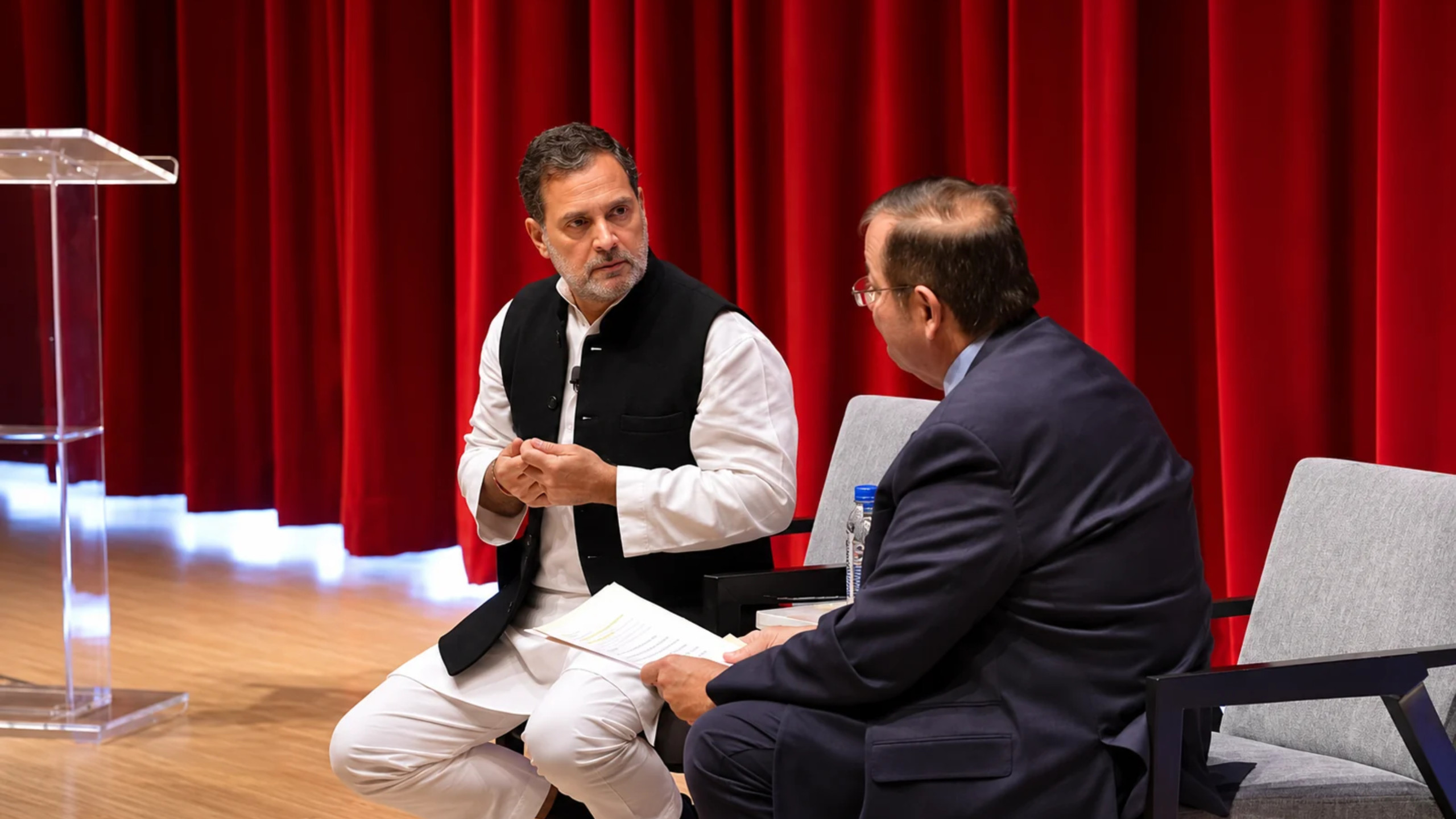
Speaking at the University of Chicago, Gandhi acknowledged that India has close relations with Israel and purchases defence equipment from the country. He said such cooperation should be assessed in the context of India’s national interests.
Gandhi also condemned the Hamas-led attack on Israel on October 7, 2023, while criticising Israel’s subsequent military offensive in Gaza. His comments have prompted a debate over whether he was outlining a pragmatic foreign policy position or avoiding a clearer political stand on the conflict.
Academic and commentator Apoorvanand described Gandhi’s remarks as “very weak”, arguing that acknowledging India’s ties with Israel was a statement of fact rather than an endorsement of those relations.
He said the problem lay in Gandhi addressing the October 7 attack and Israel’s actions in Gaza in the same breath, without adequately explaining the historical and political context of the conflict.
Apoorvanand argued that the two sides could not be discussed as though they occupied equivalent positions, pointing to decades of Palestinian dispossession and Israeli control over Palestinian territory.
He said Gandhi needed to be more explicit about his position, particularly at a time when Israel’s military campaign had caused widespread destruction and civilian suffering in Gaza.
Apoorvanand also questioned India’s defence cooperation with Israel, saying the relationship should be examined in light of the country’s actions against Palestinians. He called for international pressure, including sanctions and Israel’s isolation, rather than an approach that treated the conflict primarily as a matter of diplomatic balancing.
Activist Shabnam Hashmi also criticised Gandhi’s remarks, describing them as “unfortunate” and “unacceptable”. She said the Congress leader had taken positions on several domestic issues that she considered commendable but needed to rethink his approach to Israel.
Hashmi argued that India should draw on its own history of opposing racial discrimination and apartheid. She cited India’s stand against South Africa’s apartheid regime as an example of the kind of moral position the country should take on Palestine.
India had supported the anti-apartheid struggle for decades and was among the countries that pressed for international action against the system of racial segregation in South Africa.
Hashmi said India should show similar resolve in opposing Israel’s treatment of Palestinians, adding that any support for Israel was unacceptable.
Prashant Pundir, an activist and social media commentator who supports Palestinian rights, said the October 7 attack should not be viewed in isolation from the decades of occupation, displacement and restrictions faced by Palestinians.
He argued that describing the Hamas attack and Israel’s military campaign in Gaza in comparable terms risked overlooking the unequal balance of power between Israel and the Palestinians.
Pundir said the conflict had to be understood against the backdrop of Israel’s occupation, the expansion of settlements and the denial of Palestinian self-determination.
He also questioned the prospects of a two-state solution, saying the expansion of Israeli settlements and the fragmentation of Palestinian territory had made the creation of a viable, sovereign Palestinian state increasingly difficult.
For Pundir, the question was not simply whether Indian political leaders expressed concern over civilian casualties in Gaza, but whether their positions were consistent with the political and military relationships India maintained with Israel.
He said solidarity with Palestinians could not be limited to statements of concern while continuing relationships that, in his view, helped sustain the existing situation.
Pundir added that the debate over India’s policy towards Israel should involve the wider political spectrum and not be reduced to a disagreement between the ruling Bharatiya Janata Party and the Congress.
Pro-Palestinian activist Shrishti Khanna said Gandhi’s remarks did not surprise her, arguing that the Congress party had played a role in establishing and developing India’s relationship with Israel.
She said Gandhi’s language and presentation should not be mistaken for a fundamental ideological difference between the Congress and the BJP on Palestine.
Khanna argued that the Congress could not be described as left-wing or socialist simply because its leader used a more measured tone on international issues. She said the two major parties had broadly similar positions on Palestine and had not taken the kind of stand she believed the situation demanded.
Her criticism reflects a wider challenge for the Congress, which has sought to distinguish its foreign policy approach from that of the BJP while also maintaining continuity in strategic relationships established by successive governments.
India and Israel established full diplomatic relations in 1992, during a Congress-led government. Since then, ties have expanded across defence, agriculture, technology and other sectors.
The relationship gained further political momentum under Prime Minister Narendra Modi. He became the first Indian prime minister to visit Israel in 2017, while Israeli Prime Minister Benjamin Netanyahu visited India the following year.
Defence cooperation has remained a central part of the relationship, with Israel emerging as an important supplier of military equipment and technology to India.
The partnership has continued despite differences in the two countries’ positions on the Palestinian question. India has traditionally supported Palestinian statehood and backed a negotiated two-state solution, while also deepening its strategic engagement with Israel.
The Congress has, at times, criticised the Modi government’s response to the war in Gaza. Sonia Gandhi, the party’s former president, has also spoken against the government’s position, arguing that India should take a stronger stand on the suffering of Palestinians.
(with inputs from Nazrul Islam Nadwi)
Support Independent Media
Click Here and Join the Membership of Millat Times to Support Independent Media.
Support Millat Times