


Follow Millat Times for independent journalism.
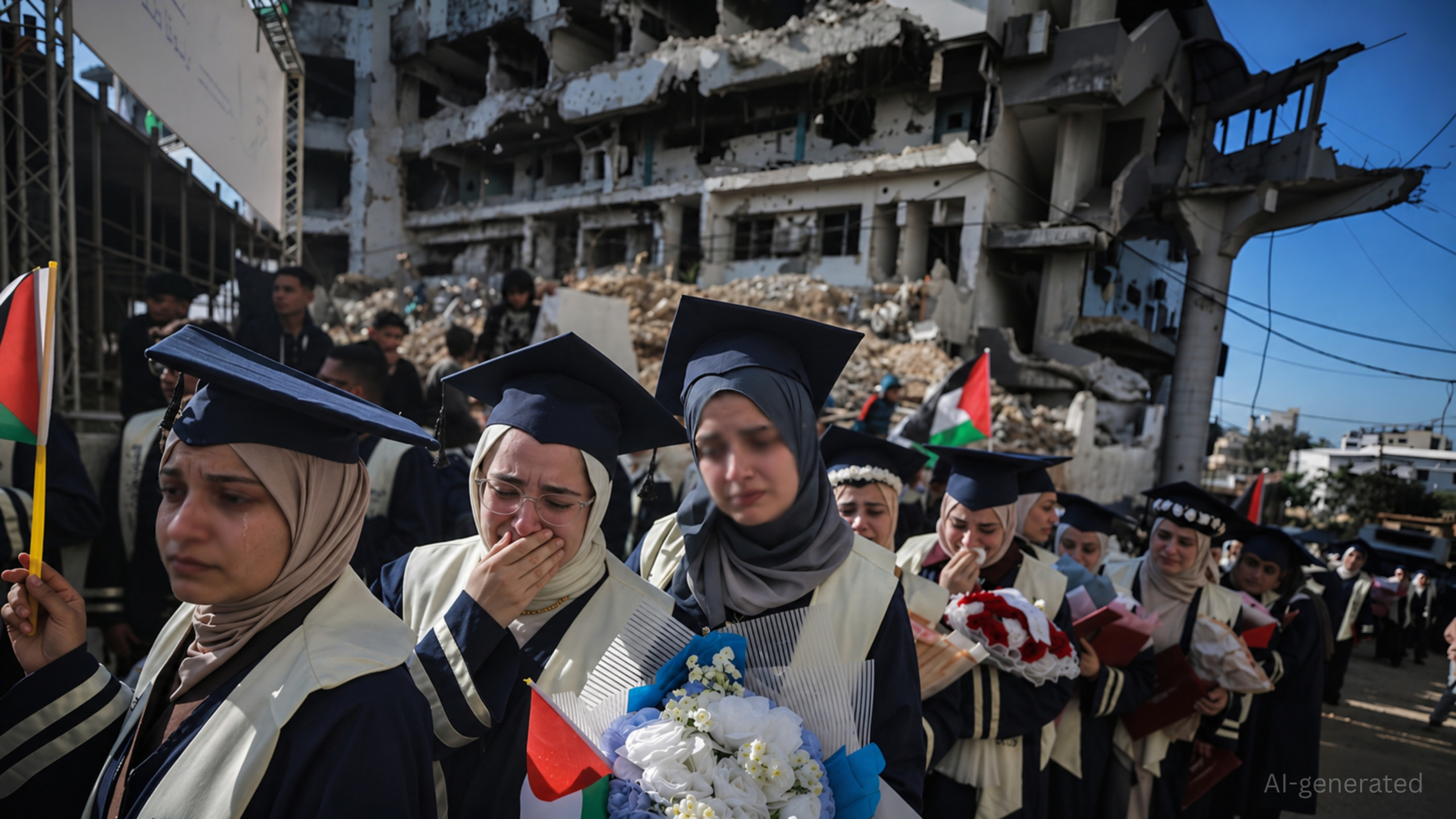
Opens the app if installed, or Google Play to download it.The destruction of Gaza is increasingly being measured in lives lost, homes demolished and hospitals reduced to rubble. But a 148-page research report published by Friends of Palestinian Universities examines another dimension of the devastation that receives far less sustained attention: the destruction of the institutions that educate future doctors, engineers, teachers, researchers and intellectuals and preserve the collective knowledge of an entire society.
The report, Scholasticide in Gaza: The Systematic Destruction of Palestinian Higher Education and the Continuation of Collective Resilience, presents a disturbing picture of an educational system devastated by war but struggling to secure the financial and institutional support necessary for survival. Its most consequential finding may not be the scale of destruction itself, but the gap between money internationally recorded as educational assistance and resources actually reaching Palestinian universities.
According to the report, bilateral donors recorded $44.1 million in higher education aid for Palestine in 2023. Yet only $8 million, 18.2 percent of that amount, reached Palestinian higher education institutions. The remainder was largely spent outside Palestine, including through donor-country universities and scholarship programmes.
The distinction is significant. Aid figures can suggest that international support for Palestinian higher education is substantial, while the institutions expected to educate Palestinian doctors, engineers, teachers, researchers and future leaders receive only a fraction of the money attributed to them.
Germany accounted for approximately $20.2 million of the reported higher education assistance in 2023. But the report says 93 per cent of that funding passed through German universities, while only $1.4 million was spent in Palestine.
This raises a fundamental question about how international assistance is measured: when aid is reported as supporting Palestinian higher education, how much actually strengthens Palestinian universities, their infrastructure, staff, research capacity and institutional survival?
The report argues that this funding architecture has long marginalised Palestinian universities. Direct development assistance to Palestinian higher education institutions has averaged less than $10 million annually over two decades, covering institutions across the occupied Palestinian territories. The authors contend that overseas scholarships and donor-country expenditure cannot substitute for strengthening universities inside Palestine.
The consequences of this imbalance become especially severe when the institutions receiving limited direct support are simultaneously facing near-total destruction.
The report states that all 19 recognised higher education institutions in Gaza have suffered severe damage or destruction since October 2023. A UNESCO assessment cited in the document found damage across 38 campuses, with 22 completely destroyed. Of 206 buildings assessed, 195 were destroyed or severely damaged. The estimated physical damage to higher education infrastructure stands at $373 million.
The human losses are equally devastating. More than 1,372 university students and 246 academics and university staff have reportedly been killed. Among the dead are university presidents, deans, researchers and educators whose expertise cannot simply be replaced by rebuilding laboratories or classrooms.
The destruction is therefore not merely a loss of physical space. It is a rupture in the system through which knowledge is produced, transmitted and preserved.
Universities are essential to the recovery of Gaza’s wider society. The healthcare sector will need trained medical professionals. Schools will require teachers. Reconstruction will demand engineers, architects, planners and technical specialists. Public institutions will need administrators, lawyers, economists and researchers. Agricultural recovery, environmental rehabilitation and economic rebuilding will also depend on specialised knowledge.
Yet the report warns that the destruction of universities threatens the very human capacity required to rebuild Gaza.
A particularly alarming dimension is the possibility that reconstruction itself could deepen the institutional crisis. The report examines externally proposed reconstruction frameworks, including plans associated with the January 2026 Gaza reconstruction master plan presented by Jared Kushner and proposals for new educational structures such as a Technical University of Reconstruction.
Its concern is that new institutions, programmes or externally managed educational initiatives could be established without adequately restoring or empowering Gaza’s existing universities.
Reconstruction, in this scenario, could become a replacement exercise rather than a recovery process.
The distinction matters because Gaza’s universities are not temporary structures created for a humanitarian emergency. They are established Palestinian institutions with histories, governance systems, academic communities, student populations and connections to society. Rebuilding education around externally designed institutions while leaving existing universities financially weakened could alter the academic landscape permanently.
The report argues that such an approach risks allowing the destruction of Palestinian higher education to continue under the language of reconstruction.
But Gaza’s academic community has not accepted institutional disappearance as inevitable.
In May 2024, university academics and administrators issued a collective statement asserting their determination to continue teaching and learning despite the destruction. They rejected externally driven plans to replace or reconstruct universities without their participation and demanded that international assistance be coordinated directly with Gaza’s academic institutions.
That mobilisation led to the establishment of the Emergency Committee of Universities in Gaza, bringing together three major non-profit universities, Al-Aqsa University, Al-Azhar University and the Islamic University of Gaza, along with affiliated colleges.
The committee represents an attempt to preserve the higher education sector collectively rather than allow individual institutions to struggle in isolation.
Through remote education, institutional coordination, emergency student support and efforts to maintain academic governance, universities have attempted to continue functioning despite displacement, damaged infrastructure and the loss of staff and students.
The ISNAD programme, established through cooperation involving the Emergency Committee, Taawon and the Palestinian Ministry of Education and Higher Education, is among the initiatives identified in the report as helping sustain students and tuition-dependent institutions.
This resilience, the authors argue, should not be mistaken for an ability to survive without substantial international support. Digital learning cannot replace laboratories, libraries, clinical training, campus facilities or the financial stability required to retain academic staff.
The report also highlights the destruction of archives, libraries, research materials and cultural collections, losses that extend beyond the immediate academic community. Such collections hold records of Palestinian history, institutional memory and generations of intellectual work.
Once destroyed, these materials may be impossible to reconstruct completely.
The authors call for a fundamental change in international assistance: funding should reach Palestinian institutions directly, aid reporting should distinguish donor-country expenditure from money actually disbursed in Palestine, and reconstruction should be led by Gaza’s own academic institutions.
They also urge governments, universities, international organisations and academic associations to establish sustained partnerships, provide financial support for institutional survival, protect academic freedom and ensure Palestinian universities have meaningful access to global research and education networks.
The report’s central warning is that rebuilding buildings alone will not restore a destroyed university system. A university is also its people, its governance, its research, its intellectual traditions and its ability to educate future generations.
Gaza’s higher education crisis therefore presents the international community with a choice that goes beyond funding reconstruction. It must decide whether assistance will restore Palestinian institutions as the owners of their academic future or create a parallel system in which Palestinian universities remain present in name but increasingly marginalised in practice.
The campuses may eventually be rebuilt. The deeper question is whether Gaza’s universities will retain the authority, resources and institutional independence to rebuild themselves.
The report suggests that unless funding reaches the institutions directly and reconstruction is shaped by Palestinian academic leadership, the destruction of higher education may outlast the war itself.
Support Independent Media
Click Here and Join the Membership of Millat Times to Support Independent Media.
Support Millat Times