
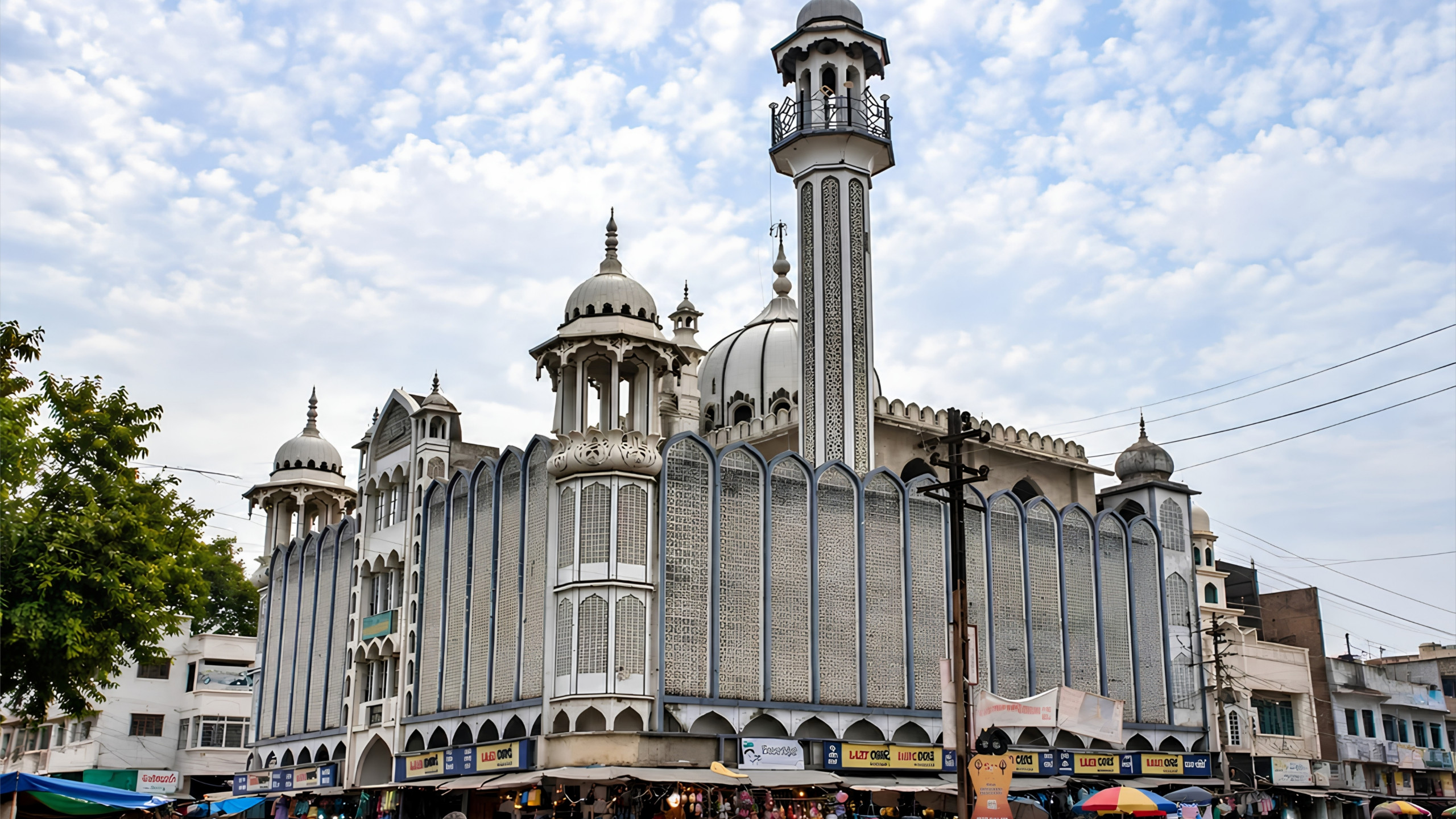




Tension was reported in the Chhatri Chowk area on Monday morning after a large number of people gathered near the Shahi Masjid on Sunday night.
A clash broke out between the crowd and police and briefly turned violent.
The Madhya Pradesh High Court has rejected an appeal filed by the Muslim side challenging the proposed action against the historic Shahi Masjid in Ujjain. The court’s decision allows the authorities to proceed with the road-widening-related action involving the portion of the mosque falling within the proposed road alignment.
The dispute, however, is not over the mosque itself but over the proposed removal of a portion of the structure that falls within the alignment of a road planned to be widened.
During the clash, stone-pelting and physical altercations were reported, following which police used tear gas to disperse the crowd. However, people denied the alligation.
A large police force has been deployed in and around the Shahi Masjid area to maintain law and order.
Railway Protection Force personnel have also been deployed at the spot, while senior police and administrative officials are present.
Ujjain Collector Roshan Singh said the administration was carrying out road-widening and other construction works as part of preparations for Simhastha 2028.
“Road widening and other construction works are being carried out according to the master plan for the preparations for Simhastha 2028. People from all religions and communities are voluntarily cooperating with the administration,” Singh said.
He said several people had voluntarily removed houses or religious structures falling within the proposed road alignment.
“The portion of the Shahi Masjid falling within the road alignment at Chhatri Chowk is also being removed voluntarily by members of the Muslim community. I appeal to everyone not to pay heed to rumours and to cooperate with the administration in maintaining peace,” Singh said.
Ujjain city Qazi Khaliq ur Rehman said the mosque committee decided to remove the portion following discussions with the district administration on Sunday night.
“After discussions between the mosque committee and the district administration on Sunday night, the committee decided to remove that portion itself. Some people became angry because of rumours. There was a minor clash because of this, but the situation is normal now,” he said.
According to the Ujjain Municipal Corporation, the road-widening work is being carried out under the Ujjain Development Plan 2035. The civic body plans to widen the road to 15 metres, and a portion of the Shahi Masjid falls within the proposed alignment.
The administration has described the widening as necessary to manage the expected increase in traffic and movement of devotees during Simhastha 2028.
Qazi Khaliq ur Rehman said the Muslim community was not opposed to Simhastha and had supported the religious event in the past.
“Simhastha has taken place before and will take place in the future as well. The Muslim community has always supported it. We are only saying that an alternative arrangement should be explored and no religious structure should be demolished, as many of these are historical monuments. The Shahi Masjid itself is around 650 years old,” he said.
The dispute comes against the backdrop of a wider concern among Muslims over the demolition of religious structures in different parts of the country.
According to a detailed report published by journalist Ayesha on English website of Millat Times, more than 2,100 mosques, madrasas and dargahs have been demolished or bulldozed in different parts of India over the last six years.
The report has also raised concerns over the targeting of historical religious structures, particularly in the context of development and road-widening projects.
In Ujjain, the immediate dispute concerns the Shahi Jama Masjid, which the mosque committee says is around 650 years old. The committee maintains that it has already surrendered portions of land from the mosque on two earlier occasions for road widening and is unwilling to provide any additional space.
The mosque committee has reportedly met the Municipal Corporation chairman three times over the issue.
The committee is headed by Qari Khaliq ur Rehman, while Hafiz Mohammad Ayub is its deputy chairman. According to the committee, portions of the mosque were first given for road widening in 1961, followed by another surrender of space.
The dispute has acquired wider significance because, according to local residents and members of the mosque committee, 27 mosques in Ujjain are located along roads in areas with a significant Muslim population. They fear that any demolition of the Shahi Jama Masjid could create a precedent for action against other mosques.
The mosque committee and local residents have also questioned why other historical structures in the same area are not being removed despite their proximity to the road.
According to them, around 500 metres before the Shahi Jama Masjid stands the approximately 400-year-old Satyanarayan Temple. The temple is also situated close to the road, and residents claim that the distance between the temple and the highway is less than the distance between the highway and the mosque.
They also point to the approximately 450-year-old Sati Gate at the entrance to the city. According to the residents, the gate creates similar challenges for road widening but has been retained because it is considered a historical structure and authorities would not want to hurt Hindu community sentiments.
Previously, the mosque committee has questioned what it describes as different treatment of the mosque and other historical structures.
Another point raised by the committee concerns a building located opposite the mosque. According to the committee, the building once belonged to the Bohra community but was sold to non-Muslims several years ago. The committee argues that taking some space from that property could help widen the road without affecting the mosque.
The committee also points to an approximately 150-foot vacant stretch between the end of the highway and the mosque and argues that the available space should be considered before any part of the mosque is demolished.
A major point of concern for the mosque committee is the mosque’s approximately 110-foot-high minaret. According to local residents, the minaret can be seen from a distance of nearly 2 km and is one of the prominent features of the mosque.
The committee alleges that the portion of the mosque sought for demolition includes the area where the minaret stands. It has therefore questioned whether road widening is the only reason behind the proposed demolition.
These claims, however, are part of the position being put forward by the mosque committee and local residents in the ongoing dispute.
Ujjain is widely regarded as a major religious city and is known for its temples. At the same time, the city has a substantial Muslim population and several mosques, including the historical structures located along major roads.
According to local residents, the central parts of Ujjain have a strong Muslim presence, particularly in areas along the highway and major markets. They say the 27 mosques located in these areas form an important part of the city’s historical and religious landscape.
The mosque committee has also received support from local Muslim residents, including women and young people.
According to the committee, around 5,000 young people remain present at the mosque at different times, offering prayers, sleeping inside the premises and taking turns to guard the structure. Many of them, the committee says, have temporarily left their jobs, businesses and other responsibilities to remain at the mosque.
Women and girls have also been participating in the campaign. According to the information provided by the committee, women gather at the mosque and around its premises every day between 2 pm and 5 pm.
The community has maintained the vigil amid reports of repeated attempts by the municipal administration and police to reach the mosque with bulldozers.
The committee said that on one occasion, the administration arrived during the night. At around 2 am, young people gathered outside the mosque and told the authorities that they would have to run the bulldozer over them if they wanted to proceed with the demolition.
The residents say the experience of a mosque demolition in Saharanpur has increased their concerns. According to them, they do not want to rely solely on assurances that the mosque will not be demolished.
The issue has also developed amid preparations for the 2028 Kumbh in Ujjain. Road widening is being undertaken in the city in connection with infrastructure requirements, according to the information provided.
The mosque committee maintains that development and road widening should not come at the cost of historical religious structures when alternative space is available.
The committee has made clear that it intends to continue its legal and community efforts to protect the Shahi Jama Masjid. It has also indicated that it will pursue the matter before higher courts if necessary.
For the Muslims involved in the protest, the dispute is not limited to one mosque. They argue that the fate of the Shahi Jama Masjid could have implications for other historical mosques in Ujjain.
Support Independent Media
Click Here and Join the Membership of Millat Times to Support Independent Media.
Support Millat Times