
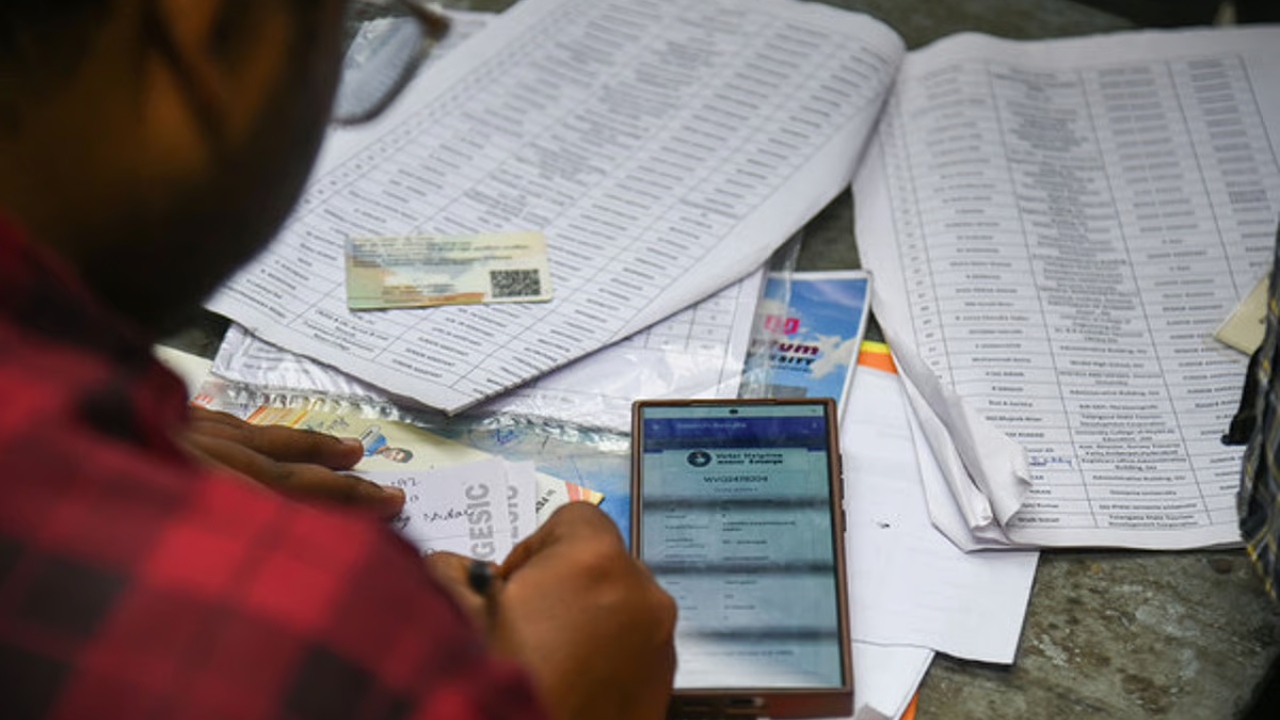




Muslims accounted for a disproportionately large share of voters flagged for discrepancies in Delhi’s draft electoral rolls during a special revision exercise, with software-driven checks raising particular concerns over criteria linked to family size, an analysis by The Hindu has found.
Muslims make up 13.6% of Delhi’s 97.54 lakh electors on the draft rolls but represented 20.3% of those flagged for “logical discrepancies” by the Election Commission of India’s (ECI) ERONET software, according to the newspaper’s analysis.
The disparity was more pronounced among voters flagged for five checks involving family size and age differences between parents, children and grandparents. Muslims accounted for 30% of the 6.75 lakh electors flagged under these criteria, more than twice their share of the electorate.
The findings raise questions about how the Election Commission developed the criteria and whether the checks could disproportionately affect Muslim voters.
The Special Intensive Revision (SIR) is intended to verify electoral rolls. In Delhi, 33.12 lakh electors were flagged for notices in the draft-roll exercise. Of these, 13.79 lakh could not be linked to the previous revision rolls, while another 19.33 lakh were marked for logical discrepancies.
Muslims accounted for just 7.6% of those classified as “unmapped” with the previous rolls, indicating that they were more likely than non-Muslims to establish the required link. Their share, however, rose sharply among those flagged for discrepancies.
For every 1,000 Muslim electors on the draft rolls, 318 were flagged for logical discrepancies, compared with 197 among non-Muslims. Muslims were therefore about 60% more likely to be flagged under this category, the analysis found.
The largest disparities emerged in checks involving family relationships and age. These included cases where six or more electors listed the same person as a parent, where the age difference between a parent and child exceeded 50 years or fell below 15 years, where a grandparent and grandchild were less than 40 years apart, and where siblings were born less than nine months apart.
Of the 1.4 lakh electors flagged because six or more people identified the same person as their parent, Muslims accounted for 58%, the analysis found.
Across the five family-size and age-related categories, 152 of every 1,000 Muslim electors were flagged, compared with 56 of every 1,000 non-Muslim electors. The figures suggest the criteria may overlap with demographic differences between religious communities.
However, India’s fertility rates have declined across religious groups. National Family Health Survey data show that the total fertility rate among Muslim women fell from 4.41 children per woman in 1992-93 to 2.36 in 2019-22. Among Hindu women, it declined from 3.3 to 1.94 over the same period, narrowing the gap.
The analysis also found that nearly 20% of electors flagged under a category in which no reason was specified were Muslims.
The Election Commission has not publicly explained the basis for each logical-discrepancy category or clarified whether being flagged automatically affects an elector’s eligibility to vote.
The newspaper reported that the decision to flag voters was made by the centralised ERONET software rather than by Electoral Registration Officers, who are legally responsible for maintaining electoral rolls. A senior election official confirmed this, speaking on condition of anonymity.
The Commission’s initial SIR instructions for Bihar and its subsequent directions for the second phase did not explicitly mention notices for logical discrepancies involving people who had submitted enumeration forms and appeared on the draft rolls. Such checks were introduced in West Bengal during the second phase without a formal announcement, the report said.
A subsequent direction issued on May 14, 2026, for the third phase referred to notices for electors who could not be linked to previous rolls or whose details contained discrepancies.
The experience in Bihar offers a comparison. Muslims accounted for 18.4% of deleted electors there, broadly in line with their 17.7% share of the adult population recorded in the 2011 Census. Bihar’s SIR did not include the logical-discrepancy checks used in Delhi.
The Hindu analysed Delhi’s draft rolls by extracting voter details using optical character recognition and matching them against lists of electors flagged for different reasons. It estimated religion using a name-based statistical classifier, which its authors had tested across households in 17 states.
The newspaper said its manual checks of a random sample also supported the classifier’s accuracy.
Support Independent Media
Click Here and Join the Membership of Millat Times to Support Independent Media.
Support Millat Times