
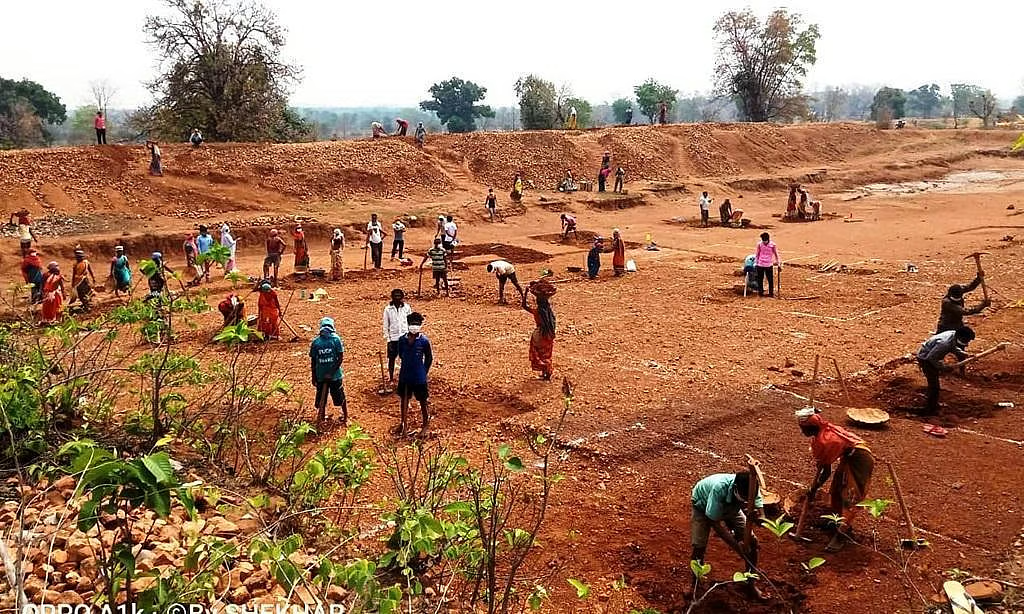

The academics called on the Indian government to restore assured central funding, ensure timely wage payments and reaffirm the law’s original guarantee of the right to work
A group of prominent international scholars, economists and policymakers has written an open letter to the Indian government urging it to halt any move to repeal or dilute the Mahatma Gandhi National Rural Employment Guarantee Act (MGNREGA), warning that recent funding and governance changes threaten the survival of the world’s largest employment guarantee programme.
This comes as the Indian Parliament on Thursday-Friday night passed the 2025 Viksit Bharat – Guarantee for Rozgar and Ajeevika Mission (Gramin) [VB-G RAM G] Bill, replacing the 2005 MGNREGA, amid Opposition protests, objecting to the removal of Mahatma Gandhi’s name from the scheme.
The bill will now be sent to the President for assent.
The letter, signed by academics and public intellectuals from the United States, Europe and Africa, describes MGNREGA as a landmark law that operationalised a legal, demand-driven right to work and provided an essential safety net for rural India.
https://x.com/roadscholarz/status/2001852294011474017
“MGNREGA transcends political lines,” the signatories said, noting that the law was passed with unanimous parliamentary support. “Its foundational principle – that the national government must guarantee an employment safety net – affirms economic dignity as a fundamental right.”
MGNREGA, enacted in 2005, guarantees up to 100 days of paid manual work per year to rural households on demand. According to the letter, the scheme has generated more than 2 billion person-days of employment annually in recent years, reaching around 50 million households. Women account for more than half of all workers, while about 40% come from Scheduled Castes and Scheduled Tribes.
Those signing the letter include UN Special Rapporteur on extreme poverty Olivier De Schutter, Nobel laureate Joseph E. Stiglitz, French economist Thomas Piketty, and economists Mariana Mazzucato, James Galbraith and Darrick Hamilton, among others.
The signatories said the programme’s early years coincided with strong rural wage growth and cited studies showing positive effects on economic output and efficiency, countering claims that the scheme is unproductive.
However, they warned that chronic underfunding, delayed wage payments and a shift towards devolving financial responsibility to states without adequate central support now pose an “existential threat” to the scheme.
Under the new funding pattern, states are expected to bear a far larger share of costs, rising from about 25% of material expenses to between 40% and 100% of total project costs, the letter said. Poorer states, it added, lack the fiscal capacity to absorb this burden and are likely to restrict project approvals, directly curbing work availability.
“This creates a catastrophic Catch-22,” the signatories said, arguing that states retain the legal obligation to provide employment while central financing is withdrawn.
The letter also criticised what it described as discretionary “switch-off” powers that allow the programme to be suspended, undermining the guarantee of work. It cited the continued defunding of MGNREGA in West Bengal over the past three years as an example of alleged political misuse.
Beyond wages, MGNREGA-funded projects have built rural assets such as roads, ponds and wells, supporting agriculture and local economies. Making these projects financially unviable for states would extinguish these multiplier effects, the authors said.
“MGNREGA has captured the world’s attention with its demonstrated accomplishments and innovative design,” the letter said. “To dismantle it now would be a historic error.”
The signatories called on the Indian government to restore assured central funding, ensure timely wage payments and reaffirm the law’s original guarantee of the right to work.