
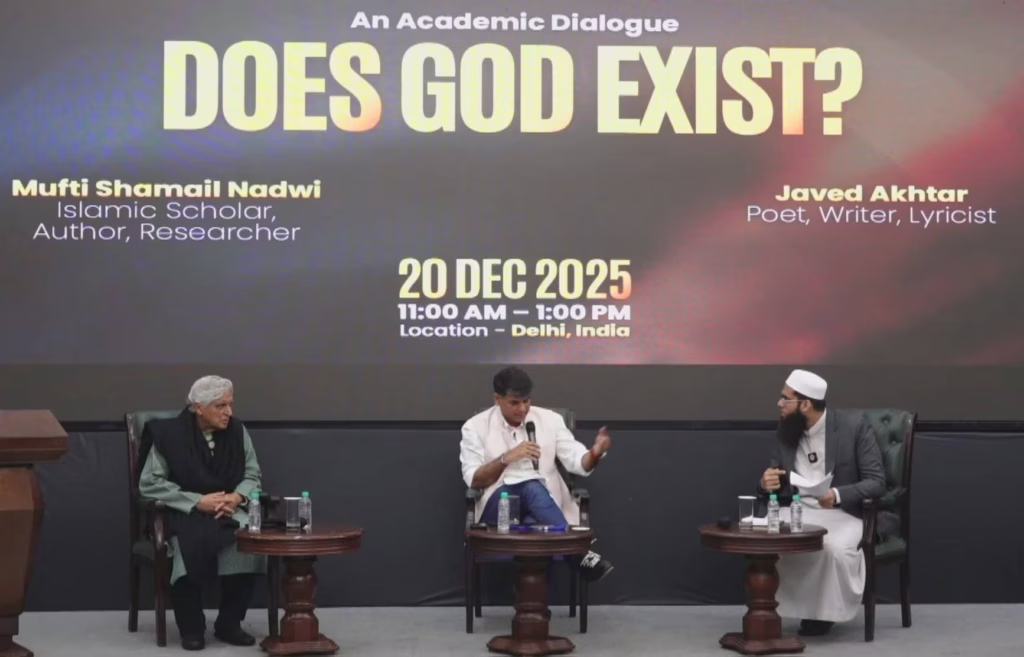

The two-hour discussion, moderated by journalist Saurabh Dwivedi of Lallantop, was framed as an academic exchange rather than a confrontational television debate
A public debate on whether God exists brought together outspoken atheist and lyricist Javed Akhtar and Islamic scholar Mufti Shamail Nadvi at the Constitution Club in New Delhi, drawing a packed audience and widespread online viewership as the two sparred over faith, logic, morality and human suffering.
The two-hour discussion, moderated by journalist Saurabh Dwivedi of India Today Hindi and Lallantop, was framed as an academic exchange rather than a confrontational television debate. Dwivedi laid out strict rules, urging participants and the audience to avoid slogans and personal attacks and stressing that the discussion was not aimed at promoting or criticising any particular religion.
Nadvi, founder of the Wahiyan Foundation and a doctoral researcher at the International Islamic University Malaysia, opened the debate by arguing that neither science nor religious scripture could serve as a shared standard for proving or disproving God’s existence. Science, he said, is limited to the physical world, while God, by definition, is non-physical. Scripture, he added, cannot persuade those who do not accept revelation as a source of knowledge.
Instead, Nadvi grounded his argument in philosophy, presenting what he described as the “contingency argument”. The universe, he said, is contingent — dependent on causes — and therefore cannot explain its own existence. This, he argued, logically requires a “necessary being” that is eternal, independent, intelligent and powerful.
Using analogies of designed objects, Nadvi said the precise laws governing the universe suggest intentional creation rather than chance. He rejected the argument that scientific explanations of natural processes eliminate the need for God, saying such discoveries merely describe how the universe functions, not why it exists at all.
Akhtar, a poet, screenwriter and long-time advocate of rationalism, countered by questioning the durability and universality of religious belief. He pointed to the many gods worshipped by past civilisations — including Greek, Roman and Egyptian societies — and noted that those beliefs once appeared as certain as modern faiths do today.
“Gods change with time,” Akhtar said, arguing that belief systems evolve as human knowledge expands. He cited declining religious influence in parts of Europe as evidence that faith is not immutable.
A central theme of Akhtar’s argument was his distinction between belief and faith. Belief, he said, is grounded in evidence, reason and testimony, while faith demands acceptance without proof. “When there is no evidence, no logic and no witness, and you are still asked to believe, that is faith,” he said, adding that such demands discourage questioning.
Akhtar also challenged the idea of divine justice, arguing that morality does not exist in nature but is created by humans to organise society. Justice, he said, functions much like traffic rules — necessary for social order but not inherent to the natural world. “Nature has no justice,” he said, noting that predators are not punished for killing prey.
In rebuttal, Nadvi accused Akhtar of drawing a false comparison between subjective social rules and what he called objective morality. Justice, Nadvi said, cannot be reduced to social consensus alone. “If oppression is declared right by the majority, does that make oppression just?” he asked.
The debate intensified when Akhtar raised the issue of suffering, questioning divine omnipotence in light of children dying in wars, hunger and disease. If an all-powerful God exists and intervenes in human affairs, Akhtar asked, why does such suffering persist? “Even if such a being exists, I find it difficult to respect it,” he said.
During the debate, Nadvi addressed the problem of evil in the world, arguing that its existence serves a purpose in defining good and justice. He explained that humans are tested through experiences of both good and evil, and that free will allows individuals to choose their actions. “The creator has made evil, but He is not evil; those who misuse their free will are responsible,” the Islamic scholar said, highlighting that acts like violence or rape are human choices done through free will, not divine faults, and emphasizing moral accountability alongside divine design.
Nadvi responded that questions about what God was doing “before” the creation of the universe were logically flawed because time itself began with the universe. He also argued that denying God’s existence is itself a claim that carries a burden of proof, urging Akhtar to directly refute the contingency argument rather than dismiss it.
Akhtar rejected the idea that skeptics must disprove God, citing philosopher Bertrand Russell’s analogy of an undetectable teapot orbiting the Earth. “The one who makes the claim must prove it,” he said.
The debate concluded with cross-examination and questions from the audience, reflecting deep philosophical divides but maintaining the restrained tone set by the moderator. While neither side conceded ground, the event highlighted the enduring tension between faith and reason in contemporary Indian public discourse.