


Follow Millat Times for independent journalism.
Opens the app if installed, or Google Play to download it.By Shams Tabrez Qasmi
Aam Aadmi Party (AAP) Rajya Sabha member Sanjay Singh has rejected allegations that his party acts as a political proxy for the Bharatiya Janata Party (BJP), saying its leaders have faced arrests, investigations and political pressure for opposing the ruling party.
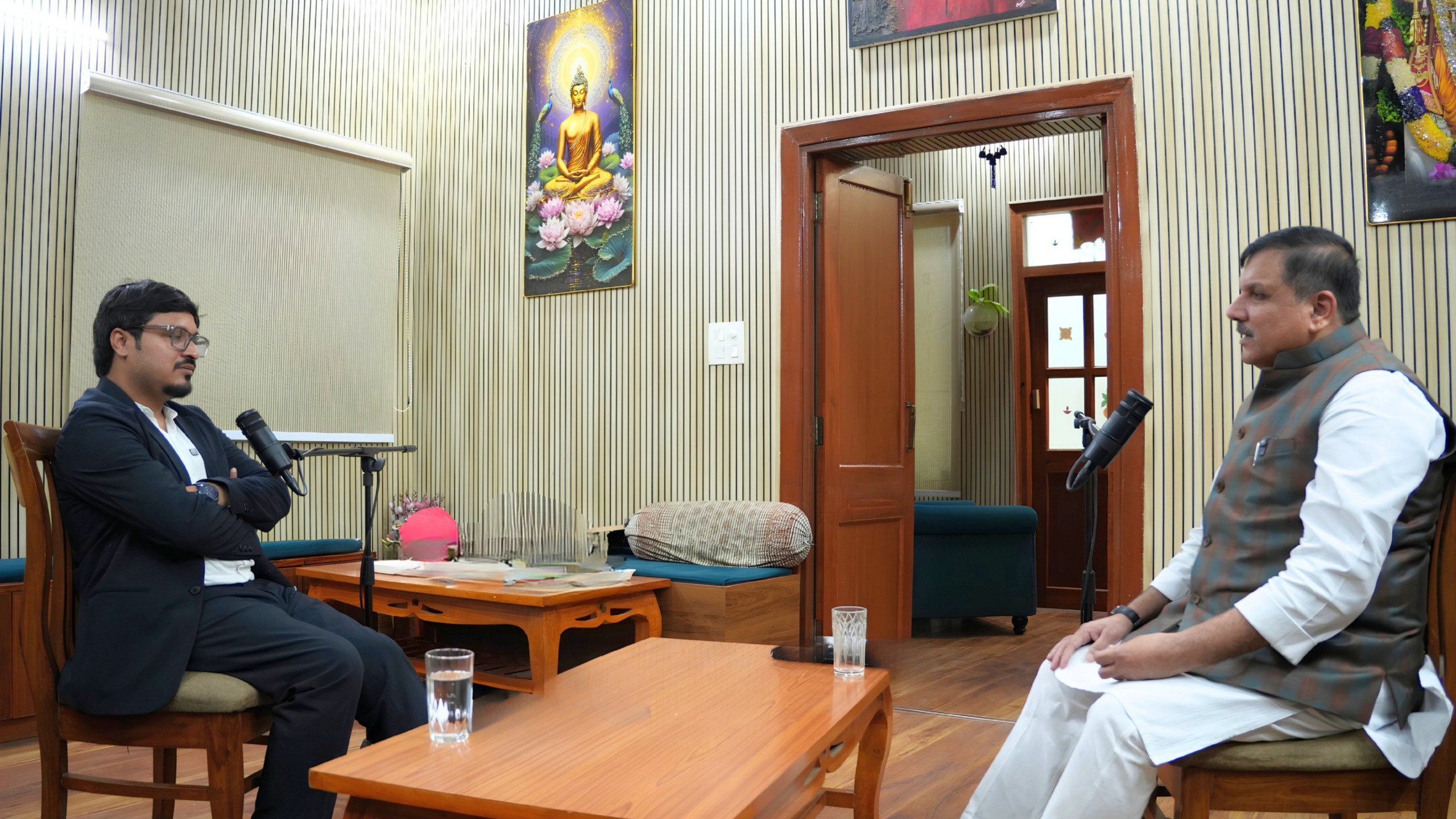
In an interview with Millat Times Editor-in-Chief Shams Tabrez Qasmi on the Millat Podcast, Singh discussed AAP’s preparations for the Uttar Pradesh assembly elections, its relationship with other opposition parties and its position on issues affecting Muslims.
The interview also covered the Shaheen Bagh protests, the Tablighi Jamaat controversy during the COVID-19 pandemic, allegations concerning land transactions linked to the Ram Mandir project in Ayodhya, electoral roll revisions and the role of Muslim political leaders.
Asked about AAP’s plans for the upcoming Uttar Pradesh assembly elections, Singh said the party was preparing to contest the polls and expanding its organisational presence across the state.
He said AAP had organised conferences, training programmes and meetings while focusing on issues such as government schools, electricity supply and healthcare.
However, Singh said the party’s Political Affairs Committee (PAC), headed by AAP leader Arvind Kejriwal, would take the final decision on the number of seats it would contest and whether it would enter into an alliance.
Asked whether AAP would contest independently or join hands with the Samajwadi Party or Congress, Singh said the decision would be taken by the party leadership.
He claimed AAP had won 10 chairperson positions and about 350 councillor and other member seats in Uttar Pradesh local body elections, describing the results as evidence of the party’s growing presence in the state.
BJP’s electoral strategy and religious polarisation
Singh accused the BJP of using religious polarisation, including disputes over temples and mosques, to divert attention from economic and governance issues.
He said voters were ultimately concerned about employment, education, healthcare and economic security.
Singh questioned the BJP’s record on promises to double farmers’ incomes, provide two crore jobs annually and deposit 1.5 million rupees in every citizen’s bank account following the recovery of black money.
He said unemployment, examination paper leaks and a shortage of government jobs had become major concerns for young people.
The political debate, he argued, should focus on farmers’ incomes, employment opportunities and public services rather than religious divisions.
Bangladeshi infiltration allegations and voter lists
Singh questioned the BJP’s claims that three crore Bangladeshi infiltrators were living in India and asked Prime Minister Narendra Modi and Home Minister Amit Shah to provide evidence supporting the figure.
He also raised concerns about the Special Intensive Revision (SIR) of electoral rolls, saying that people whose names were missing from voter lists should not automatically be treated as foreign nationals.
Singh said Bengali-speaking Indian citizens risked being wrongly identified as Bangladeshis because of their language.
He called for nationality to be established through proper legal procedures and criticised what he described as the repeated use of Pakistan and Bangladesh in election campaigns.
Indian Muslims, he said, should not be required to repeatedly demonstrate their loyalty to the country.
AAP’s position on the Shaheen Bagh protests
Singh rejected allegations that AAP had organised or directed the Shaheen Bagh protests against the Citizenship Amendment Act (CAA) and the proposed National Register of Citizens (NRC).
He said the party had raised questions about the concerns of the protesting women and the central government’s responsibility to address them.
Singh recalled asking why BJP leaders, who had spoken about the rights of Muslim women, had not visited the protest site to hear the demonstrators’ grievances.
He said the central government had the authority to address their concerns and criticised the legal difficulties faced by some young people associated with the protests.
Tablighi Jamaat controversy during COVID-19
Asked whether AAP had contributed to the targeting of Muslims during the COVID-19 pandemic, when separate figures were reportedly maintained for Tablighi Jamaat members who tested positive, Singh acknowledged that the presentation of the data had generated controversy.
He said the party subsequently corrected its position after the issue was examined and a court order was issued.
Singh argued that public health information should not be presented in ways that create suspicion against particular religious communities.
He said political parties and government institutions should avoid using health emergencies to deepen communal divisions.
‘We are not BJP’s B-team’
Singh strongly rejected allegations that AAP was created to weaken Congress or divide opposition votes in favour of the BJP.
He cited AAP’s electoral victories in Delhi and Punjab and its political confrontations with BJP-led governments as evidence that the party was an independent opposition force.
He also referred to the arrests of senior AAP leaders, including Kejriwal and former Delhi deputy chief minister Manish Sisodia, as well as his own imprisonment.
Singh said he had spent 183 days in jail and alleged that the Uttar Pradesh government had filed multiple cases against him because of his political activities.
He questioned how AAP could be described as the BJP’s B-team when its leaders had faced investigations and arrests under BJP-led governments.
Such allegations, he said, were intended to weaken opposition parties and discourage political challenges to the ruling establishment.
Ayodhya land transactions and Ram Mandir Trust
Singh defended his allegations of irregularities in land transactions associated with the Ram Mandir project in Ayodhya, saying farmers had approached him with documents concerning the deals.
He cited one transaction in which, according to him, land purchased for 20 million rupees was sold for 185 million rupees within minutes.
Singh said he had examined the documents, consulted people familiar with the transactions and held a news conference on the matter.
He claimed to have collected documents relating to 29 alleged transactions and said the material had been submitted to a Special Investigation Team (SIT).
He expressed dissatisfaction with the outcome of the investigation and called for greater transparency.
Singh said the issue deserved scrutiny because people had donated money, jewellery and other valuables to the temple project in good faith.
The allegations were made by Singh during the interview and were not independently established in the discussion. No evidence of wrongdoing by the individuals or institutions concerned was established in the interview.
Welfare policies and Muslim voters
Asked why many Muslim voters continued to support Congress or the Samajwadi Party despite benefiting from AAP’s welfare policies in Delhi, Singh said the party’s programmes were intended for all residents, irrespective of religion or caste.
He cited improvements in government schools, public hospitals, neighbourhood clinics and access to free medicines, as well as electricity subsidies and free bus travel.
He also highlighted the Farishtey scheme, which provided cashless treatment for eligible road accident victims.
Singh said such programmes particularly benefited economically disadvantaged communities, including Muslims.
He argued that governments should develop welfare policies for all citizens rather than create schemes based on religious identity.
He acknowledged that political messaging and campaigns against AAP had influenced public perceptions but said the party would continue to focus on education, healthcare, employment and welfare.
Owaisi, AIMIM and Muslim political representation
Singh praised All India Majlis-e-Ittehadul Muslimeen (AIMIM) chief Asaduddin Owaisi for his knowledge of parliamentary procedures and debating skills.
He also praised the parliamentary contributions of Congress MP Imran Masood, Samajwadi Party MP Iqra Hasan and Congress MP Imran Pratapgarhi.
However, Singh said appreciating a parliamentarian’s debating abilities did not necessarily mean agreeing with their political strategy.
Asked whether AIMIM’s electoral strategy benefited the BJP by splitting opposition votes, Singh said parties should be assessed on the basis of their electoral decisions and their consequences.
He argued that opposition parties needed to examine whether their candidates were strengthening the challenge to the BJP or dividing votes in constituencies where the ruling party was competitive.
Singh also criticised statements suggesting that Muslims who wanted to remain in India could have moved to Pakistan.
He said Indian Muslims had the same constitutional rights as Hindus, Sikhs and Christians.
Referring to former president A.P.J. Abdul Kalam, soldier Abdul Hamid and freedom fighter Khan Abdul Ghaffar Khan, Singh highlighted the contributions of Muslims to India’s independence and national development.
He said Muslims should never be made to feel that they did not belong in India.
Singh called on political leaders to address discrimination and the challenges facing Muslim communities in education, healthcare and employment, while avoiding rhetoric that could deepen religious divisions.
From social activism to Parliament
Singh said his involvement in social and political activism predated the Anna Hazare movement of 2011.
He recalled working with street vendors for about 16 years and participating in social welfare activities, including blood donation campaigns, distributing blankets during winter and providing assistance during disasters.
He said he had also been associated with the Right to Information movement and first met Kejriwal around 2009-10.
Singh later became involved in the Swaraj movement and joined the Anna Hazare-led anti-corruption campaign, which eventually led to the formation of AAP.
Asked why Hazare was no longer actively involved in the political movement, Singh said he respected his decision not to enter electoral politics.
He said AAP believed electoral participation was a way to bring about social change, while Hazare had chosen a different approach.
India’s economic and political future
Singh said India needed to move away from what he described as politics based on hatred, intimidation and religious division.
He identified education and healthcare as essential priorities for national development and expressed concern about the condition of small and medium-sized businesses.
He questioned the government’s approach to corporate debt relief, arguing that farmers, small traders and ordinary citizens also needed greater financial support.
Singh said economic progress would depend on strengthening public services, supporting small industries and creating employment opportunities.
He also criticised what he described as excessive publicity and event management in political communication, saying governments should be judged on their performance rather than their promotional campaigns.
Backs Akhilesh Yadav for Uttar Pradesh chief minister
Asked whether he would prefer Samajwadi Party chief Akhilesh Yadav or Chief Minister Yogi Adityanath to lead Uttar Pradesh, Singh expressed support for Yadav, describing him as a leader he respected.
The interview also touched on the relative political influence of Modi and Shah, the challenges facing AAP and the role of opposition parties in Indian politics.
Throughout the discussion, Singh defended AAP’s record, rejected allegations of an understanding with the BJP and argued that political competition should focus on governance, economic development and democratic rights.
He said his party had faced political and personal consequences for challenging the ruling establishment and maintained that India needed politics centred on development, social harmony and accountability rather than religious polarisation.
Support Independent Media
Click Here and Join the Membership of Millat Times to Support Independent Media.
Support Millat Times