
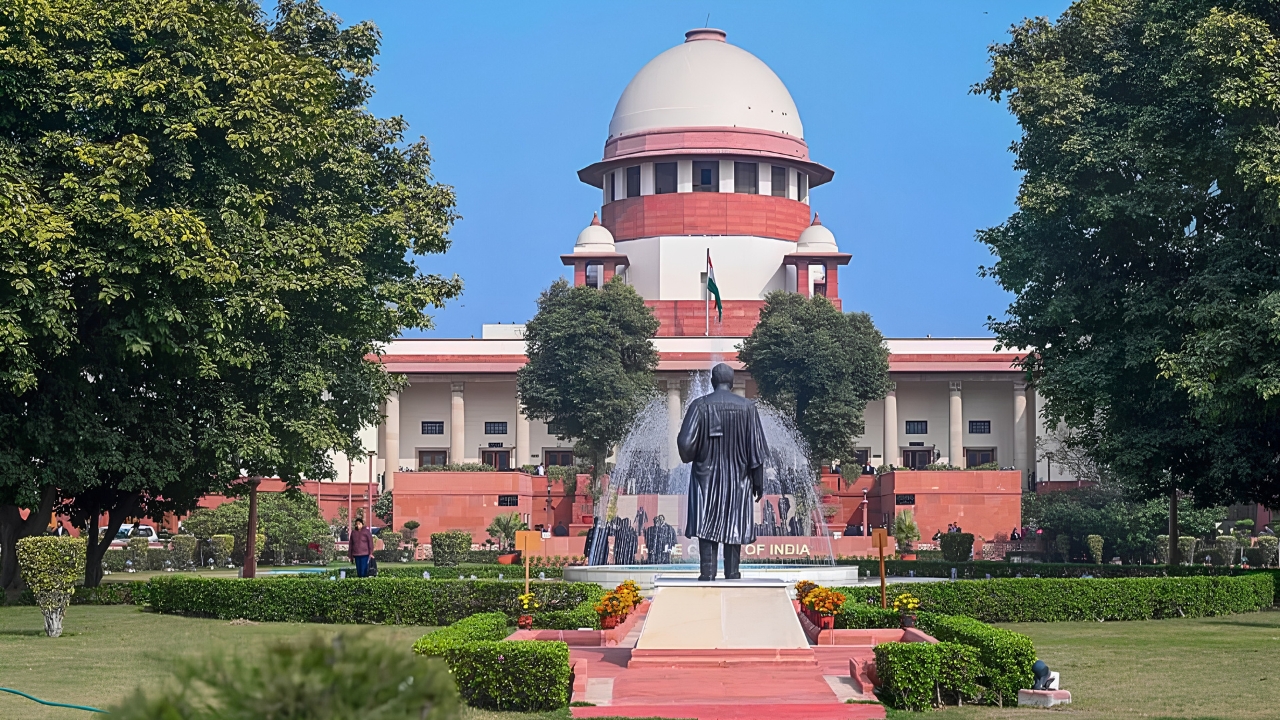




The Supreme Court on Tuesday asked the Union government to respond to a challenge against a 2026 amendment extending penal protection to the national song Vande Mataram, while indicating that people who refuse to sing it for religious reasons should not face criminal consequences.
A bench headed by Chief Justice of India Surya Kant, with Justices Joymalya Bagchi and V. Mohana, was hearing a petition filed by Carnatic musician T.M. Krishna challenging the constitutional validity of the amendment to the Prevention of Insults to National Honour Act, 1971.
The petition also challenges Ministry of Home Affairs directions requiring the singing of all six stanzas of Vande Mataram at specified official functions.
During the hearing, the bench referred to the Supreme Court’s 1986 judgment in Bijoe Emmanuel v. State of Kerala, which protected three schoolchildren who had declined to sing the national anthem on religious grounds but had stood respectfully while it was played.
Justice Bagchi said the ruling remained the law and indicated that it should govern the amended legislation.
The court said it was not for judges to determine what constituted the national song or whether two or all six stanzas should be sung.
“What is the national song is not in dispute,” the court said, adding that it was for the democratic process to determine the scope of the song.
The bench said, however, that a person exercising a conscientious objection or claiming protection under Articles 25 and 26 of the Constitution should not be subjected to criminal consequences for refusing to sing.
Krishna’s challenge centres on the final four of the six stanzas of Vande Mataram, which he says contain references to Hindu deities including Durga, Lakshmi and Saraswati.
The petition argues that compelling citizens to sing those portions could amount to forced religious or ideological expression and violate constitutional guarantees relating to freedom of conscience and secularism.
Senior advocate S. Muralidhar, appearing for Krishna, argued that the 2026 amendment did not define the term “National Song”. He also questioned the government’s decision to prescribe the complete six-stanza version through official directions.
The amended Section 3 of the 1971 law provides for imprisonment of up to three years, a fine, or both, for a person who intentionally prevents the singing of the national anthem or national song, or causes a disturbance to an assembly engaged in such singing.
Krishna argues that the provision, read with the MHA directions, effectively makes participation in the complete version of Vande Mataram compulsory.
The petition also challenges the word “disturbance” as vague and potentially broad enough to affect academic discussion, artistic expression and criticism concerning the song.
During the hearing, Justice Bagchi referred to the reference to God in the U.S. national anthem. Solicitor General Tushar Mehta responded that “secularism cannot be this narrow”.
An exchange also took place after Mehta referred to “Naxalites” while arguing against the petition. Muralidhar objected and asked him to withdraw the remark. Mehta declined, saying he was referring to people who did not respect the law-making process. The bench said it was not taking note of the comments.
The petition also cites the historical practice of limiting public singing of Vande Mataram to its first two stanzas. It says the Indian National Congress adopted such an arrangement in 1937 after objections from Muslim members to religious references in the later portions.
Krishna’s plea further argues that Vande Mataram was not formally adopted as the national song by the Constituent Assembly in the same manner as Jana Gana Mana was adopted as the national anthem.
The petition invokes Articles 14, 15, 19, 21 and 25 of the Constitution, arguing that the amended law infringes equality, freedom of expression, personal liberty and freedom of conscience.
It also distinguishes a March 2026 Supreme Court decision in Muhammed Sayeed Noori v. Union of India, where the court declined to entertain a challenge to the January MHA order because there was then no penal provision for refusing to sing Vande Mataram.
Krishna argues that the subsequent amendment introducing criminal penalties has materially changed the legal position.
The petitioner has sought the striking down of the amended provision, clarification of the scope of the national song and interim protection pending a final decision.
Support Independent Media
Click Here and Join the Membership of Millat Times to Support Independent Media.
Support Millat Times