
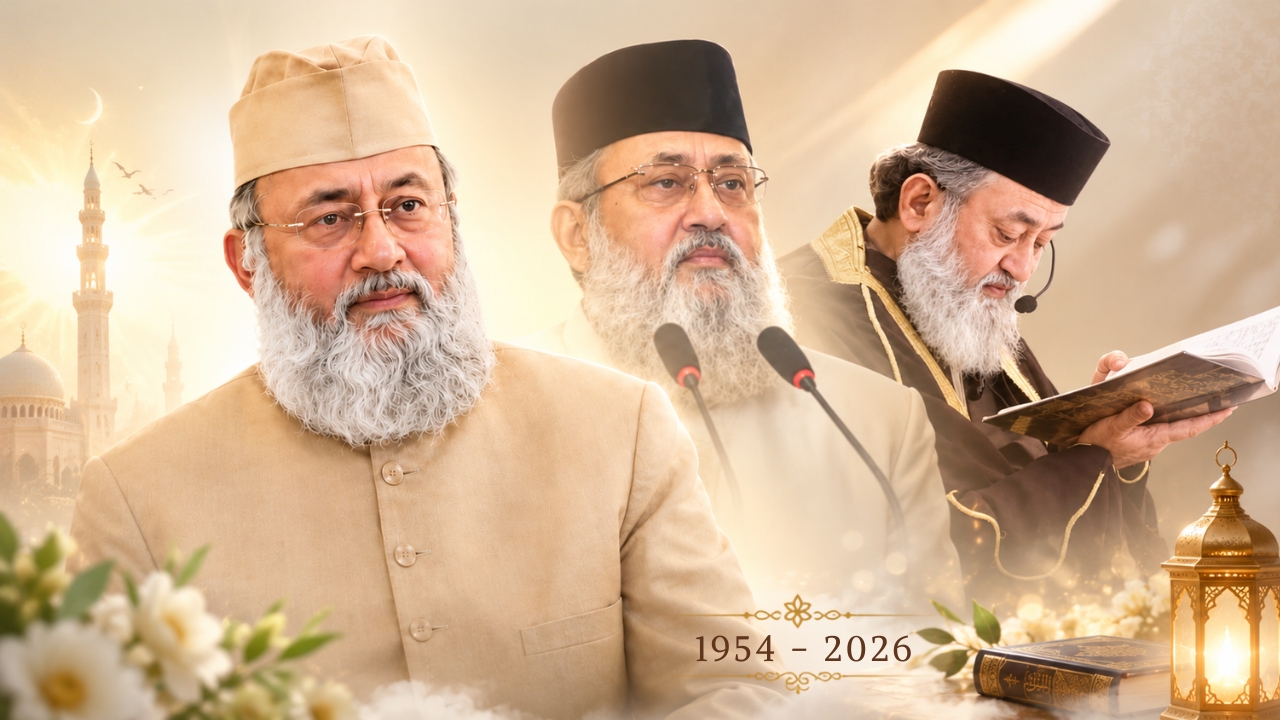




Lucknow, June 29, 2026 – A great light of Islamic scholarship has been extinguished. Maulana Syed Salman Hussaini Nadwi, one of India’s most celebrated Islamic scholars, educators and authors, passed away in Lucknow on Monday after a brief illness. He was 72. Thousands of his students, followers and well-wishers gathered in Maleehabad, near Lucknow, to offer his funeral prayers and bid him a tearful farewell.
Who Was Maulana Salman Nadwi?
To understand why his passing has caused such deep grief across India and the wider Muslim world, one must understand the man he was – a scholar, a teacher, a writer, an institution-builder and a fearless voice for truth.
Maulana Salman Nadwi was not simply a religious cleric. He was a man whose knowledge spanned Islamic theology, the sayings of the Prophet (Hadith), Islamic law (jurisprudence), Islamic history, Arabic literature and contemporary Muslim affairs. He spoke and wrote with equal ease in Arabic and Urdu, and his words – whether delivered from a podium or written on a page – had the power to move hearts and sharpen minds.
For decades, he served as the Dean of the Faculty of Dawah and Shariah at Darul Uloom Nadwatul Ulama, one of India’s most prestigious Islamic seminaries, based in Lucknow. He mentored thousands of students who came to him from all across India and from countries around the world. He also edited and co-edited as many as 13 academic journals published in English, Urdu, Arabic and Persian – a remarkable achievement that speaks to the breadth of his intellectual reach.
A Life Rooted in Knowledge
Maulana Salman Nadwi was born in Lucknow in 1954, into a family with a long and distinguished tradition of Islamic scholarship. His lineage traced all the way back to Imam Husayn ibn Ali, the grandson of Prophet Muhammad (peace be upon him) – a lineage that connected him to the very heart of Islamic history.
His education began at a branch school of Darul Uloom Nadwatul Ulama, where he memorised the entire Quran at a young age. He then pursued advanced studies in Islamic sciences at Nadwatul Ulama, graduating from its College of Shariah and Usul al-Din in 1974.
In that same year, he co-founded Jamiat Shabaab ul Islam, an organisation created to connect and guide Muslim youth – a sign, even at that early age, of his concern not just for books and classrooms, but for the real-world challenges facing young Muslims.
He earned his first master’s degree in Hadith studies from Nadwatul Ulama in 1976. Driven by a thirst for deeper knowledge, he then travelled to Saudi Arabia to study at Imam Muhammad ibn Saud Islamic University in Riyadh. There, under the guidance of the world-renowned Hadith and Islamic jurisprudence scholar, Sheikh Abd al-Fattah Abu Ghuddah, he completed a second master’s degree in Hadith in 1980 – graduating with high distinction. His thesis, a meticulous study of terms used in the evaluation of Hadith narrators drawn from the classical reference work Tahdhib al-Tahdhib by Ibn Hajar al-Asqalani, was a work of serious academic depth.
He was also recognised as holding a PhD in Hadith studies, and his mastery of Islamic sciences was widely described as reaching the level of a mujtahid – a scholar capable of forming independent legal judgements from original sources.
Notably, Maulana Salman Nadwi was a close disciple of the legendary Maulana Abul Hasan Ali Nadwi, popularly known as “Ali Miyan” – one of the greatest Islamic scholars of the 20th century. His mother was the niece of that very same Maulana Ali Nadwi, meaning the connection was both spiritual and familial.
A Builder of Institutions
Maulana Salman Nadwi’s vision extended far beyond the walls of a lecture hall. He understood that education – Islamic or otherwise – requires institutions, and he devoted significant energy to building them.
He was the founder of Jamia Syed Ahmad Shaheed and the co-founder of Jamiat Shabaab ul Islam. He served as Chancellor of Darul Uloom Syed Ahmad Shaheed in Katoli, and as Chairman of Dr Abdul Ali Unani Medical College and Hospital. He was also associated with the founding of medical, engineering and information technology colleges across India – a remarkable range that showed his belief in holistic development for Muslim communities, not just religious education.
A Prolific Writer and Scholar
Throughout his life, Maulana Salman Nadwi authored a large number of books and scholarly works in both Arabic and Urdu. His writings covered Islamic theology, the life of Prophet Muhammad (Seerah), Hadith sciences, Islamic jurisprudence, Islamic history and the contemporary challenges confronting Muslim societies around the world.
He was also an editor and co-editor of multiple journals, making him one of the most productive intellectual voices of his generation. His pen, like his tongue, was sharp, clear and fearless.
A Voice That Did Not Fear Controversy
Perhaps what set Maulana Salman Nadwi apart most visibly in his later years was his willingness to speak uncomfortable truths, regardless of who might be displeased.
He was an outspoken critic of Arab monarchies, accusing them of remaining indifferent to what he saw as Western and imperialist aggression against Muslim peoples around the world – particularly with regard to the Palestinian cause. His understanding of the political strategies of Western powers and their impact on the Muslim world was considered exceptionally sharp, and he did not hesitate to name and confront what he believed were the injustices of his time.
He was also a strong advocate of Shia-Sunni unity, believing firmly that divisions within the Muslim community only served the interests of its enemies. In India, he similarly worked to promote harmony between Hindus and Muslims.
These positions earned him great admiration among many. They also made him a controversial figure in some circles, and he paid a price for his candour – he was removed from India’s Muslim Personal Law Board, and later from Darul Uloom Nadwatul Ulama, the institution where he had grown up, learned and taught. Those who knew him say that separation from Nadwa – his intellectual and emotional home – was deeply painful for him.
Those who sat with Maulana Salman Nadwi describe an extraordinary presence. His dignified appearance, powerful voice, logical reasoning and sheer depth of knowledge left a lasting impression on everyone he met – whether they were students, professors or political leaders.
An Irreplaceable Loss
Following the news of his passing, condolence messages poured in from scholars, seminaries, universities, former students and community organisations across India and abroad.
The Indian Muslims for Civil Rights (IMCR) described his passing as “an immense and irreparable loss not only for the Muslim community in India but also for the entire Muslim world.” The organisation said he had dedicated his entire life to the promotion of Islam, the advancement of Islamic education, and finding solutions to the challenges confronting the Muslim community.
IMCR Chairman and former Member of Parliament, Mohammad Adeeb, said he had personally watched Maulana Nadwi from his student days at Nadwatul Ulama. “Witnessing his extraordinary intelligence, vast knowledge, refined manner of speaking and exceptional abilities even in those days, I was convinced that this young man would one day become a guiding light for the Muslim community – and history proved exactly that,” he said.
Many who remembered him described a man who had “intellectually inspired millions and strengthened their attachment to Islam” through his speeches, writings and scholarly gatherings.
Farewell in Maleehabad
Thousands gathered in Maleehabad, near Lucknow, for his funeral prayers – students, scholars, community leaders and ordinary people who had been touched by his words and his work. The scale of the gathering was itself a testament to the immense reach and impact of a man who had devoted his entire life to knowledge and service.
Support Independent Media
Click Here and Join the Membership of Millat Times to Support Independent Media.
Support Millat Times