




Follow Millat Times for independent journalism.
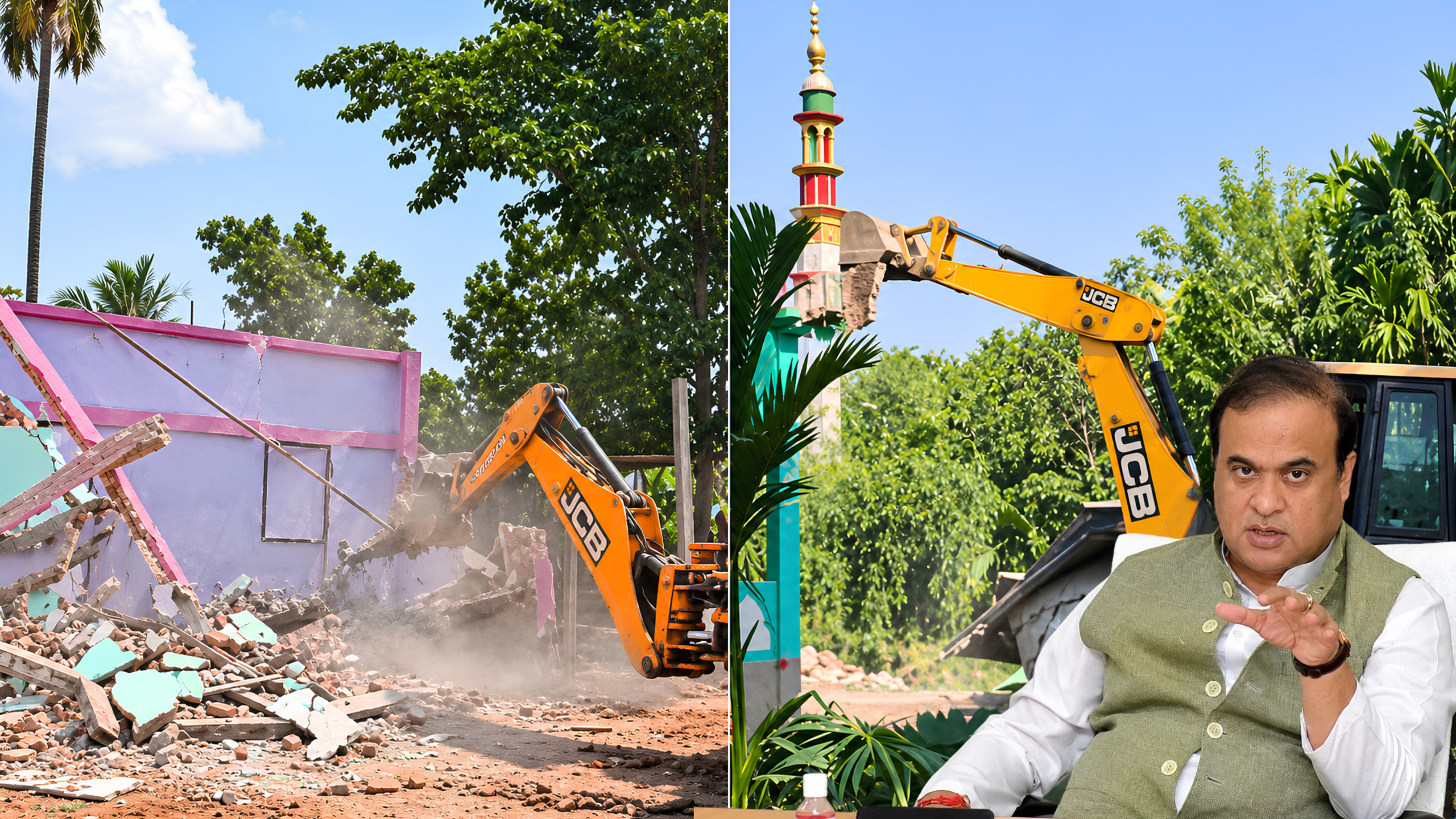
Opens the app if installed, or Google Play to download it.More than 4,000 people have been displaced after authorities in Assam’s Dhubri district demolished the homes of over 640 Bengali Muslim families during a massive eviction drive on Sunday, November 1.
The demolition took place across approximately 650 bighas of government-owned land in Alamganj Part-IX village. The operation has left hundreds of families homeless, with many now taking shelter in relatives’ houses, temporary huts and roadside settlements.
According to media reports, Dhubri District Commissioner Dibakar Nath said eviction notices had been served to residents occupying around 800 bighas of land. However, the administration did not carry out demolition on the remaining 150 bighas because of pending court cases.
Nath said the cleared land would be handed over to the Industrial Department, which has been looking for land to establish an industrial park for the past two years. He added that the final decision would be taken by the state government.
The district commissioner claimed that residents had settled on the land at different times, with some arriving five years ago and others around a decade ago. He also alleged that most families owned land elsewhere. Residents, however, have disputed these claims.
Among those affected is 80-year-old Ali Chand Fakir, who told Scroll that he had been living in the village since 1962. He said his family moved from neighbouring Goalpara district after losing its home to erosion and floods caused by the Brahmaputra river.
Fakir said that bulldozers demolished three houses, trees and toilets belonging to him. He had already dismantled parts of his house before the administration’s machinery arrived.
He also said several residents had paid land revenue under the touzi system between 1972 and 2016. Touzi receipts are records of payments made by people occupying government land.
According to Fakir, most displaced families have no alternative land and are now staying with relatives, in makeshift shelters covered with tarpaulins or in low-lying riverine areas known as char lands.
Videos circulating on social media before the demolition showed residents dismantling their own houses and moving their belongings in anticipation of the eviction drive.
The displacement has also renewed questions about the treatment of Bengali-speaking Muslims in Assam and the wider history of the region.
Assam and West Bengal share international borders with Bangladesh. Before the Partition of 1947, the territory that is now Bangladesh was part of British India. Following Partition, it became East Pakistan and later gained independence as Bangladesh in 1971.
Bengali has deep historical, cultural and linguistic roots across this region. Millions of people in West Bengal and Assam speak Bengali, and Bengali-speaking communities have lived in the region for generations.
However, Bengali-speaking Muslims in Assam have increasingly faced questions about their identity and citizenship, with some being labelled as Bangladeshi immigrants or foreigners.
Critics of the Assam government’s eviction policy argue that Bengali-speaking Muslim communities are disproportionately affected by demolition drives and that language, religion and perceptions of origin have contributed to their targeting. They question why similar action is not consistently taken against other alleged encroachments.
The government, on the other hand, maintains that its eviction operations are intended to clear government and forest land from illegal occupation. The allegations of discriminatory targeting remain a matter of serious public and political debate.
The controversy has intensified after Assam Chief Minister Himanta Biswa Sarma shared a video of the Dhubri eviction operation on his official X account.
In another post on November 2, Sarma used the caption “Encroachers in Dhubri – It’s done bro!” and wrote that Assam’s land was meant for its people, not infiltrators. He also referred to bulldozers as a “guaranteed formula” for removing alleged encroachments.
The post attracted criticism because it came after thousands of people had lost their homes. Critics described the Chief Minister’s celebratory language as insensitive towards displaced families who were struggling to find shelter.
The post has also raised questions about the government’s approach towards people accused of occupying government land, particularly when many affected residents claim decades-old connections to their settlements.
The Dhubri demolition is part of a wider series of eviction operations carried out under the BJP-led Assam government.
According to data, the state Revenue and Disaster Management Department and district authorities, approximately 19,000 families, the majority of them Muslims, have been evicted from government land during the BJP’s ten years in power.
Around two weeks before the Dhubri operation, more than 1,100 Muslim families were evicted across Nagaon, Hojai and Golaghat districts in a two-day demolition drive.
These repeated operations have prompted concerns among opposition parties, civil rights groups and community representatives about the scale of displacement, rehabilitation and the treatment of Bengali-speaking Muslims in Assam.
The latest demolition has once again brought the issue of land rights, citizenship, linguistic identity and religious discrimination into the national spotlight. While the Assam government maintains that it is reclaiming government land, displaced residents are left facing an immediate question: where will they live after losing their homes?
Support Independent Media
Click Here and Join the Membership of Millat Times to Support Independent Media.
Support Millat Times