
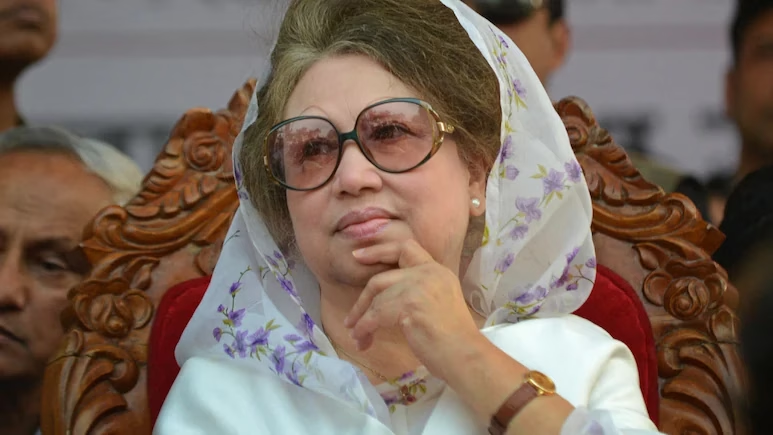

A towering figure in Bangladesh politics for over three decades, Zia served three terms as prime minister and alternated in power with longtime rival Sheikh Hasina, a rivalry that defined the country’s political landscape.
Khaleda Zia, Bangladesh’s first woman prime minister and leader of the Bangladesh Nationalist Party (BNP), died on Tuesday after a long illness, her party said. She was 80.
She had been suffering from advanced cirrhosis of the liver, arthritis, diabetes, chest and heart problems, Reuters quoted her doctors as saying.
Zia died at a hospital in Dhaka, where she had been receiving treatment since Nov. 23 and was placed on ventilator support on Dec. 11 as her condition deteriorated.
A dominant figure in Bangladesh’s politics for more than three decades, Zia served three terms as prime minister — from 1991 to 1996, briefly in 1996, and from 2001 to 2006 — alternating in power with her longtime rival Sheikh Hasina, the daughter of the country’s founding leader. Their rivalry came to define Bangladesh’s political landscape.
The BNP announced Zia’s death in a statement on social media. It did not specify a cause.
Zia was the widow of former President Ziaur Rahman, a military officer who emerged as a key figure in Bangladesh’s 1971 war of independence and later ruled the country before being assassinated in a failed coup in 1981. She entered politics soon after his death, rising quickly to lead the BNP.
Born Khaleda Khanam Putul in 1945 or 1946 in what is now northern Bangladesh, Zia came of age during the upheavals of the subcontinent’s partition and the country’s violent birth as an independent nation. Her exact date of birth has long been disputed and was itself a subject of political controversy.
Zia first came to power in 1991 after leading a mass movement, alongside Hasina, against the military dictatorship of Hussain Muhammad Ershad. While their alliance was short-lived, it helped restore parliamentary democracy and made Zia Bangladesh’s first female prime minister.
Her second term ended amid an opposition boycott and fresh elections under a caretaker government, which she lost to Hasina. Zia returned to office in 2001 at the head of a coalition that included Islamist parties, a period marked by allegations of rising militancy and corruption involving senior party figures.
Her political fortunes declined sharply after her third term, when a military-backed caretaker government arrested her on corruption charges. Though briefly freed, she spent much of the past decade either in jail or under house arrest as legal cases mounted under governments led by Hasina.
In February 2018, Zia and five others, including her elder son Tarique Rahman, were convicted of embezzling 21 million takas (approximately Rs 1.6 crore) in foreign donations meant for the Zia Orphanage Trust. Later that year, she received a seven-year sentence in a separate corruption case involving the Zia Charitable Trust, with the sentences running concurrently. Prosecutors said the trusts existed only on paper.
Zia was released from prison on medical grounds in 2020. After contracting Covid-19 in 2021, doctors advised she seek treatment abroad, but courts repeatedly denied her requests under the government of Hasina. Bangladesh’s then foreign minister said she could bring foreign doctors to Dhaka but would not be allowed to leave the country.
After Hasina was ousted from power in August 2024 following weeks of student-led protests, Nobel laureate economist Muhammad Yunus took charge as chief adviser of an interim government. Zia was freed from house arrest, several cases against her were dropped, and she was permitted to travel to London for treatment before returning to Bangladesh in May.
Despite being bedridden in her final months, the BNP nominated Zia to contest multiple seats in elections scheduled for February. From her hospital bed, she welcomed Hasina’s downfall as “the end of tyranny.”
“Through a long movement of struggle and sacrifice, we have freed ourselves from the fascist, illegal government,” she said in what became her final public statement.
In January, Bangladesh’s Supreme Court acquitted Zia in the corruption cases.
She is survived by her son Tarique Rahman, the BNP’s acting chairman, who returned to Bangladesh last week after 17 years in exile and is widely seen as a contender for the country’s top office. A younger son, Arafat Rahman, died in 2015.