




Follow Millat Times for independent journalism.
Opens the app if installed, or Google Play to download it.Syed Qasim Rasool Ilyas
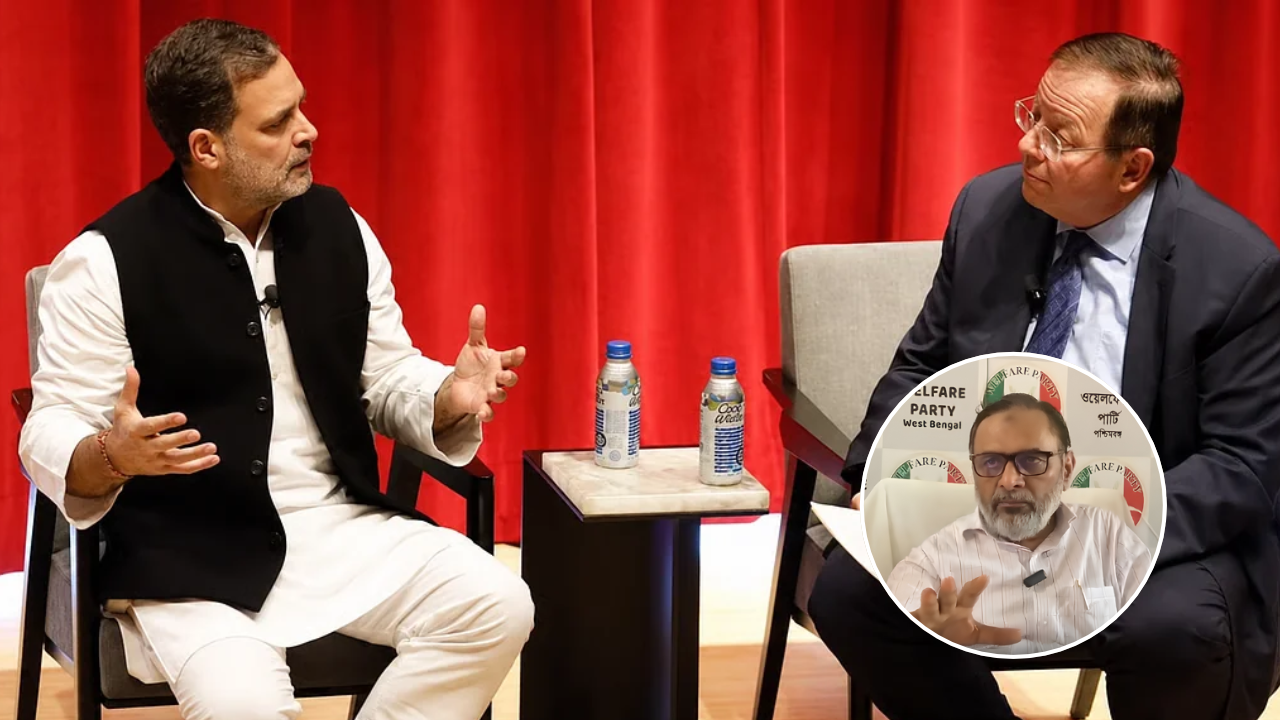
Rahul Gandhi’s recent remarks in the United States, in which he described India’s relations with Israel positively and endorsed the purchase of Israeli weapons, are deeply disappointing. At a time when Israel’s military campaign in Gaza has attracted widespread international condemnation, one would have expected the Congress leader to take a more unequivocal position. At the very least, he should have called out the genocide in Gaza and condemned it without ambiguity. Instead, his remarks appeared to echo the position of the Modi government.
This raises an uncomfortable question: has the Congress Party developed a clear and independent position on Israel’s actions in Palestine, or is it increasingly reluctant to depart from the Modi government’s strategic and political formulation?
It is possible that Rahul Gandhi’s remarks were not deliberate. Perhaps he was caught off guard by the question and responded without fully considering the implications of his answer. Nevertheless, that does not absolve the Congress Party of its responsibility to articulate a clear position on an issue of such grave humanitarian consequence.
The destruction in Gaza is impossible to overlook. More than 72,000 people have reportedly been killed, and much of the territory has been reduced to rubble. Hospitals, educational institutions and essential infrastructure have been devastated, while restrictions on humanitarian assistance have compounded the suffering of an already vulnerable population. These are not merely geopolitical developments to be discussed in the language of diplomatic convenience. They raise fundamental questions about international law, human rights and the moral responsibility of the international community.
India’s historical position on Palestine makes the Congress Party’s ambiguity even more troubling. Until 1992, India did not maintain diplomatic relations with Israel. It was under the prime ministership of PV Narasimha Rao that formal diplomatic ties were established. This was a significant shift in India’s foreign policy, although it did not mean abandoning its longstanding support for Palestinian self-determination.
Mahatma Gandhi had famously expressed the view that just as Britain belonged to the British people, Palestine belonged to the Palestinian people. India’s solidarity with the Palestinian cause was rooted in the principles of self-determination, opposition to colonialism and the rights of oppressed peoples. These principles should not become expendable merely because India’s diplomatic and military relationship with Israel has expanded.
Over the years, India’s relationship with Israel has evolved from diplomatic engagement into a strategic partnership. Defence cooperation, in particular, has become an important pillar of this relationship, with India purchasing substantial quantities of military equipment from Israel. The Modi government’s approach has further strengthened these ties. But strategic cooperation cannot become an excuse for overlooking grave violations of international law and humanitarian principles.
India must, therefore, reconsider the nature and limits of its defence relationship with Israel. It is not enough to argue that weapons are purchased for India’s security needs while ignoring the broader consequences of sustaining Israel’s military-industrial ecosystem. Given Israel’s record of disregarding international law and United Nations resolutions, India should seriously consider stopping its purchases of Israeli weapons.
Nor should India limit itself to issuing routine diplomatic statements. It must actively support international resolutions condemning Israel’s actions, its blockade of Gaza and violations of Palestinian rights. It should also use its diplomatic influence to press for an immediate end to the violence, unrestricted humanitarian assistance, the reconstruction of Gaza and a credible political settlement based on a two-state solution.
India must also recognise that it possesses considerable diplomatic and political influence. We frequently describe ourselves as an emerging global power and aspire to become a Vishwaguru. But global leadership cannot be measured merely through economic growth, military strength or strategic partnerships. It must also be reflected in the willingness to defend universal principles, even when doing so involves difficult diplomatic choices.
If India genuinely believes in international law, humanitarian values and the rights of oppressed peoples, it must be prepared to hold even its strategic partners accountable. If Israel continues to disregard these principles, India should not rule out stronger measures, including a reassessment of diplomatic relations.
There are those who argue that national interest must take precedence over morality and human rights. According to this argument, India’s strategic, military and economic interests in maintaining close relations with Israel should outweigh concerns about what is happening in Gaza. But this is an excessively narrow understanding of national interest.
National interest cannot be reduced to defence contracts, military technology or economic benefits. It must also encompass international peace, humanitarian responsibility and the values that shape a country’s place in the world. A nation that seeks global leadership cannot selectively invoke international law when it suits its interests and remain silent when those principles are violated by a strategic partner.
India has historically presented itself as a country committed to peace, justice, anti-colonialism and humanitarian solidarity. These are not ornamental values to be invoked in speeches and diplomatic declarations. They must inform the country’s foreign policy, particularly when the lives and rights of vulnerable populations are at stake.
The Congress Party, too, must recognise that its response to Gaza is not simply a question of political positioning against the BJP. It is a question of moral and political clarity. It must reaffirm its commitment to Palestinian self-determination and unequivocally condemn the destruction in Gaza. It must also recognise that the sentiments of Indian Muslims, alongside the broader humanitarian concerns of millions of Indians, cannot be dismissed when discussing India’s position on Palestine.
Ultimately, India’s credibility as a global power will depend not only on the relationships it builds but also on the principles it is willing to defend. Upholding human rights and humanitarian values is not contrary to India’s national interest. It is an essential part of it.
(As told to Millat Times)
Support Independent Media
Click Here and Join the Membership of Millat Times to Support Independent Media.
Support Millat Times