
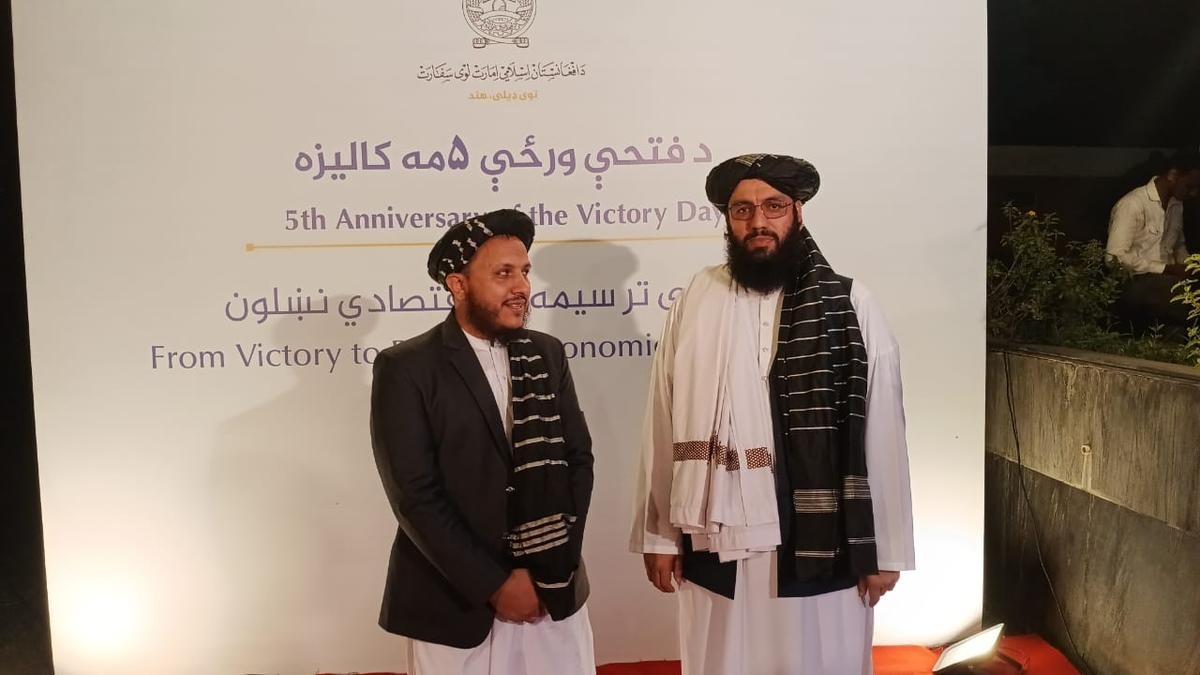




India has signalled a further shift towards closer engagement with Afghanistan’s Taliban rulers, with a senior Indian diplomat attending an event in New Delhi to mark the fifth anniversary of the group’s return to power.
Anand Prakash, joint secretary in the Ministry of External Affairs’ Pakistan, Afghanistan and Iran division, attended the event at the Afghan embassy on Monday, alongside other Indian officials, according to The Hindu
The gathering was the first time the Afghan embassy in New Delhi publicly celebrated the Taliban’s Aug. 15, 2021, takeover of Kabul as “Victory Day”, The Hindu reported.
India does not formally recognise the Taliban government, but has steadily expanded official contacts with Kabul, reflecting a pragmatic approach driven by security concerns, trade, connectivity and India’s wider interests in the region.
“Taliban is a reality and we have to engage with them,” a senior Indian official told The Hindu, describing the government’s approach to the Taliban.
The event also highlighted how much India-Afghanistan ties have changed since the Taliban returned to power following the withdrawal of U.S.-led forces and the collapse of the previous Afghan government.
Standing beside the flag of the Islamic Emirate of Afghanistan, the name used by the Taliban, Mufti Noor Ahmad Noor, the group’s charge d’affaires in New Delhi, called for stronger political and economic relations with India.
“Afghanistan’s geography should not be a field for negative competition, but rather a bridge for connectivity, cooperation and shared prosperity,” Noor said in a speech delivered in Pashto, according to The Hindu.
He said Afghanistan had “left the chapter of war behind” and was moving towards stability, reconstruction, economic growth and greater engagement with the international community.
The reception was attended by diplomats from several countries, including Russia, China, the United States, Iran, Qatar, the United Arab Emirates and Uzbekistan, according to The Hindu and The Times of India.
For New Delhi, the outreach comes against the backdrop of increasingly strained relations between Afghanistan and Pakistan. The Taliban and Pakistan have repeatedly clashed along their border, while Islamabad has accused Kabul of allowing militants from the Tehreek-e-Taliban Pakistan to operate from Afghan territory. Kabul denies the allegation.
The deterioration in Afghanistan-Pakistan ties has added another dimension to India’s efforts to maintain direct links with Kabul.
India has historically had close development and diplomatic ties with Afghanistan and invested heavily in infrastructure and public projects before the Taliban takeover. New Delhi evacuated its diplomatic personnel after the Taliban seized Kabul but subsequently reopened a technical mission and gradually resumed official engagement.
That engagement has accelerated over the past year.
Taliban acting Foreign Minister Amir Khan Muttaqi visited India last year, followed by visits from other senior Afghan officials, including acting Industry and Commerce Minister Nooruddin Azizi, Public Health Minister Noor Jalal Jalali and acting Agriculture Minister Ataullah Omari, according to The Hindu.
India subsequently upgraded its technical mission in Kabul into an embassy, while the Taliban appointed Noor as its charge d’affaires in New Delhi.
Noor said India and Afghanistan had made “significant progress” in their relationship through political engagement and shared interests. He referred to centuries of commercial and cultural links between the two countries and thanked India for its support in protecting what he described as Afghanistan’s international rights, The Times of India reported.
The economic relationship remains important for New Delhi.
India currently has at least four weekly flights connecting the two countries, while bilateral trade is estimated at around $1 billion, The Hindu reported. Indian officials said regional conflicts had affected trade but that freight links had helped maintain economic ties.
Afghanistan is also strategically important to India because of its location at the crossroads of South and Central Asia. Indian policymakers have long sought greater access to Central Asian markets while avoiding dependence on routes through Pakistan.
Noor highlighted projects such as the TAPI gas pipeline and CASA-1000 electricity transmission project as examples of Afghanistan’s potential role in regional connectivity. He also pointed to investments in transport, energy, mining and agriculture.
For India, deeper engagement with Kabul offers economic opportunities but also carries diplomatic risks.
New Delhi must balance its dealings with the Taliban with its concerns over terrorism, human rights and regional security. The Taliban’s restrictions on women and girls, particularly on education and employment, remain a major international concern.
Noor did not address the status of women in Afghanistan in his speech, The Hindu reported.
India’s policy therefore remains one of engagement without formal recognition. Officials have maintained that direct contact is necessary to protect Indian interests and ensure that Afghanistan does not become a base for groups hostile to India.
The prominent role given to the Taliban at Monday’s embassy event nevertheless marked a significant departure from the cautious approach seen immediately after the group returned to power.
The Afghan embassy, which had faced resistance from some staff members to the arrival of Taliban officials during Muttaqi’s visit last year, displayed the Islamic Emirate flag prominently during Monday’s event, The Hindu reported.
Noor said stronger political trust, economic partnership and continued engagement between India and Afghanistan would contribute to regional stability and prosperity, according to The Times of India.
For New Delhi, the message appears clear: while formal recognition may remain some distance away, India is increasingly treating the Taliban authorities as the government it must deal with in Afghanistan.
Support Independent Media
Click Here and Join the Membership of Millat Times to Support Independent Media.
Support Millat Times