
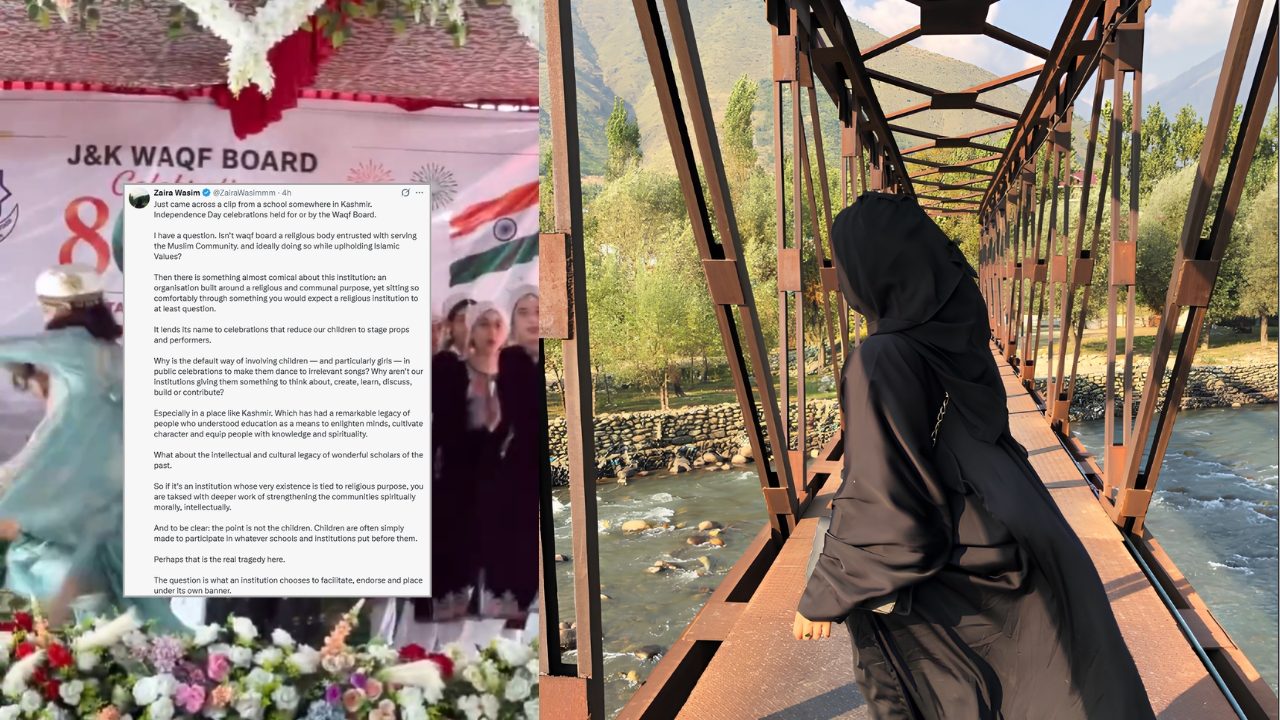




Former Bollywood actor Zaira Wasim has questioned the Jammu and Kashmir Waqf Board’s role in an Independence Day celebration at a school in Kashmir, after coming across a video showing children, including girls, taking part in dance performances.
Wasim said the video left her wondering why dancing had become such a routine way of involving children in public celebrations, and whether institutions with religious and educational responsibilities could offer them something more meaningful.
Millat Times could not independently verify which video Wasim was referring to that purportedly showed an event organized by the Waqf Board.
Her concern, she made clear, was not with the children.
“The point is not the children,” Wasim said, pointing out that students generally participate in whatever activities schools and institutions put before them.
For her, the bigger question was about the adults making those choices — and the institutions that decide what to organise, support or place under their name.
She asked why children could not instead be encouraged to take part in activities that make them think, create, learn, discuss, build or contribute.
The question comes against the backdrop of a significant change in the way Independence Day has been marked in Kashmir since the abrogation of Article 370 in August 2019 and the conversion of the erstwhile state into a Union Territory.
For decades, Independence Day and Republic Day functions in the Valley were often heavily secured and largely confined to official venues, amid shutdown calls from separatist groups and the threat of militant attacks. Participation by ordinary people was comparatively limited.
That began to change after 2019, with the administration placing greater emphasis on taking national-day celebrations into schools, government offices and local communities. In 2021, for example, the government directed every government school in Jammu and Kashmir to hoist the national flag and organise Independence Day activities, while teachers reported that schools were being closely monitored for compliance.
The expansion has continued. In 2023, the administration directed government employees to attend Independence Day functions as part of their official duty, warning that absence could invite disciplinary action.
In 2024, a General Administration Department circular again directed all government employees stationed in Srinagar and Jammu to attend the main functions, allowing absence only with prior permission.
The result is a much more visible presence of students, teachers and government employees in Independence Day programmes across the Union Territory.
It is against this backdrop that Wasim’s criticism takes on a broader meaning. Her question is not simply about a school dance, but about what kind of participation institutions are encouraging as national celebrations have become increasingly prominent in everyday public life in Kashmir.
Wasim, who became a household name after starring in Aamir Khan’s Dangal and later appeared in Secret Superstar, has herself taken a very public step away from the entertainment industry in the name of her faith.
In 2019, she announced that she was quitting acting, saying that her career was interfering with her relationship with her imaan, or faith. She had made her acting debut with Dangal in 2016, winning the National Film Award for her performance, and later appeared in Secret Superstar and The Sky Is Pink.
Her latest remarks again bring religion, education and popular culture into the same conversation.
The Jammu and Kashmir Waqf Board is a statutory body that administers waqf properties and institutions in the Union Territory. Its responsibilities extend to religious sites and educational institutions, along with welfare and community-oriented activities.
It is this wider role that Wasim appears to have in mind when she questions the Board’s association with the school programme.
She argues that an institution with a religious and educational purpose should be doing more than simply facilitating public performances. In her view, it should be helping young people develop intellectually, morally and spiritually.
She suggested that school celebrations could give children opportunities to debate, explore history, create projects, discuss ideas and engage with their communities.
There is, of course, nothing unusual about children performing at Independence Day celebrations. Across India, school functions regularly feature patriotic songs, dances, tableaux and other cultural performances. Jammu and Kashmir is no different.
Wasim’s criticism is less about children performing and more about what she sees as an over-reliance on performance as a form of participation, particularly when girls are involved.
She also drew on Kashmir’s long intellectual and spiritual tradition, recalling a region shaped by generations of scholars and thinkers who saw education as a way of cultivating knowledge, character and spiritual awareness.
Support Independent Media
Click Here and Join the Membership of Millat Times to Support Independent Media.
Support Millat Times