




By Ayesha
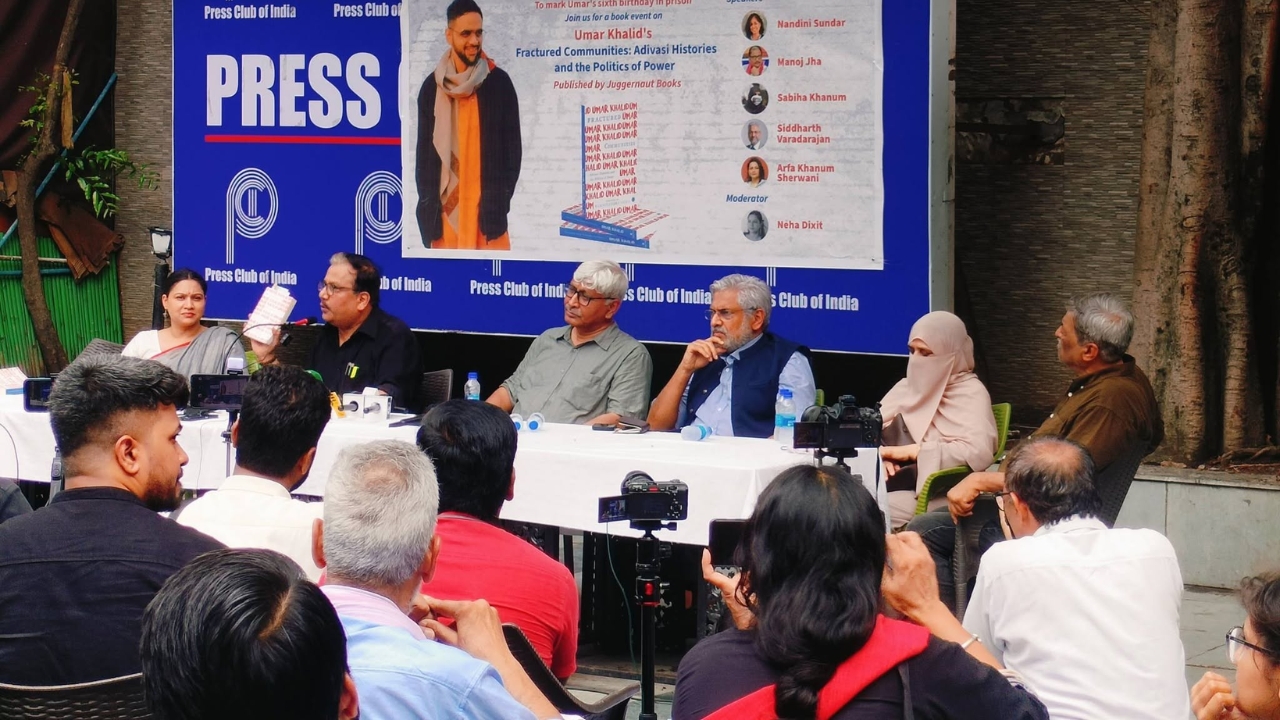
Panel discussion at Press Club on Umar Khalid’s recently published book, “Fractured Communities”, has drawn attention to jailed activist and former JNU scholar Umar Khalid, coinciding with the completion of six years in custody as of August 2026.
The event on Tuesday booked Fractured Communities: Adivasi Histories and the Politics of Power, drawn from his PhD thesis on Adivasi communities in the Singhbhum region of present-day Jharkhand, and featured emotional remarks from his mother, Sabiha Khanum, alongside scholars, activists and supporters.
The discussion featured Rajya Sabha MP Manoj Jha, Professor Prabhu Mohapatra of the University of Delhi, journalist Siddharth Varadarajan, journalist Arfa Khanum Sherwani, journalist Neha Dixit, Sabiha Khanum and other speakers.
Professor Prabhu Mohapatra spoke about the relationship between history, power and education. Referring to colonial rule, he discussed the use of “pacification” and repression against different communities, including Adivasis, Dalits, workers and farmers.
Khalid has been in judicial custody since September 2020, arrested under the Unlawful Activities (Prevention) Act (UAPA) in connection with the larger conspiracy case tied to the February 2020 riots in northeast Delhi, which broke out amid protests against the Citizenship Amendment Act (CAA).
Participants recalled that Khalid was completing his doctoral thesis around the time he first faced legal trouble in 2016, submitting his final work while dealing with police and court proceedings, with support from friends and colleagues. His book, published by Juggernaut in June 2026, has been described by supporters as a significant scholarly contribution on Adivasi history, colonial-era governance, and indigenous resistance in the Singhbhum region work they say deserves wider readership regardless of the politics surrounding its author.
The discussion arrives against the backdrop of a real and reported controversy. Jawaharlal Nehru University cancelled a student-organised event to discuss Fractured Communities that had been scheduled for August 10, 2026, at the School of Social Sciences I auditorium, timed to mark the International Day of the World’s Indigenous Peoples.
According to multiple reports, JNU’s administration said the organisers of the JNU Students’ Union (JNUSU) had not fully disclosed in their venue-booking form that the event would centre on Khalid’s book, describing it instead only as a general “Public Talk for Adivasi Diwas.”
JNUSU called the cancellation an “arbitrary and authoritarian” decision and accused the administration of trying to suppress academic discussion and dissent.
Several speakers reflected on the differential treatment of student activists depending on religious identity, arguing that a Muslim activist raising his voice faces harsher consequences than others, and that similar dynamics affect Dalit activists labelled “Naxalite” or “Maoist” for speaking out.
They argued that while fear can spread through a community facing such pressure, so too can courage and that Khalid’s continued advocacy for marginalised groups, including tribal communities, resonates because he has “risen above” narrow identity politics to speak for anyone treated unjustly, in their view.
Umar Khalid’s mother brought a personal dimension to the discussion, reflecting on the journey behind bringing the book to readers and the circumstances that changed her son’s life after 2016.
She spoke about the importance of allowing readers to engage directly with Umar’s ideas and scholarship. For the family, the publication represents not only an academic achievement but also a way of keeping his intellectual voice alive.
A hearing is listed in the Delhi High Court on August 27, with the possibility of the matter eventually reaching the Supreme Court. They expressed hope that a sympathetic bench would expedite the years-long process.
Watch the coverage on Millat Times:
Support Independent Media
Click Here and Join the Membership of Millat Times to Support Independent Media.
Support Millat Times