
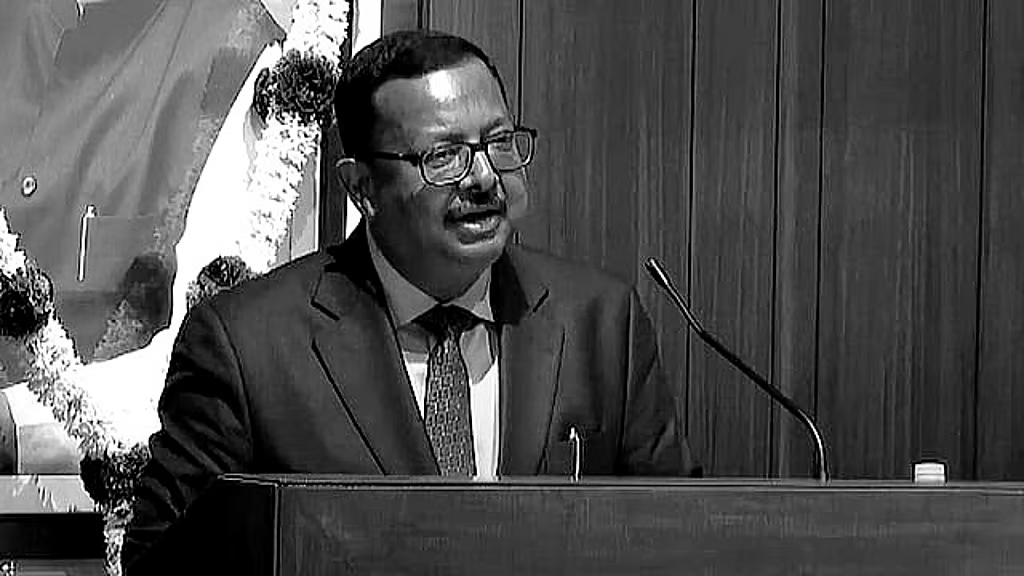



Justice Ujjal Bhuyan of Supreme Court on Saturday said public space for expressing dissent in India was shrinking, criticised the criminalisation of peaceful protest and restrictive bail conditions, and questioned the legal basis of arrests made over an iftar gathering on the Ganga and the denial of permission for a solidarity march for Gaza.
Delivering the 5th Justice G.P. Singh Memorial Lecture at the National Law Institute University (NLIU) in Bhopal, Justice Bhuyan said the rights to free speech and peaceful assembly were fundamental constitutional freedoms but warned that citizens, including students, were increasingly facing criminal proceedings for exercising those rights.
“I will not comment on any contemporary happenings in the country; I will refrain from doing so. But it will not be an exaggeration to say that public space for expressing divergent opinion is shrinking in India. Right to express one’s views and right to demonstrate peacefully are fundamental freedoms of citizens. Debate and dissent are the essence of democracy. Unfortunately, even formal activities are criminalised. People who come to voice their anguish for environmental degradation, which is a reality, are chased away as if they are criminals. Students protesting on campuses are arrested, and they don’t get bail for 30-40 days. They are suspended, and then have to go to the Court, which takes time.”
Justice Bhuyan said that although courts often grant bail, the conditions imposed in several cases significantly curtail personal liberty and raise concerns about whether judicial orders are discouraging citizens from participating in public life.
Referring to a case involving a Facebook post criticising a minister’s remarks, he said bail conditions sometimes go beyond what is necessary.
“For putting a post on Facebook commenting on the conduct of a minister who had called a serving Indian Army officer a daughter of a terrorist, an FIR is lodged, and he has to seek anticipatory bail. Bail is granted but what does the Court do? [Asking them to] deposit your passport [when] he is not even on a flight risk. [Then it says] don’t post anything on Facebook.”
He also referred to the Supreme Court’s bail order in the Delhi riots case involving student activist Gulfisha Fatima, saying the conditions attached to bail warranted closer examination.
“Take the case of young student activists who had suffered long incarceration. While the Court granted them bail, they were directed not only to surrender their passport, but also not to participate or address any public meetings whether physically or virtually. Imposing such restrictive conditions severely undermines their fundamental freedoms and liberty. People would be justified in asking whether, by passing such orders or by imposing such conditions, is the Court also sending a message that don’t participate in such public activities?”
Justice Bhuyan also questioned the arrest of 14 Muslim men who were jailed after they were accused of consuming chicken biryani while breaking their Ramadan fast on a boat in the Ganga in Uttar Pradesh, saying there was no law prohibiting such an act.
“I am sure consuming chicken biryani is not an offence. It can’t be an offence. There is no law prohibiting consumption of chicken over the Ganga river,” he said, noting that the men had remained in jail for three months.
“Can people be arrested and denied bail for 3 months for such an activity, I ask myself! Citizens are watching, people are watching.”
Turning to freedom of expression, Justice Bhuyan criticised the Bombay High Court’s refusal to interfere after permission was denied for a march in solidarity with Palestinians in Gaza.
“I found it very amusing that when in Bombay, Shivaji Park, when a group of people wanted to demonstrate in solidarity with the people of Gaza, the permission was not granted by the government. So, they moved a writ in the Bombay High Court; the learned judge said, ‘Don’t you have any issues in India? Why do you have to go that far to agitate?'”
He said India has traditionally recognised Palestine and maintained diplomatic relations with it, adding that universities should encourage students to engage critically with both national and international developments.
“India has recognised Palestine; we have a Palestinian Embassy in India. Traditionally, India has always recognised Palestine. The recent incidents in Gaza, it is South Africa that moved the International Court of Justice against what is happening there, saying that make a declaration that it is Genocide. Justice Muralidhar, former judge of the Orissa High Court, UN appointed him to go into the violence in Gaza. He has published a report, which is accepted by the UN and is now in the public domain, about the violence meted out by the State on such children, women and elderly.”
“I am not saying that only these issues should be debated. These are the issues which should agitate the mind of a young student, of a research scholar. You must read, you must question. That is the place of a university.”
Calling for greater judicial introspection, Justice Bhuyan said criticism of judgments should not be seen as criticism of judges and that the judiciary’s legitimacy ultimately rested on public confidence.
“For the judges and the judiciary to remain legitimate and to remain relevant, public perception is most crucial,” he said.
Justice Bhuyan also defended the constitutional principle of separation of powers, saying the judiciary, executive and legislature must function independently. Referring to the post-retirement entry of former Chief Justice of India Ranjan Gogoi into the Rajya Sabha, he said such developments blurred constitutional boundaries.
“If we have two legs at one place, the stool will fall apart. This is the fundamental principle. Therefore, when a former Chief Justice of India says he is going to the Rajya Sabha to bridge the gap between the judiciary and the executive, it is fundamentally wrong. It is completely wrong fundamentally. It goes against the principles of separation of powers; it’s the fundamental fallacy there,” he said.
He also defended the Supreme Court’s Kesavananda Bharati judgment on the basic structure doctrine, saying it had stood the test of time and criticising attempts to question its legitimacy.
“The judgment has stood the test of time. It has been applied for more than a dozen times by the Constitution benches. So it is wrong when the then Vice President of India questions the jurisprudential legitimacy of the judgment…It is also wrong when the former Chief Justice of India asserts in the Rajya Sabha that I[he] is not very sure of the jurisprudential legitimacy of the judgment,” he said.
Support Independent Media
Click Here and Join the Membership of Millat Times to Support Independent Media.
Support Millat Times