
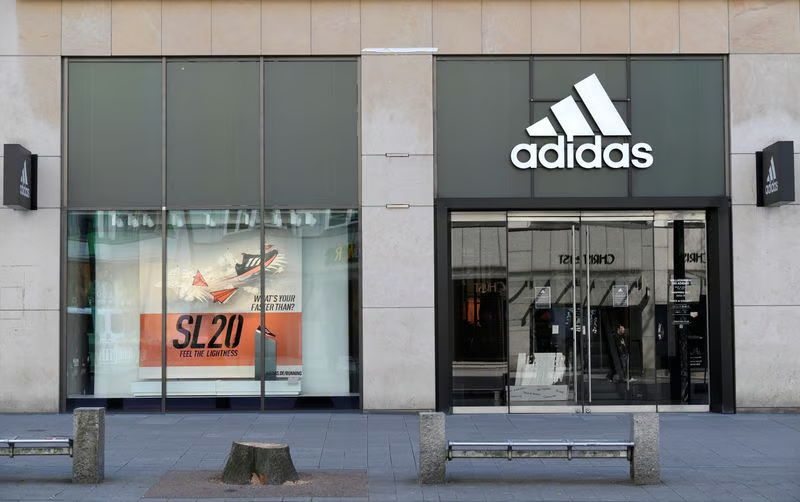



German sportswear maker Adidas is facing growing calls for a boycott after featuring a former Israeli soldier who served in Gaza and lost a leg while in the Israeli military in a campaign promoting its “single-shoe service” for amputees.
The campaign featuring retired soldier Shalev Biton has drawn criticism of Adidas and raised questions about the impact of the controversy on the company’s brand and business in markets where support for Palestinians is widespread.
Adidas said the campaign was created by its local team in Israel and was not part of its global advertising strategy.
Adidas Arabia apologized following the backlash, saying it understood the concerns raised by the campaign and was taking regional sensitivities into account.
The controversy comes as amputations and other severe injuries among civilians in Gaza have become a prominent issue in the wider debate over the war, intensifying criticism of the use of a former Israeli soldier to promote a product aimed at people who have lost limbs.
Boycott debate highlights Adidas’ global footprint
The dispute has also focused attention on Adidas’ commercial presence in countries that have supported international resolutions concerning Palestinian rights.
Adidas’ official website lists 3,722 sales locations worldwide. A comparison of those locations with a U.N. General Assembly resolution adopted on Dec. 12, 2025, supporting the International Court of Justice’s advisory opinion on Israel’s obligations in the occupied Palestinian territory, shows that 3,378 Adidas locations, or about 90.8% of the company’s physical network, are in countries that backed the resolution.
The resolution received 139 votes in favor, 12 against and 19 abstentions.
The 12 countries that voted against the resolution account for 287 Adidas locations, according to the company’s store data. The largest concentrations are in the United States, with 179 locations, Israel with 62 and Argentina with 41.
Exposure in key growth markets
Adidas reported global net sales of 24.81 billion euros ($28.8 billion) in 2025, up 5% from the previous year, while operating profit increased 54% to 2.06 billion euros.
Several countries that backed the U.N. resolution are also important markets for Adidas, particularly across emerging economies.
In Türkiye, Adidas lists 125 sales locations, including 40 in Istanbul and 10 in Ankara. The company is estimated to account for roughly 22% to 25% of the country’s sportswear and footwear market, putting it among the two largest players in the sector.
China is another major market. The country accounted for about 15% of Adidas’ global revenue in 2025, while currency-neutral sales there rose 16% in the first half of the latest reporting period. Adidas is estimated to have an 11% to 13% share of the Chinese sportswear market.
Consumer boycotts in China have previously inflicted substantial losses on multinational brands, making the market particularly important to Adidas.
Saudi Arabia, the largest economy in the Middle East, has 101 Adidas sales locations and is an important regional market for the company. Adidas is estimated to hold an 18% to 20% share of the country’s sportswear market.
The company’s rapid apology through Adidas Arabia underscored the potential sensitivity of the issue in Gulf markets, where public sentiment over the Gaza conflict has been closely watched by international brands.
Adidas is also a significant player in Pakistan’s premium sportswear segment, where it is estimated to have a 12% to 15% market share. Its strong brand recognition among younger urban consumers could make the market particularly responsive to social-media campaigns and boycott calls.
In Iraq, Adidas relies primarily on distributors and wholesale channels and is estimated to account for about 10% of the branded sportswear market.
Nigeria, Africa’s most populous country and largest economy, is another market viewed as important to Adidas’ longer-term expansion on the continent. The company operates there through wholesalers and local retail partners and is estimated to have a 14% to 16% market share.
Brand reputation in focus
Adidas’ recent financial performance highlights the importance of emerging markets to its growth strategy.
The company reported a 14% increase in currency-neutral global net sales in the first six months of 2026, one of its strongest periods in recent years. Wholesale sales accounted for 60% of revenue, while direct-to-consumer sales made up the remaining 40%.
Currency-neutral sales rose 27% in Latin America and 11% in emerging markets.
Store counts do not directly translate into revenue, and market-share estimates vary by source. But Adidas’ broad presence in countries such as Türkiye, China, Saudi Arabia, Pakistan, Iraq and Nigeria means a boycott campaign could extend beyond the Israeli market and pose a wider reputational risk.
Adidas had 2,022 company-operated concept and outlet stores, underscoring the importance of maintaining consumer confidence and a consistent global brand image as the company expands in international markets.
Support Independent Media
Click Here and Join the Membership of Millat Times to Support Independent Media.
Support Millat Times