
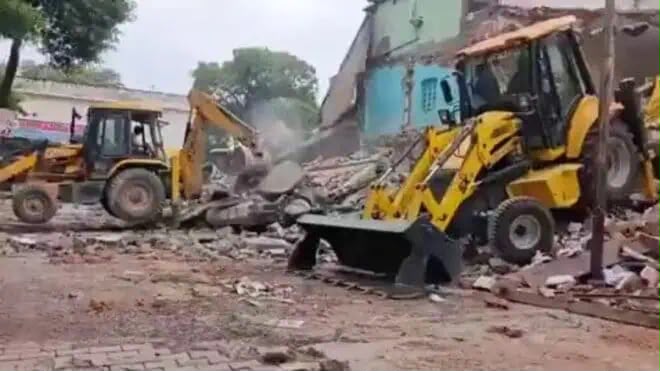




Government and administrative authorities across several Indian states have taken action against mosques, mazars, dargahs, madrasas and other Muslim religious or community properties in a series of demolition, removal and eviction drives since 2020, according to government statements, court records, media reports and documented cases reviewed for the report.
The compilation contains at least 2,166 reported instances, structures or aggregate figures relating to such action between 2020 and 2026. However, the figure should not be interpreted as 2,166 individually verified demolitions, as the underlying material combines individual cases with government-reported totals, partial demolitions and aggregate figures that may overlap.
Authorities have predominantly cited land and planning-related grounds for the action, including alleged encroachment, occupation of government or forest land, unauthorised construction, road widening and construction on reserved or other public land.
The legal status of the cases varies. While affected religious bodies and residents have challenged some demolitions in courts, proceedings in other cases have been allowed to continue after eviction or other administrative findings.
The reported cases are spread across Uttar Pradesh, Uttarakhand, Gujarat, Delhi, Maharashtra, Madhya Pradesh, Rajasthan, Telangana, Assam and other states.
Early cases
One of the prominent early cases occurred in May 2021 at Ram Sanehi Ghat in Uttar Pradesh’s Barabanki district, where the Garib Nawaz, also known as the Tehsil Wali Mosque, was demolished by the district administration.
Authorities described the structure as illegal and said it stood on government land. The Sunni Waqf Board subsequently challenged the action before the High Court.
In 2022, a mazar in the Mariani area of Kanpur was removed during administrative action linked to highway construction. In Gujarat’s Bet Dwarka, authorities demolished 10 mazars or shrines as part of a wider drive against structures described as illegal or encroaching on government land.
Delhi also witnessed demolitions involving Muslim shrines in 2023. The Nanhe Mian Chishti Mazar near Mandi House was demolished in an action linked to alleged encroachment and urban development, while a mazar in Bhajanpura was removed during an anti-encroachment drive associated with a road project.
Uttarakhand emerged as one of the largest sources of aggregate figures, with reports in 2023 referring to the removal of about 200 mazars and 28 temples from forest land. Other reports put the number of mazars involved in a wider campaign at more than 300. The figures overlap and are therefore not treated as separate totals.
Demolitions and larger figures in 2024
Documentation increased substantially in 2024.
On January 30, 2024, the Delhi Development Authority carried out an operation in Mehrauli in which the Akhoondji Masjid and Behrul Uloom Madrasa were demolished, while 77 mazars were reported removed.
The DDA linked the action to alleged illegal structures in Sanjay Van and reserved forest land. The Delhi High Court subsequently questioned aspects of the basis and notice for the action in proceedings concerning the demolition.
On February 8, the Maryam Masjid and Abdul Razzaq Zakariya Madrasa in Banbhoolpura, Haldwani, were demolished by the municipal administration. Authorities said the structures stood on government or Nazul land. The demolition was followed by deadly violence in the area, while the underlying land dispute continued through legal proceedings.
In Gujarat, state Home Minister Harsh Sanghavi told the state Assembly in February 2024 that 108 mazars had been demolished across the state as part of action against encroachment. That figure is treated as a government-reported aggregate rather than 108 separately verified cases and is therefore not added to individually documented Gujarat cases.
Other actions during the year included the partial demolition of Madani Mosque in Ahmedabad over alleged unauthorised construction, the demolition of around 20 metres of a mosque boundary wall in Mangolpuri, Delhi, and action against unauthorised portions of Subhani Mosque in Dharavi, Mumbai.
In September 2024, nine mosques, dargahs or shrines in Gir Somnath, Gujarat, were demolished in an operation described by authorities as action against encroachment on government land. The demolitions later became the subject of proceedings before the Supreme Court.
The Sanjauli Mosque in Shimla also became the subject of demolition proceedings in 2024, with three floors demolished following municipal and court proceedings over alleged unauthorised construction.
In December, a large portion of the Noori Jama Masjid in Lalauli, Fatehpur, was demolished during action linked to road widening and alleged encroachment. Proceedings followed in the High Court, after which the state said further demolition was not required.
Wider series of cases in 2025
The number of individually documented cases increased again in 2025.
A timeline published by The Polis Project recorded 15 mosque, mazar or related demolition or attempted-demolition cases between January and June 2025. The cases included both complete and partial demolitions and therefore cannot be treated as 15 completed demolitions.
On January 11, a dargah and nine mazars in Bet Dwarka, Gujarat, were demolished. The same month, Takiya Masjid in Ujjain, Madhya Pradesh, was demolished, while nine mazars on Pirotan Island in Gujarat were also removed.
A mosque in Chimbhal in Pune district was bulldozed on January 23.
In February, Madani Masjid in Hata, Kushinagar, faced partial demolition, while a centuries-old mosque in Sidhauli, Sitapur, was bulldozed. Pardeshi Baba Dargah in Thane also faced partial demolition.
A decades-old mosque in Meerut was demolished on February 21.
On March 1, the top two floors of Abu Huraira Mosque in Gorakhpur were demolished. The Jama Masjid in Rajapur, Ratnagiri, was later the subject of an attempted demolition or attack.
In April, a mazar at the Doon Medical College campus in Dehradun was demolished, while an under-construction mosque in Bhojpur, Saharanpur, was demolished in May.
In June, mazars inside the Katarniaghat sanctuary in Bahraich were removed. The 128-year-old Chawkhowa Jama Masjid in Dibrugarh, Assam, was also demolished.
Around the same period, two mosques and a shrine in the Rampur-Sambhal area were demolished.
Madrasa demolitions and government-land disputes
The 2025 data also includes a series of madrasa demolitions.
A madrasa in Bulbul Newaz, Bahraich, was demolished following an eviction order concerning government land. Madrasas in Panna, Madhya Pradesh, and Udham Singh Nagar, Uttarakhand, were also demolished over allegations that they stood on government land.
Three madrasa cases were documented in Shravasti, Uttar Pradesh — Jamia Razvia Shamsul Uloom, Madrasa Bahare Tayyaba and Madrasa Islamia Arabia Anwarul Uloom — with reports citing government, Gram Sabha or cemetery land as the basis for the action.
The cases involved different authorities and land claims and cannot be treated as part of a single coordinated demolition without documentary evidence establishing such a connection.
Uttarakhand figures
Uttarakhand again produced some of the largest aggregate figures in the compilation.
Five mazars in Kundeshwari/Kashipur and three in Ramnagar were reported demolished. A Pir Baba shrine in Lutabad was demolished on railway land, while another mazar in the Nawada forest area of Dehradun was removed.
By July 2025, The New Indian Express reported a government figure of 538 mazars removed statewide. That number is an aggregate and cannot be added directly to individually named Uttarakhand cases if those cases formed part of the same campaign.
Some later reports put the cumulative number of Muslim shrines or structures removed in Uttarakhand at more than 600. However, the material reviewed does not contain a sufficiently authoritative state dataset to independently establish that figure, so it is not treated as a verified total.
Uttar Pradesh-Nepal border campaign
Uttar Pradesh also reported large-scale action along the India-Nepal border.
In April 2025, the state government reported that 20 mosques and madrasas had been removed from government land. A subsequent figure of 429 illegal structures was reported for a wider campaign.
The larger figure included different types of structures, including religious buildings, and overlapped with the earlier 20-property figure. The two numbers therefore cannot be added together.
Demolitions reported in 2026
The reported cases continued into 2026.
In January, the Rawa Buzurg Mosque in Sambhal was demolished, while Hajipur Madrasa was demolished over a claim involving Gram Panchayat land.
A separate mosque in Salempur Salar, Sambhal, was demolished by local residents before government action and is therefore excluded from the government-demolition category.
In February, Masjid-e-Maulana in Sangareddy, Telangana, was demolished amid a land dispute, with a legal challenge reported.
In April, two mazars in Uttarakhand were demolished over claims that they stood on reserved forest land. Another mazar in Garmirpur, Haridwar, was demolished on land belonging to the Irrigation Department.
In May, Dargah Panch Peeran in Mangolpuri, Delhi, was largely demolished. The DDA said the demolished portion constituted unauthorised construction on government land.
In June, Sayyed Shah Baba Mazar in Etawah, Uttar Pradesh, was demolished in action linked to forest or government land.
Further demolition notices and actions were reported in Rajasthan’s border belt involving mosques, madrasas and dargahs. The cases generated legal disputes over land and the grounds cited by authorities, including national-security concerns.
In August, Arabia Ziaul Uloom Madrasa in Siddharthnagar, Uttar Pradesh, was demolished over an alleged government-land issue.
Saharanpur mosque demolition
One of the latest cases in the compilation is the demolition of the Collectorate Mosque in Saharanpur on September 5, 2026.
A district court on September 2 rejected an appeal and upheld an earlier eviction finding concerning alleged unauthorised occupation of government land.
The September 2 order did not itself constitute a demolition order; the demolition followed the eviction finding.
The case attracted further attention after workers found a roughly 20-foot-deep well beneath or near the demolished structure. The Archaeological Survey of India was asked to examine whether it had historical significance.
The available material does not establish that the discovery was a temple and should therefore not be presented as evidence that a temple had been found.
What the 2,166 figure represents
The compilation contains several large government-reported figures, particularly from Uttarakhand and Gujarat.
In Uttarakhand, reports include about 200 mazars removed from forest land in 2023, reports of more than 300 mazars in a wider campaign, more than 300 demolitions reported for the 2023-24 period by one research source, and 538 mazars reportedly removed statewide by July 2025.
In Gujarat, the figures include 10 mazars or shrines demolished in Bet Dwarka in 2022, 108 mazars reportedly demolished statewide by February 2024, and nine religious shrines, including mosques and dargahs, demolished in Gir Somnath in 2024.
These figures cannot simply be added together because some represent aggregate campaign figures, some individual cases and some may cover the same operations.
The 2,166 figure should therefore be understood as a count of reported instances, structures and aggregate figures in the source dataset, rather than a definitive count of 2,166 individually verified Muslim religious properties demolished by the government.
Government action and mob attacks kept separate
The compilation also records attacks on Muslim religious properties by mobs and private individuals. These incidents are kept separate from government demolitions.
During the February 2020 Delhi riots, at least 17 mosques, madrasas and shrines were listed in the underlying documentation as having been attacked, burned, vandalised or otherwise damaged.
Other documented incidents include attacks on Muslim religious properties in Tripura, Maharashtra, Madhya Pradesh, Karnataka, Gurugram, Bihar, Telangana and Uttar Pradesh between 2021 and 2025.
These incidents involve communal violence or private attacks rather than government demolition and are therefore excluded from the government-action total.
A fragmented national picture
Taken together, the cases show a recurring pattern of government and administrative action affecting Muslim religious and community properties across several Indian states between 2020 and 2026.
The authorities involved include district administrations, municipal bodies, development authorities, forest departments, public works agencies and other state institutions.
The reasons publicly cited are predominantly land and planning-related, including alleged encroachment, occupation of government or forest land, unauthorised construction, road widening, infrastructure projects and construction on reserved or other public land.
However, the legal status of individual cases varies considerably. Some demolitions have been challenged in court, with courts in some proceedings questioning notices or the basis of administrative action. In other cases, eviction findings have been upheld and demolition has proceeded.
The available material therefore documents the scale and geographical spread of reported action, but does not by itself establish whether the stated legal grounds were correct in every case, whether due process was followed in every instance, or whether similar enforcement was applied consistently to religious properties belonging to different communities.
Support Independent Media
Click Here and Join the Membership of Millat Times to Support Independent Media.
Support Millat Times