
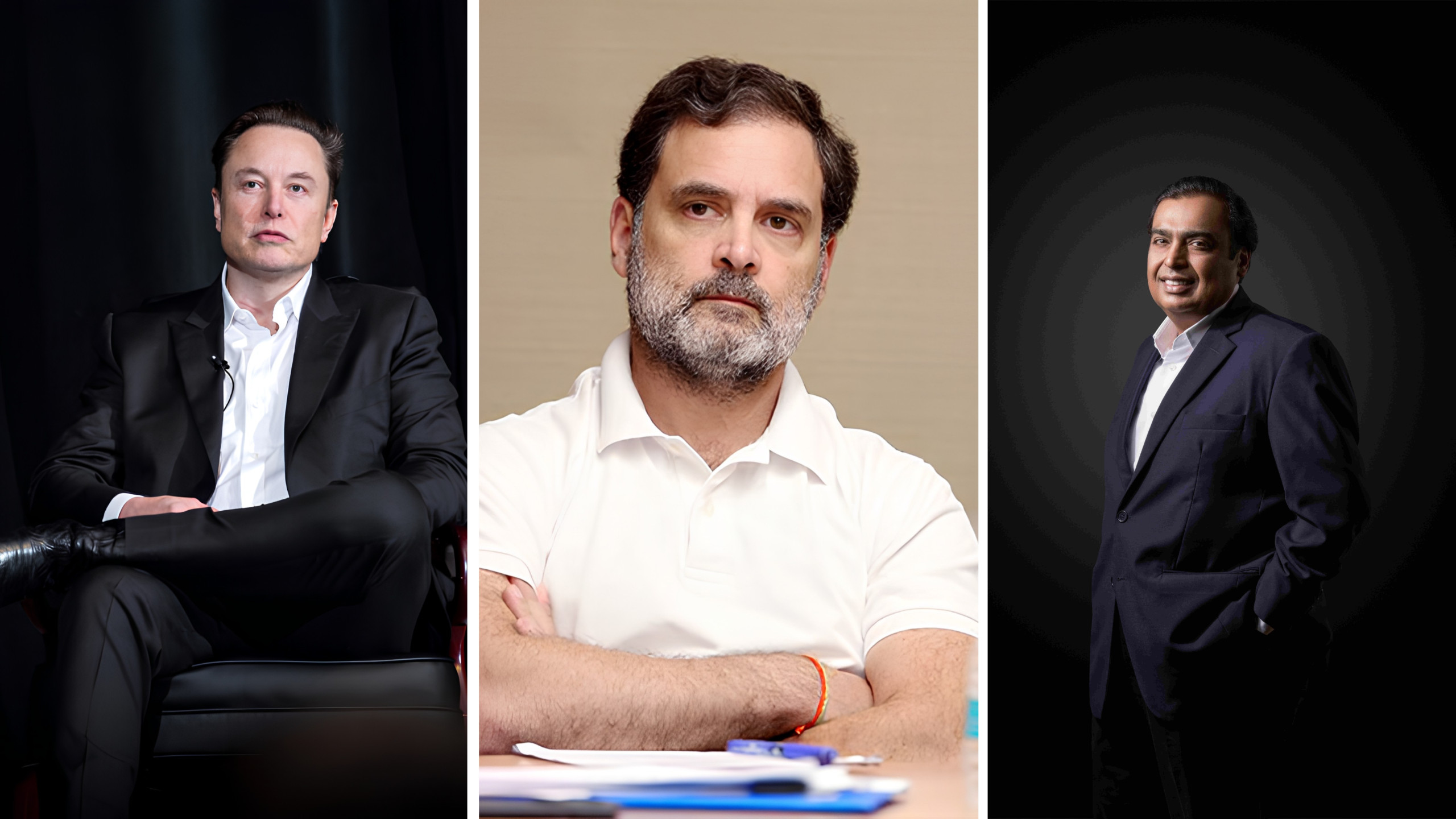




Elon Musk has intensified his criticism of industrialist Mukesh Ambani over delays in the launch of his satellite internet service, Starlink, in India. The dispute has drawn responses from Congress leader Rahul Gandhi, the Bharatiya Janata Party (BJP) and Union Communications Minister Jyotiraditya Scindia.
On Saturday, Musk escalated the exchange by sarcastically addressing Ambani as “Prime Minister Ambani”, renewing questions about the influence of major business groups and the regulatory hurdles facing Starlink in the Indian market. The remarks followed his earlier question on X: “Is Ambani the real boss of India?”
The controversy centres on Musk’s allegation that powerful business interests are obstructing Starlink’s entry into India to protect existing market dominance. The government has rejected the suggestion that its regulatory framework is discriminatory, saying satellite communication operators must fulfil the applicable security conditions and other requirements before launching commercial services.
Musk alleges obstruction to Starlink’s India launch
On October 7, Musk alleged that powerful business interests were preventing Starlink from entering the Indian market to protect their dominance.
“Unfortunately, we are being blocked by certain oligarchs in order to maintain their monopolistic chokehold on the Indian people. You can guess who they are,” Musk wrote on X. He described the alleged obstruction as “a crime against the people of India”.
Starlink, operated by Musk’s SpaceX, uses a network of satellites in low Earth orbit to provide internet connectivity. The service is designed to reach areas where conventional broadband and mobile networks may be difficult or expensive to deploy.
Musk has argued that satellite connectivity could help underserved communities gain access to education, business opportunities and reliable internet services. However, Starlink has yet to begin commercial operations in India, where regulatory approvals, security clearances and spectrum-related requirements remain central to its proposed launch.
On October 8, Musk directly questioned Ambani’s influence, writing, “Starlink is licensed in over 165 countries and has spent five years complying with every single law and requirement of the government of India, so why still no licence?” Is Ambani the real boss of India?”
His remarks brought Reliance Industries, whose chairman is Ambani, and its telecom subsidiary Reliance Jio into the centre of the debate. Jio is a major player in India’s telecommunications market and is also pursuing satellite communication services.
Rahul Gandhi tells Musk to ‘wait till you discover the other guy’
Leader of the Opposition in the Lok Sabha Rahul Gandhi joined the exchange on October 8.
“Welcome to India, Elon. Wait till you discover the other guy,” Gandhi wrote on X in response to Musk’s criticism.
Gandhi did not identify the person he was referring to. However, the remark was widely interpreted as an apparent reference to industrialist Gautam Adani, whom Gandhi and the Congress have repeatedly accused of benefiting from favourable treatment by the BJP-led government. Those allegations are contested and are separate from the question of Starlink’s pending approvals.
Musk responded to Gandhi, writing, “Thank you, Rahul. This is indeed troubling.”
The exchange turned a dispute over commercial approvals into a wider political debate about corporate influence, competition and the relationship between major businesses and the government.
Musk shares reports on Reliance-linked political donations
Musk also intensified his criticism of Ambani by sharing media reports concerning a Reliance-linked company’s political donations and a firm reported to have helped promote BJP campaigns on social media.
One report he highlighted was a 2022 Al Jazeera investigation titled ‘How a Reliance-funded firm boosts BJP’s campaigns on Facebook’. He also shared an archived report by The Indian Express concerning Qwik Supply Chain Private Limited and its electoral bond donations.
The Indian Express report’s headline cited donations of Rs 385 crore to the BJP and Rs 25 crore to the Shiv Sena. However, the report’s body, citing data released by the Election Commission of India, stated that Qwik Supply had donated Rs 395 crore to the BJP and Rs 25 crore to the Shiv Sena.
Qwik Supply has been described in media reports as a company linked to Reliance Industries. A Reliance Industries spokesperson previously stated that Qwik Supply Chain was not a subsidiary of any Reliance entity.
The reports concern political donations and social media campaigning. They do not, by themselves, establish that Ambani or Reliance intervened to block Starlink’s entry into India.
Government rejects allegations of discrimination
The Union Ministry of Communications rejected the suggestion that India’s regulatory framework was being used to unfairly obstruct Starlink.
The ministry described allegations that the regulatory process was unfair or discriminatory as “baseless and misconceived”. It said the country’s satellite communication framework was fair and non-discriminatory and that security assessments and other regulatory requirements applied to licensed operators.
According to the government’s position, Starlink, Reliance Jio’s satellite communication venture and Bharti-backed Eutelsat OneWeb were at broadly comparable stages of the approval process. The operators still needed to meet the relevant security conditions and complete outstanding formalities before commencing commercial services.
The government’s response did not establish that any private company had influenced the approval process. Instead, it maintained that the launch of satellite communication services depends on compliance with the rules and requirements laid down by the authorities.
BJP questions Rahul Gandhi’s response
The BJP also criticised Gandhi for backing Musk’s concerns.
BJP leader Ram Madhav said India was not a “banana republic” and argued that spectrum allocation and satellite communication approvals would be governed by the law.
Madhav questioned Gandhi’s intervention and referred to spectrum-related controversies during the Congress-led United Progressive Alliance government. The BJP’s response framed the dispute as a matter of regulatory sovereignty and compliance rather than evidence of preferential treatment for a particular business group.
The party rejected the suggestion that the government was favouring one operator over another.
Scindia says India does not allow monopolies
Union Communications Minister Jyotiraditya Scindia separately rejected Musk’s allegations on October 9 and defended the government’s approach to satellite communications.
“Now let me be very clear, India does not allow monopoly in any sector,” Scindia said.
He pointed out that Starlink, Jio Satcom and Eutelsat OneWeb had received satellite communication licences but could not begin commercial operations until they met the applicable security requirements and completed the remaining regulatory formalities.
Scindia also said the government was working towards finalising revenue-based charges for satellite spectrum, with the Department of Telecommunications and the Telecom Regulatory Authority of India (TRAI) involved in the process.
The minister criticised the Congress over Gandhi’s response to Musk, questioning the party’s position on satellite communication licensing. He argued that the opposition’s stance was inconsistent in its criticism of the licensing process.
Starlink, Jio and Airtel: competition and cooperation
The dispute comes as companies compete to expand satellite internet services in India, a market with substantial demand for affordable and reliable connectivity.
In March 2025, Reliance Jio and Bharti Airtel signed agreements with SpaceX to distribute Starlink equipment and services in India, subject to government approval. The agreements illustrate that the companies’ relationship with Starlink involves both commercial cooperation and competition.
Satellite internet could provide an alternative for people living in remote and poorly connected areas. At the same time, questions remain about pricing, national security, data protection and the regulation of satellite networks.
Indian authorities have previously reported recovering Starlink equipment during investigations in the Andaman and Nicobar Islands and Manipur in 2024. Musk said at the time that Starlink’s service had not been active in India.
The company has not announced final Indian consumer pricing. Affordability is likely to be a significant consideration in a market where many customers are sensitive to the cost of internet services.
The central question is whether Starlink can fulfil the outstanding security, spectrum and regulatory requirements needed to begin commercial operations in India.
Musk has alleged that powerful business interests are obstructing the company’s entry, but his public remarks have not established that Ambani or Reliance caused the delay. The government, meanwhile, maintains that the same regulatory framework applies to licensed satellite communication operators.
The controversy also highlights a wider challenge for India: encouraging competition and expanding internet access while safeguarding national security and ensuring transparent regulation.
Starlink’s eventual entry into the market could affect competition in satellite communications and connectivity in underserved regions. Until the remaining approvals are completed, however, the dispute remains centred on Musk’s allegations, the government’s defence of its process and the political exchanges that have followed.
Support Independent Media
Click Here and Join the Membership of Millat Times to Support Independent Media.
Support Millat Times