
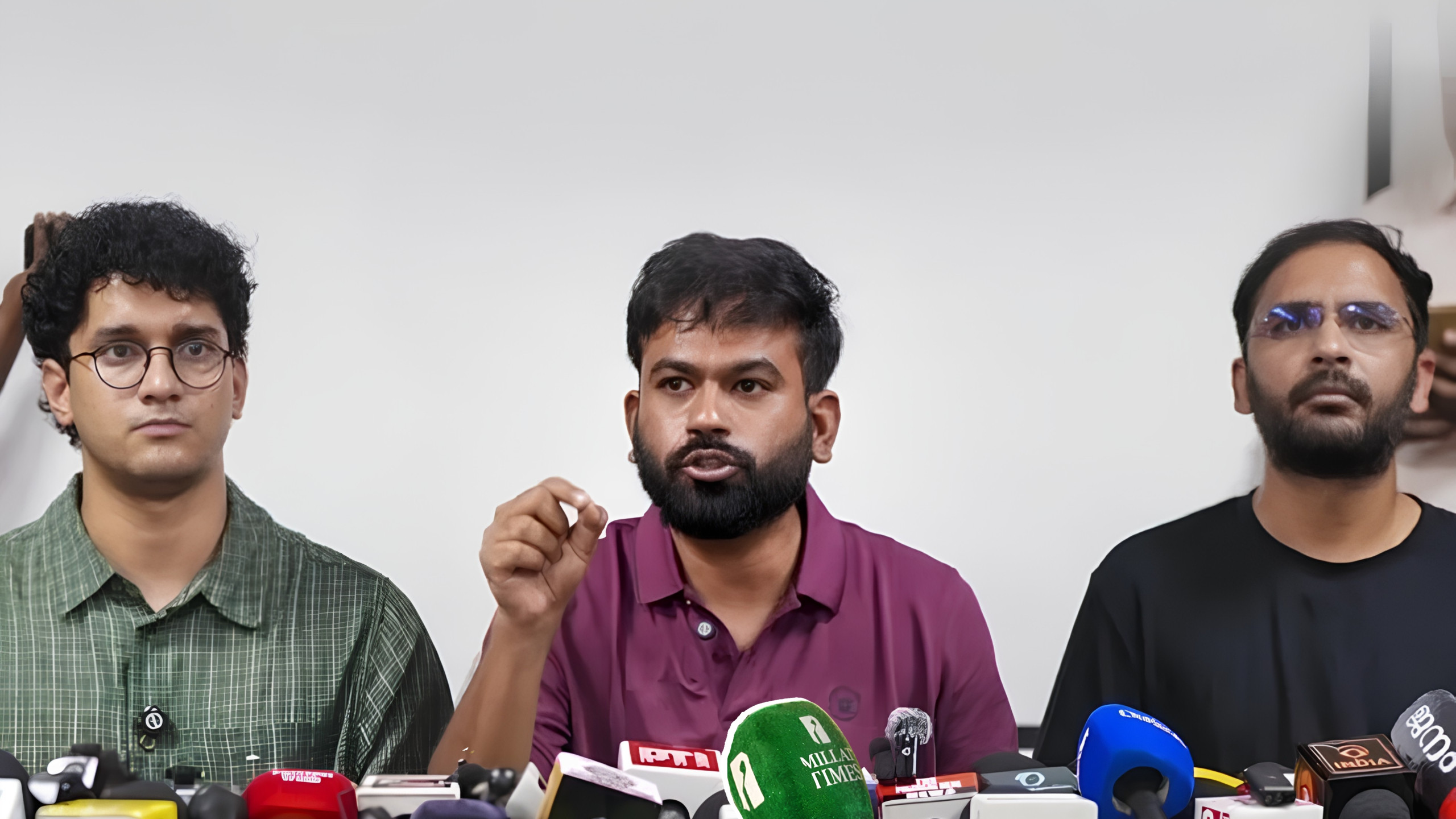




The Cockroach Janta Party (CJP) on Thursday set a 48-hour deadline for Gyanesh Kumar to resign as India’s chief election commissioner, vowing “Jantar Mantar 2” style protests if he did not.
The youth-focused organisation’s threat came after The Indian Express in investigative reports on Wednesday and Thursday blew the lid off two election commissioners’ objections to decisions taken by the Election Commission of India on the nationwide Special Intensive Revision (SIR) of electoral rolls.
“If within 48 hours Gyanesh Kumar doesn’t resign, we will hold a nationwide protest,” CJP founder Abhijeet Dipke said at a press conference. “Right now, Gyanesh Kumar is the biggest anti-national and traitor of the country.”
Dipke was joined by party colleagues Sourav Das and Asutosh Ranka, who discussed The Indian Express’s reports and alleged collusion between the ruling BJP and the ECI.
The CJP made three key demands:
- Removal of Gyanesh Kumar: The CJP has demanded Kumar’s removal and an investigation into alleged violations.
- Halt to upcoming elections: The organisation has called for an immediate pause to upcoming polls and an independent inquiry into the SIR process.
- Reform of the Election Commission: The CJP has demanded a new legal framework to restructure the Election Commission and strengthen public confidence.
CJP also appealed to the Supreme Court to secure the SIR-related records and ensure that the documents remain protected during any investigation.
Dipke accused Kumar of being closely aligned with the ruling BJP and claimed that the party’s electoral performance had improved since Kumar became Chief Election Commissioner. He described Kumar as “the face of the BJP” while making the claim.
CJP team also raised concerns about the deletion and addition of names in electoral rolls.
According to CJP, large-scale changes to voter lists and complaints regarding the process require an independent examination.
CJP representative Das alleged that the electoral registration process was creating difficulties for young voters seeking to register for the first time.
He particularly raised concerns about Form 6, which is used for adding new voters.
Das said applicants were being asked about whether their parents had been mapped during an earlier SIR exercise.
While the Election Commission has described the question as optional, Das claimed that applicants were effectively being pressured to provide the information.
“They said it was optional but made it mandatory,” Das said, arguing that such a requirement should not be introduced without an appropriate legal amendment.
CJP team also raised concerns about the electoral-roll revision process in West Bengal.
Das claimed that around 60 lakh names were initially removed because of what was described as “logical discrepancy”, including differences in names or problems relating to identity records.
He further claimed that around 33 lakh names were subsequently restored following court intervention.
The organisation questioned how decisions relating to additions and deletions were being implemented and whether adequate independence existed at the local level.
Dipke also alleged that important decisions concerning electoral rolls were being influenced from Delhi rather than being handled independently by local Electoral Registration Officers.
“Delhi remote control is behind addition and deletion,” Dipke said.
The CJP further raised concerns about the use of software and centralised systems in electoral-roll management.
The organisation claimed that, in some cases, even voters who had won appeals faced difficulties getting their names restored.
Ashutosh Ranka said the consequences would go beyond voting.
“If you don’t vote for BJP, you will not get access to government schemes,” Ranka said, while expressing concern over the potential impact of voter-list exclusions.
“Who the hell is Gyanesh Kumar to revoke our right to vote?” Ranka said, calling on political parties and citizens to protest.
The CJP said the issue was not limited to one political party or one election and argued that the integrity of the electoral process was a matter of public concern.
“Take a stand,” Dipke said, urging opposition parties and citizens to join the movement.
Support Independent Media
Click Here and Join the Membership of Millat Times to Support Independent Media.
Support Millat Times