
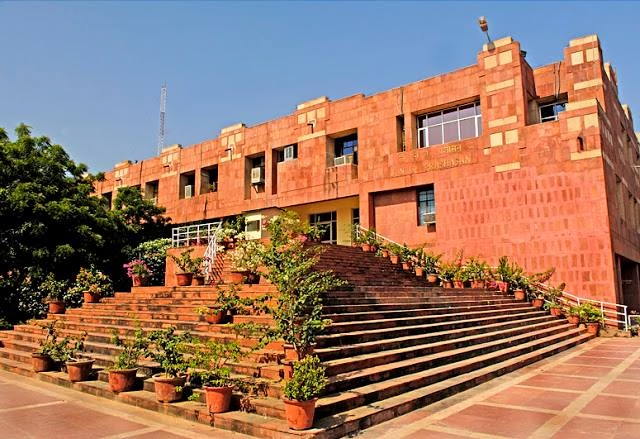



The Jawaharlal Nehru University has withdrawn permission for a book discussion organised by the JNU Students’ Union, citing the alleged non-disclosure of complete details about the programme.
The discussion, centred on Fractured Communities: Adivasi Histories and the Politics of Power, a book authored by former JNU student Umar Khalid, was scheduled at the School of Social Sciences-I auditorium.
The university said on Sunday that the auditorium booking had been cancelled after it found that the “full facts” concerning the programme had not been disclosed.
In a post on X, JNU said the event was scheduled for August 10 from 3 pm to 6 pm and clarified that the permission had been granted by the Dean of the School of Social Sciences, who subsequently cancelled it.
“JNU is a democratic and decentralised institution,” the university said, adding that the auditorium booking stood cancelled because of the alleged non-disclosure of complete details about the programme.
The JNU Students’ Union, however, strongly objected to the decision, describing it as “arbitrary and authoritarian”. It accused the administration of attempting to restrict academic discussion and dissent on campus.
The union claimed that the Dean had himself directed that the auditorium be booked in the format in which the request was submitted, and questioned the administration’s justification for withdrawing the permission.
The JNUSU said the discussion would continue despite the cancellation and announced plans to hold it in the open outside the SSS-II building while also exploring an alternative venue.
The programme has been organised to mark the International Day of the World’s Indigenous Peoples. According to the event poster, professors Prabhu Mahapatra and Uma Chakravarti, writer and artist Shuddhabrata Sengupta, and social activists Harsh Mander and Banojyotsna are among those scheduled to participate.
The union said the book examines Adivasi histories, resistance and struggles over “Jal, Jungle and Jameen”, and argued that discussions around such subjects form an important part of academic and democratic engagement.
It also alleged that the university had adopted “double standards”, claiming that campus space and cooperation had been provided for events organised by ISKCON while the book discussion was denied a venue.
The union further appealed to students, teachers and staff to attend the programme, maintaining that cancellation of the auditorium would not prevent the discussion from taking place.
Khalid, a former JNU student leader, has been in jail since September 2020 under the Unlawful Activities (Prevention) Act in connection with the alleged conspiracy behind the 2020 northeast Delhi riots. His trial is yet to begin.
The communal violence broke out amid protests against the Citizenship (Amendment) Act and the proposed National Register of Citizens. It left 53 people dead and more than 700 injured.
Support Independent Media
Click Here and Join the Membership of Millat Times to Support Independent Media.
Support Millat Times