
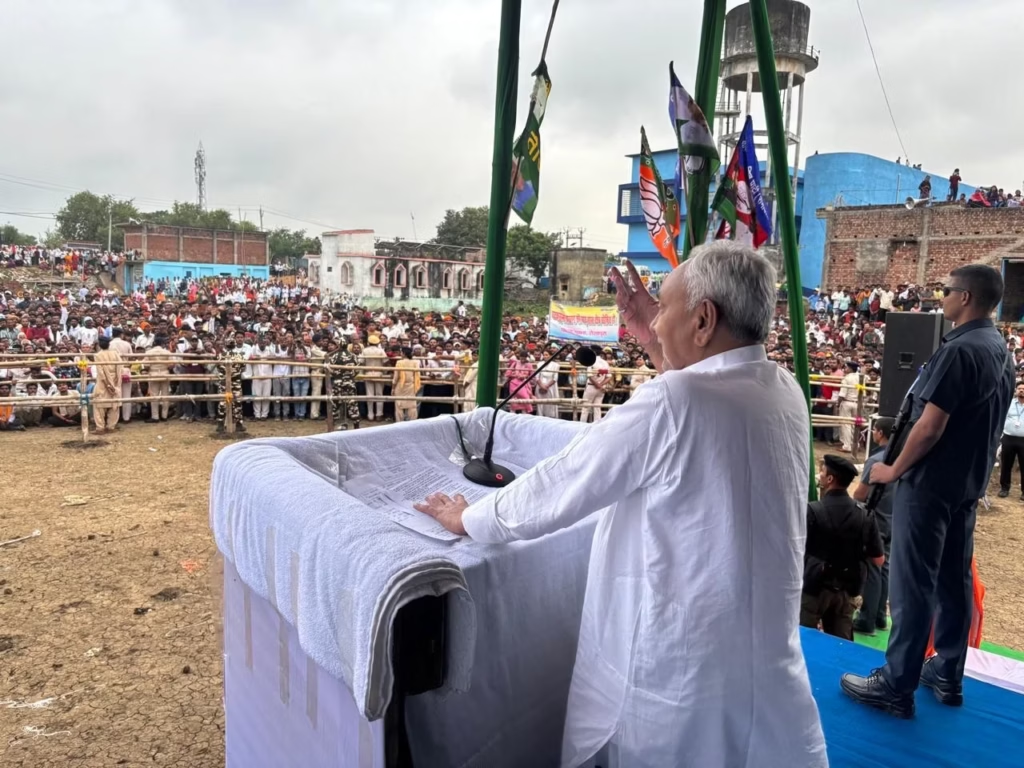

Bihar Chief Minister Nitish Kumar, once hailed as “Sushasan Babu” or the man of good governance, faces one of the toughest elections of his two-decade political career as the state prepares to vote next week.
A new white paper released by the All India Milli Council (AIMC) accuses Kumar’s government of presiding over worsening poverty, endemic corruption, crumbling infrastructure and rising communal tensions, a far cry from the reformist image he built after ending Lalu Prasad Yadav’s “Jungle Raj” in the mid-2000s.
The report comes as Bihar, India’s third-most populous state, heads for assembly elections on November 6 and 11. Results will be announced on November 14.
Political Shifts
Kumar, 74, has served nine terms as chief minister between 2000 and 2025, a tenure spanning 18 years and 90 days. His reputation as a shrewd coalition manager has helped him stay in power despite frequent shifts in alliance between the Bharatiya Janata Party (BJP)-led National Democratic Alliance (NDA) and the opposition Mahagathbandhan led by the Rashtriya Janata Dal (RJD).
But the constant realignments, most recently a return to the NDA in January 2024 after 17 months with the RJD, have earned him the nickname “Palturam,” or turncoat, among both allies and critics.
“He no longer inspires confidence among voters who once saw him as a stabilising figure,” said political analyst Sanjay Kumar of the Centre for the Study of Developing Societies. “Even his administrative strengths have been overshadowed by fatigue and inconsistency.”
The AIMC paper notes a steep decline in Kumar’s popularity among Bihar’s 17.7 percent Muslim population, who once regarded him as a moderate alternative to communal politics. The Janata Dal (United), Kumar’s party, fielded nine Muslim candidates in 2020 but failed to win a single seat. This year, it has nominated only four Muslim candidates out of 101.
Muslim leaders blame Kumar’s endorsement of the Waqf (Amendment) Act 2025, which many see as undermining minority property rights. “This was the final straw,” said AIMC secretary Aftab Alam. “Nitish Kumar can no longer claim to represent Bihar’s inclusive politics.”
Poverty and Corruption
Despite annual claims of progress, Bihar remains India’s poorest state, with 33.76 percent of its population living in multidimensional poverty, according to NITI Aayog’s 2023 review. Rural poverty stands at 36.7 percent compared with 13.6 percent in urban areas, reflecting weak job creation and poor industrial growth. The state has only 3,386 operational factories, about 1.3 percent of India’s total.
Bihar’s labour force participation rate, at 48.8 percent, is among the lowest in the country. “Most people are simply not in the labour market because there are no opportunities,” said economist Prasanna Mohanty, writing in The Federal last month.
Around 30 million Biharis, roughly a quarter of the population, are estimated to work outside the state, mainly in Delhi, Maharashtra and neighbouring states. Analysts warn that this continued out-migration weakens Bihar’s economic base.
In the last two years, at least 18 bridges have collapsed across Bihar, several within weeks of completion. Opposition parties have cited the collapses as evidence of corruption and poor oversight. A bridge worth Rs 12 crore in Araria fell in June 2024, followed by similar incidents in Siwan, East Champaran and Nalanda.
Kumar has ordered investigations but rejected allegations of widespread graft, calling the incidents “isolated engineering failures.”
Crime data from the State Crime Records Bureau shows that overall crime in Bihar rose by 80 percent between 2005 and 2024. In 2023, the state recorded 354,000 cases, keeping Bihar among India’s ten worst-performing states in law enforcement.
Even NDA allies have voiced frustration. “Law and order is a serious concern,” said Chirag Paswan, leader of the Lok Janshakti Party (Ram Vilas). “People must feel safe, and they don’t right now.”
Social Decline
The AIMC report highlights rising communal tensions in the state. Clashes erupted in Nalanda and Sasaram during the 2023 Ram Navami processions, followed by incidents in Bhagalpur, Siwan, Darbhanga and Jamui in 2024. Bihar recorded 65 communal incidents that year, the second-highest in India after Madhya Pradesh.
Violence against women also remains high despite the alcohol ban. The National Commission for Women received 28,811 complaints from Bihar in 2023, among the highest in the country.
Bihar’s education sector is in decline. Government school enrolment dropped by nearly one million students between 2022-23 and 2023-24, while teacher vacancies exceed 250,000. Repeated examination paper leaks, including the BPSC and NEET tests, have eroded public confidence. A leaked “rate chart” allegedly priced NEET-PG papers at up to Rs 80 lakh.
The state’s health infrastructure is also under strain. Forty-five percent of doctor posts, 70 percent of specialist posts and 84 percent of paramedical posts are vacant. Private clinics fill some gaps but remain largely unregulated and expensive.
Despite low inflation, Bihar’s economy shows signs of stress. The state recorded deflation of 0.5 percent in September 2025, one of the lowest rates in India, but analysts say that does not ensure political comfort. “Inflation is not the issue here,” said Moneycontrol’s Adrija Chatterjee. “Jobs and governance are.”
As voters prepare to cast ballots, Nitish Kumar’s image as “Sushasan Babu” appears deeply tarnished. Former finance minister P. Chidambaram, writing in The Indian Express on November 2, called Bihar “a failed state,” arguing that the 2025 election “is not about the 1990s but about Mr. Nitish Kumar and his 20 years of governance.”
Whether Kumar can defy anti-incumbency once again remains uncertain. What is clear is that Bihar’s voters, long promised stability and progress, must now decide whether the promise of good governance still holds any meaning.