
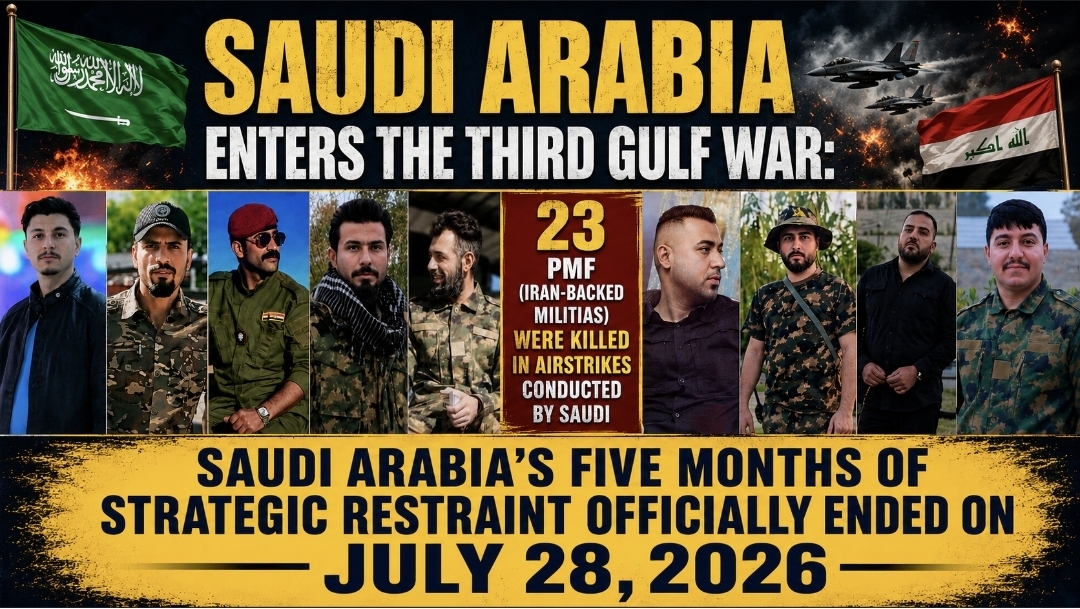




Following the joint U.S.-Israel war on Iran which resulted in the death of Iran’s Supreme Leader, the Kingdom of Saudi Arabia has now joined U.S. airstrikes against Iran-backed militias. Finally, it marked the end of Saudi Arabia’s five months of strategic restraint policy.
Initially, Saudi Arabia sought to avoid being drawn into a wider ongoing regional war. Riyadh maintained open channels of communication with Tehran and exercised strategic restraint despite repeated drone and missile attacks allegedly carried out by Iran-backed militias against Saudi oil facilities.
Saudi Arabia had shown significant restraint for a long time. The policy of strategic patience was built on a calculated, long-term approach that prioritized diplomacy, economic stability, and calibrated restraint over immediate military escalation.
However, recent cross-border and maritime attacks have pushed this restraint to its limits, prompting Riyadh to signal a shift toward active deterrence.
Earlier this month, the Houthis (Yemen based Iran backed militias) accused Saudi Arabia of bombing Sanaa International Airport to prevent a direct flight from Tehran from landing after warnings to divert were ignored. The aircraft was carrying a Houthi delegation returning from the funeral of Iran’s former Supreme Leader, Ali Khamenei. However, Saudi officials feared the aircraft may also have been transporting ammunition cargo, further escalating tensions.
According to Saudi officials, multiple drones launched from Iraqi territory by Iran-aligned militias targeted petroleum facilities in Saudi Arabia’s Eastern Province and the Riyadh region. Saudi air defences intercepted and destroyed the drones, but the attacks marked another serious escalation. The assault led officials to conclude that “all red lines had been crossed,” while regional sources reported that anti-Houthi Yemeni forces were assembling in eastern Yemen and could receive Saudi air support if the conflict expanded.
On Wednesday, 29 July 2026, invoking its right of self-defence under Article 51 of the United Nations Charter, Saudi Arabia announced that, in coordination with U.S. Central Command (CENTCOM), it had conducted precise and targeted airstrikes on 29 July 2026 against Iran-backed militia targets inside Iraq. It launched strikes against headquarters and military sites belonging to the Iran-backed Popular Mobilization Forces (PMF/Hashd al-Shaabi) in Ninveh, Basra & Babil killing atleast 23 members of PMF (an IRGC proxy).
The joint strikes with the US against Tehran-backed paramilitaries mark Riyadh’s first publicly declared participation in joint military operations alongside Washington since the Iran hostilities erupted. It symbolises a significant shift in Saudi Arabia’s regional security policy.
According to the Saudi Ministry of Defence, the operation targeted militia headquarters, weapons depots and military infrastructure linked to attacks on Saudi petroleum infrastructure.
According to PMF officials, the attacks hit positions in Basra, Wasit, Nineveh, Babil, Baghdad, Kirkuk, Karbala, and Diyala, targeting headquarters, weapons depots, and logistics facilities. Preliminary reports say at least 20 PMF fighters were killed, with dozens more injured.
Influential Iraqi Shiite cleric and leader of the Sadrist Movement, Muqtada al-Sadr condemned what he described as the “shameless actions of rogue militias” attempting to drag Iraq into a pointless war. He has called on Iran’s Islamic Revolutionary Guard Corps (IRGC) to avoid military actions inside Iraq, while urging Iraqi armed factions not to give foreign powers a reason to target the country.
Al-Sadr posted a strongly worded statement on the social media platform X, saying: “Rogue militias must not give our brothers in the Gulf states a pretext to target our sacred land.” He urged all sides not to “be drawn into the schemes of the Zionist-American enemy to incite brothers to fight and kill one another.” “Iraq and its people need peace,” al-Sadr added, calling for a region free from foreign military bases and colonial domination.
Saudi Arabia maintains that it does not seek escalation, but insists it will respond decisively to any attack threatening its national security.
The operation marks Riyadh’s first publicly acknowledged participation in joint military operations with the United States since the current Iran-related hostilities began, signalling a major shift in Saudi Arabia’s regional security posture and raising fears of a broader regional conflict.
Md Irshad Ayub is Founding English editor at millat times and Delhi-based freelance journalist
Support Independent Media
Click Here and Join the Membership of Millat Times to Support Independent Media.
Support Millat Times