
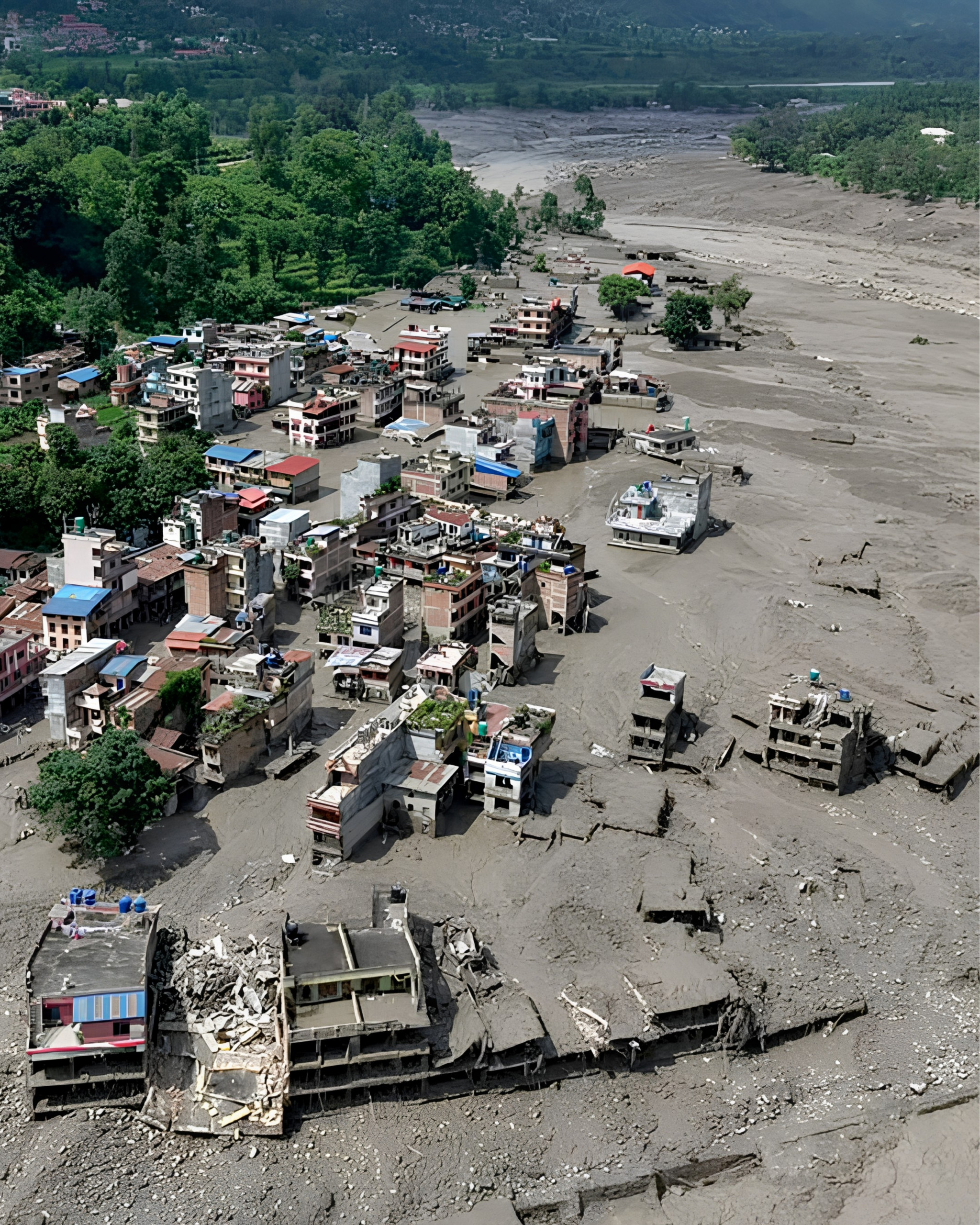




Death toll from last week’s catastrophic flash floods in central Nepal has climbed to 734, authorities said Sunday, as rescue teams continued recovering bodies five days after a glacial collapse near the Nepal-Tibet border unleashed a wall of water, mud and rock across the region.
Nepal’s National Disaster Risk Reduction and Management Authority said bodies have now been pulled from all eight affected districts, even as nearly 2,500 people remain unaccounted for. Chitwan district has borne the heaviest toll, with 259 confirmed deaths, followed by 184 in Nawalparasi East, 82 in Nawalparasi West and 58 in Gorkha, according to official figures. The remaining affected districts, Rasuwa, Nuwakot, Dhading and Tanahun, have also reported casualties as search operations continue.
The disaster began early Wednesday when an ice-and-rock avalanche, triggered by a glacial collapse near Langtang Lirung close to the Chinese border, sent a massive debris flow down the Trishuli River corridor. Scientists say the collapse was powerful enough to register as a magnitude-5.2 tremor on seismometers worldwide. The resulting torrent tore through towns and villages across roughly 70 kilometres, destroyed bridges and roads, and swept away several hydropower stations before crossing into Tibet, where it flattened the Gyirong Port complex, a key trade and tourism crossing between the two countries. Some victims’ remains have reportedly been swept as far as 240 kilometres downstream into India.
On the Chinese side, officials in Tibet’s Gyirong County have confirmed 16 deaths and said 546 people remain missing, though no new survivors have been located there in recent days.
One of the most urgent fronts in the rescue effort involves Nepal’s hydropower sector, which was hit hard by the flood. Industry figures suggest close to 900 workers linked to hydropower projects along the Trishuli corridor were initially unaccounted for, with several hundred rescued so far. Attention has focused on the Trishuli-3 “A” project in Rasuwa district, where more than 100 workers are believed to remain trapped inside a mud-clogged tunnel. Soldiers and rescue crews have been pumping air into the tunnel and clearing its entrance with excavators, and Nepal has brought in tunnel-rescue specialists from India and China to assist.
With the search entering its fifth day, hopes of finding more survivors are fading even as helicopters and ground teams continue combing debris fields for the missing. The government has also warned communities downstream to remain alert, citing concern about further flooding risk from unstable debris and blocked waterways in the affected valleys.
Nepal’s mountainous terrain and monsoon climate make it prone to flash floods and landslides most years, but this week’s disaster, triggered by a high-altitude glacial collapse rather than rainfall alone, ranks among the most destructive in the country’s modern history, both in its death toll and the scale of infrastructure lost. Combined with the toll in Tibet, more than 750 people are confirmed dead and well over 3,000 remain missing across both countries.
Watch the full video below:
Support Independent Media
Click Here and Join the Membership of Millat Times to Support Independent Media.
Support Millat Times