


Follow Millat Times for independent journalism.
Opens the app if installed, or Google Play to download it.By Shams Tabrez Qasmi
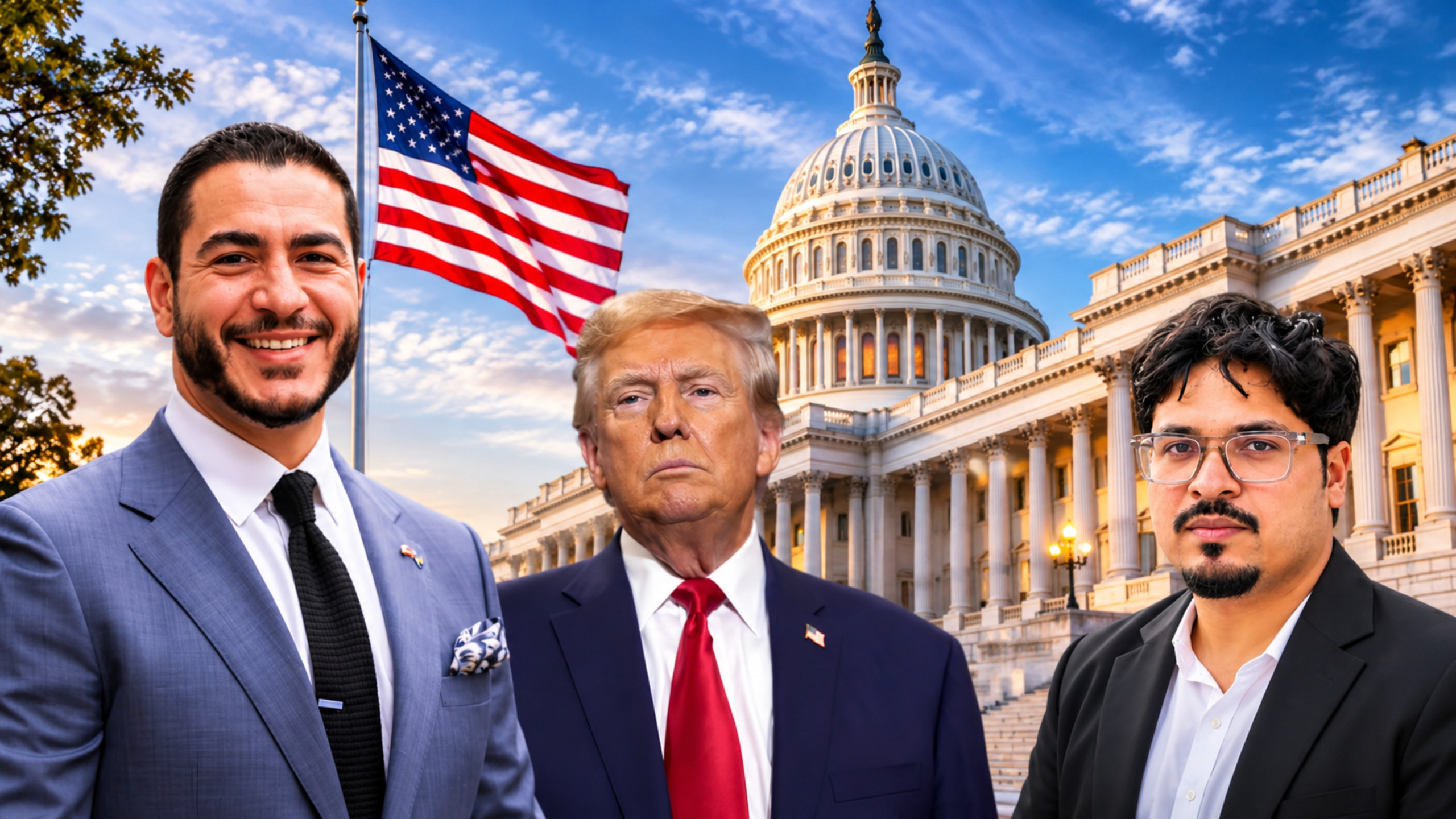
When Abdul El-Sayed stood before his supporters in Michigan after winning the US Senate election, he was not celebrating an ordinary political victory. He had become the first Muslim ever elected to the United States Senate. Thousands of miles away, another Muslim American, Dr Adam Hamawy, was preparing to enter Congress after a political journey shaped by his experiences treating patients in war-torn Gaza.
Their victories were part of a much larger story. Across the United States, Muslim candidates won elections at federal, state and local levels, breaking records and expanding their presence in American political institutions.
According to preliminary figures released by the Council on American-Islamic Relations (CAIR), at least 97 Muslim candidates won elections or re-election in the November 3, 2026, midterms. They secured positions across 21 states, including 38 state legislative victories. The number is 15 higher than the 82 victories recorded in the 2022 midterms, an increase of approximately 18 per cent.
This is not simply a story about Muslims winning elections. It is about a community increasingly transforming its political participation into representation, influence and a voice in decisions that affect millions of people.
A record-breaking political moment
The 2026 midterms have produced an important milestone in the history of Muslim representation in America. CAIR tracked 168 Muslim candidates who made it through their primaries and contested federal, state and local offices. Of these, 97 had confirmed victories in its preliminary count, while 15 were leading in races still being counted and six were in contests too close to call.
The confirmed victories were spread across different levels of government, from Congress and state legislatures to courts, city councils and school boards.
The figures tell a story of political participation that extends far beyond a handful of prominent names.
The numbers behind the victories
The preliminary CAIR tally provides a picture of how widely Muslim candidates have succeeded across American political institutions.
| Level of representation | Muslim winners |
| US Congress | 7 confirmed |
| Statewide and state legislative offices | 39 |
| Judicial positions | 8 |
| County and municipal offices | 16 |
| Education and school boards | 27 |
| Total | 97 |
The seven confirmed congressional victories include one Senate seat and six House seats. Aisha Wahab also declared victory in California’s 14th Congressional District, although CAIR listed her final result as pending at the time of its preliminary report.
From Michigan to New Jersey: historic victories
Abdul El-Sayed’s victory in Michigan stands out as one of the defining moments of this election. A physician and former public health official, he defeated Republican Mike Rogers to become the first Muslim member of the US Senate.
His campaign focused on healthcare, the cost of living, working families and corporate influence. He also criticised unconditional American military support for Israel and described its military actions in Gaza as genocide.
His religious identity became a target during the campaign. Nevertheless, voters elected him to one of the most powerful legislative institutions in the world. His victory challenges the assumption that a Muslim candidate must distance himself from his identity or remain silent on Palestine to become electorally acceptable.
Another remarkable victory came from New Jersey, where Dr Adam Hamawy won the 12th Congressional District.
Hamawy’s story is particularly significant because his political journey was shaped by his medical work in Gaza. An Egyptian-American surgeon, former US Army combat physician and Iraq War veteran, he volunteered at Gaza’s European Hospital in 2024 and undertook further medical missions in 2025.
His experiences in Gaza changed his understanding of politics. He entered the election campaign with a message of “healthcare not bombs”, highlighting the contradiction between funding military operations abroad and the healthcare and financial struggles faced by ordinary Americans at home.
His victory means he will become the first Muslim elected to represent New Jersey in Congress. More importantly, he will enter the same institution that plays a central role in determining American foreign policy and military assistance.
The presence of a doctor who has witnessed Gaza’s humanitarian suffering firsthand in the US Congress carries a significance that goes beyond party politics.
Muslim women are also changing the political landscape
The victories were not limited to Muslim men. Muslim women also strengthened their presence in American politics.
Darializa Avila Chevalier won New York’s 13th Congressional District, becoming the first Latina Muslim elected to Congress. A civil rights investigator and doctoral student, she had previously defeated longtime incumbent Adriano Espaillat in the Democratic primary.
Nabeela Syed won an Illinois State Senate seat in District 26, flipping a previously Republican-held constituency. Her victory is another important example of Muslim women gaining political influence at the state level.
Other women also secured victories across the country. Iman Jodeh won in Colorado, Maryam Khan in Connecticut, Madinah Wilson-Anton in Delaware, Zaynab Mohamed in Minnesota and Munira Abdullahi in Ohio.
These victories matter because representation is not only about religious identity. It is also about gender, background, political experience and the ability of communities to participate in institutions where decisions are made.
Where did Muslim candidates win?
The victories were spread across the country rather than concentrated in one state.
Michigan recorded major gains, including El-Sayed’s Senate victory, Rashida Tlaib’s re-election and several state-level wins. New Jersey elected Hamawy to Congress and saw victories in local government. New York elected Chevalier to the House, while Illinois elected Nabeela Syed to its State Senate.
Other notable victories came from Minnesota, Ohio, Connecticut, Colorado, Pennsylvania, Texas, Georgia, Oregon and North Carolina.
Among the elected officials were Ilhan Omar in Minnesota, André Carson in Indiana, Lateefah Simon in California, and Rashida Tlaib in Michigan, all of whom retained their congressional seats.
The geographical spread matters. It demonstrates that Muslim political participation is no longer limited to a few urban constituencies or communities with large Muslim populations.
The 2022 record has been surpassed
Muslim electoral victories: 2022 vs 2026
Historic growth in Muslim representation across the United States
Source: CAIR, November 5, 2026. 2026 count is preliminary.
Where did Muslim candidates win?
Distribution of 97 confirmed electoral victories
Source: CAIR and CAIR Action, November 5, 2026.
The 2026 results are particularly significant when compared with the previous midterm elections.
In 2022, CAIR recorded 82 Muslim electoral victories nationwide. The preliminary 2026 figure of 97 has surpassed that record by 15 victories.
This makes 2026 the strongest midterm election cycle for Muslim representation in CAIR’s tracking.
The increase is not merely statistical. It reflects years of political organising, voter registration, community engagement and the willingness of more Muslim Americans to contest elections.
The question India must ask itself
There is another aspect of these victories that deserves attention, particularly in India.
When Hindu candidates or Indian-origin personalities achieve electoral success abroad, sections of Indian media and social media often celebrate their achievements with considerable enthusiasm. Their victories are presented as moments of pride, identity and international recognition.
But when Muslim candidates achieve something equally historic, where is the same enthusiasm?
Abdul El-Sayed has become the first Muslim elected to the US Senate. Darializa Avila Chevalier has made history as the first Latina Muslim elected to Congress. Nabeela Syed has won a state Senate seat, while Dr Adam Hamawy has entered Congress after working in Gaza’s hospitals.
These are achievements that deserve recognition regardless of political ideology or nationality.
It would be inaccurate to claim that nobody in India celebrated these victories. Some individuals and platforms have certainly acknowledged them. But the larger question is whether Muslim achievements receive the same public attention and pride as achievements associated with other religious identities.
If a Hindu candidate’s victory is celebrated primarily because of religious identity, while a Muslim candidate’s historic achievement is ignored for the same reason, that is not equal recognition. It is selective celebration.
The problem is not that one community receives appreciation. Every community deserves to celebrate its achievements. The problem begins when recognition becomes conditional on religion.
Indian Muslims, who often face questions about political representation, citizenship and belonging, have particular reason to pay attention to these developments. The American experience offers an important reminder that political participation, organisation and democratic engagement can create opportunities even in societies where prejudice remains present.
A lesson beyond American politics
The 2026 midterms do not mean that Islamophobia has disappeared from American politics. Several Muslim candidates faced attacks and scrutiny over their religious identities. El-Sayed and Hamawy both experienced anti-Muslim rhetoric during their campaigns.
Yet their victories demonstrate that prejudice does not automatically determine electoral outcomes. Voters can look beyond religious identity and evaluate candidates on their policies, public service and ability to represent their constituencies.
The success of Muslim candidates should therefore not be understood as a victory for one religion over another. It is a victory for democratic participation and the principle that citizens should have an equal opportunity to seek public office.
For India, the lesson is equally important. A person’s achievement should not become less significant because of their religion. If democracy is truly about equal citizenship, then political success must be recognised on equal terms.
The journey from Gaza’s hospitals to the halls of Congress, and from Michigan’s political debates to the US Senate, tells a powerful story. Muslim Americans are no longer simply demanding a place in the political conversation. They are increasingly occupying the seats where decisions are made.
And perhaps the most important question is not how many Muslims won in America, but why their victories still need to be explained, defended and sometimes fought to receive the recognition they deserve.
Support Independent Media
Click Here and Join the Membership of Millat Times to Support Independent Media.
Support Millat Times