
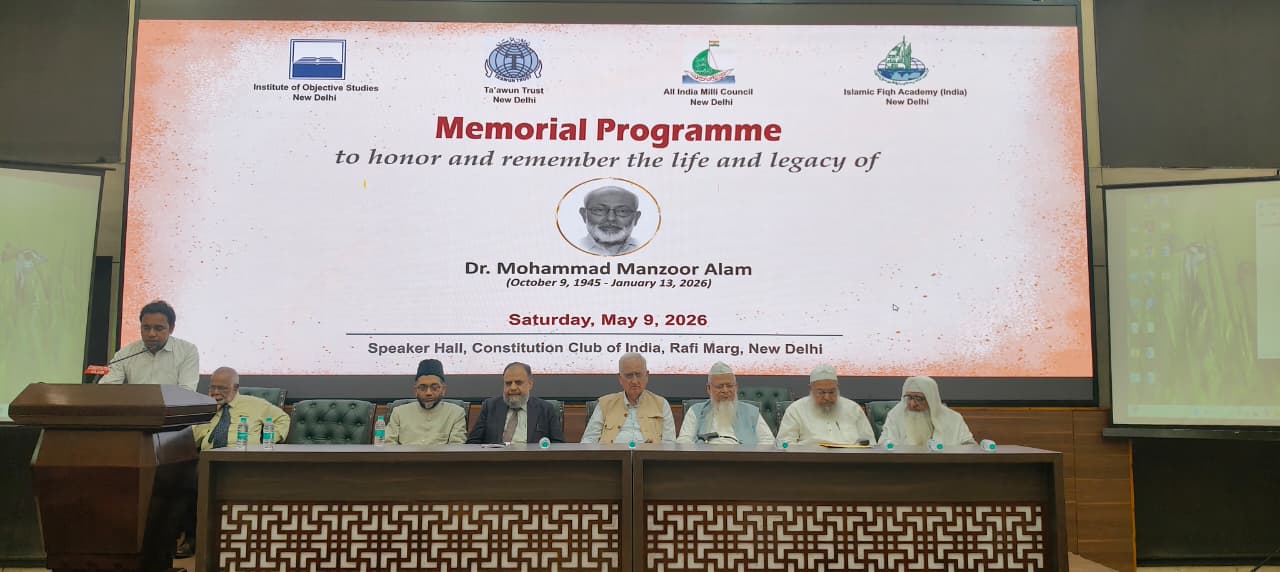




Academics, politicians and Muslim community leaders from India and abroad gathered in New Delhi on Saturday to remember the life and work of Dr Manzoor Alam, a noted scholar and former leader of the Institute of Objective Studies (IOS) and the All India Milli Council, praising his contributions to education, interfaith dialogue and minority rights.
The memorial programme, held at the Constitution Club of India, drew participants from across academic, religious and political circles, many of whom described Alam as a bridge-builder who combined intellectual engagement with social activism.
Dr Alam, who served as patron-in-chief of the Institute of Objective Studies and general secretary of the All India Milli Council, was widely known for his work on education, Muslim social reform and policy advocacy. Speakers at the event said his ideas and institutional initiatives continued to shape public discourse on minority welfare and national integration.
Professor Dawood A. Yahya Al-Hidabi of the International Islamic University Malaysia said Alam had worked to address educational backwardness among Muslims while promoting interfaith understanding and social cohesion.
“He believed in combining Islamic scholarship with social sciences and worked consistently for social justice,” Al-Hidabi said.
Professor Jasser Auda, president of Maqasid Institute Global in the United States, said Alam’s intellectual influence extended beyond India. He credited him with encouraging research in Islamic economics and waqf studies and supporting projects aimed at making Islamic scholarship accessible to English-speaking students.
Jamaat-e-Islami Hind president Syed Sadatullah Husaini described Alam as a strong advocate of research-based policymaking and institution-building.
“He encouraged dialogue among people with differing viewpoints and believed social reform must be rooted in serious intellectual work,” Husaini said.
Former external affairs minister Salman Khurshid said Alam remained deeply concerned about India’s social harmony and future direction. He said Alam contributed to discussions around minority welfare, including debates linked to the Sachar Committee, which studied the socio-economic condition of Muslims in India.
“His unfinished work remains relevant even today,” Khurshid said.

Islamic scholar Maulana Khalilur Rahman Sajjad Nomani said Alam valued cooperation across ideological and institutional lines and maintained a balanced approach on religious and social issues.
Professor Emeritus Akhtarul Wasey of Jamia Millia Islamia said Alam played an important role in establishing IOS as a major intellectual platform that brought together scholars and thinkers from different backgrounds.
Senior Congress leader Mani Shankar Aiyar described Alam as someone committed to public service and dialogue. Journalist and social activist John Dayal said Alam consistently worked towards communal harmony and inclusive engagement with different communities.
Several speakers joined online from abroad, including Dr Abdullah Al-Luhaidan from Saudi Arabia’s Ministry of Education, who said Alam’s initiatives had influence across South Asia and the Middle East.
Others who addressed the gathering included Maulana Anisur Rahman Qasmi, Maulana Fazlur Rahim Mujaddidi, Dr Mohammad Afzal Wani, Professor Omar Hasan Kasule, journalist Iqbal Ahmed, political analyst Piyush Babele and former parliamentarian Mohammad Salim.
The nearly four-hour event concluded with prayers led by Maulana Anisur Rahman Qasmi. Organisers said the programme aimed not only to honour Alam’s memory but also to encourage younger generations to continue his work in education, social reform and community dialogue.
Support Independent Media
Click Here and Join the Membership of Millat Times to Support Independent Media.
Support Millat Times