
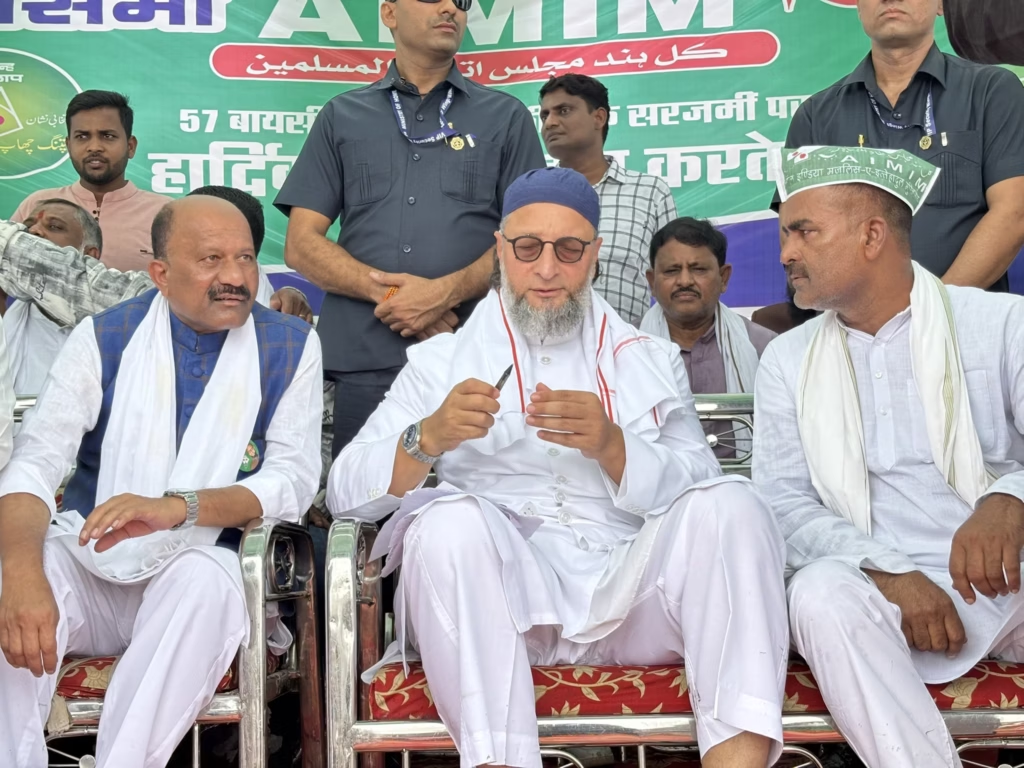

In a wide-ranging exclusive interview with Millat Times, All India Majlis-e-Ittehadul Muslimeen (AIMIM) president and Hyderabad MP Asaduddin Owaisi launched a scathing critique of India’s mainstream political parties, accusing them of “using Muslims as a vote bank” while denying them leadership and development.
Speaking to journalist Shams Tabrez Qasmi in Kishanganj, Owaisi defended his party’s expanding presence in Bihar, reiterated his independence from both the BJP and the Congress-led INDIA bloc, and made a passionate appeal for the rise of “authentic Muslim political leadership.”
Owaisi began by emphasizing that AIMIM’s political project in Bihar is rooted in the demand for dignity and self-representation for marginalized Muslims. “We are fighting elections on 24 seats in alliance with Chandra Shekhar Azad’s party and Swami Prasad Maurya. Inshallah, we will perform well,” he said.
Rejecting criticism that his alliances never last beyond elections, Owaisi asserted that AIMIM has never broken any partnership. “Our alliances end not because of us. Ask anyone who left, who betrayed whom?” he remarked pointedly.
He dismissed accusations that his party acts as the BJP’s “B-team,” calling such labels “a convenient fraud” propagated by his opponents. “This is a lie repeated to keep Muslims tied to traditional parties. We are not here to do poetry or attend iftar parties. We are here to fight politically,” Owaisi declared.
Owaisi reserved particular criticism for the Rashtriya Janata Dal (RJD) and its leader Tejashwi Yadav, accusing them of hypocrisy over alliances. “Tejashwi says AIMIM should not fight in Bihar because we don’t fight in Hyderabad. Then why does Congress fight in Delhi or Maharashtra? Who stops them from contesting in Hyderabad?” he asked.
He revealed that AIMIM had written to all major parties in the INDIA bloc, including Congress president Mallikarjun Kharge, CPI, CPM, and RJD, seeking inclusion, but never received a reply. “We wanted unity against communal forces, but they ignored us. What can we do? We won five seats last time. Still, they treat us as outsiders,” he said.
When asked whether AIMIM would support either Nitish Kumar or Tejashwi Yadav as chief minister, Owaisi quipped: “If there is no marriage, how can we hold a reception? Let the results come first.”
Pressed further, he made his preference clear: “Why shouldn’t Bihar have a Muslim Chief Minister? Muslims are the largest social group. What’s wrong in demanding political representation?”
Citing data compiled by AIMIM researchers, Owaisi painted a grim picture of Muslim deprivation in Bihar. “There is only one community earning less than their grandfathers, the Muslims,” he said. He accused successive governments, whether led by Nitish Kumar, Lalu Prasad Yadav, or Congress, of neglecting Muslim areas like Simanchal.
“Fifty percent of Muslim children in Kishanganj are underweight, 90 percent of Muslim women deliver at home, and 45 percent of Muslims live below the poverty line. Migration is the highest under Nitish Kumar’s government. These are facts, not emotions,” Owaisi asserted.
On Development and Promises
Asked what tangible change AIMIM has brought to Simanchal since winning five seats in 2020, Owaisi admitted that development remained poor but blamed state neglect. “Development has halted here, education, flood control, agriculture, all are ignored. Tejashwi was Deputy Chief Minister twice. What did he do for Kishanganj?”
To critics who claim he has not delivered on promises like building schools and colleges, Owaisi cited his Hyderabad model: “Majlis started from one municipal seat in 1960. After decades of hard work, we opened a medical college in 1984. Give us time. Leadership takes years to build. Once we have political power here, development will follow.”
Responding to claims that AIMIM sidelines religious scholars, Owaisi bristled. “This is nonsense. We respect Ulema. We have given tickets to religious scholars like Mufti Ismail. Those spreading such lies are the ones who never gave representation to Ulema themselves,” he countered.
Owaisi distinguished between religious and political leadership, emphasizing the need for both: “We have respected religious leaders of every sect. But the crisis is in political leadership. Muslims have religious guidance, but who will represent them politically? That’s what AIMIM is building.”
He urged Muslim scholars and community leaders to contest elections directly rather than remaining “on the sidelines.” “Leading prayers is easier than leading a people politically,” he said. “It’s difficult work, but we must do it.”
The interview also veered into international affairs. Asked about India’s ties with the U.S. and Pakistan, Owaisi blamed the Modi government’s “confused diplomacy.” “The Prime Minister is not even meeting world leaders. He didn’t attend the UN or ASEAN summits. What is he afraid of?” Owaisi asked.
Commenting on the recent visit of the Taliban’s foreign minister to India, Owaisi recalled his own earlier statements urging engagement with Afghanistan. “We always said India should maintain dialogue with Afghanistan. Now, when Jaishankar meets the Taliban foreign minister, will they arrest him too?” he asked sarcastically.
Owaisi also spoke about the controversial Waqf Amendment Act and the use of the UAPA law. “We opposed UAPA from the beginning. I warned it would be used against Muslims and Dalits, and that is exactly what happened,” he said.
Regarding the new requirement to register Waqf properties on the government’s ‘Umeed’ portal, Owaisi called it a legal compulsion but said AIMIM was pursuing remedies in the Supreme Court. “We have filed petitions. The matter is before a constitutional bench,” he explained.
Throughout the interview, Owaisi returned to one central theme: political self-reliance. “You have tried everyone since 1947. What have you got? The time has come to build our own leadership, whether at the level of village panchayat, assembly, or parliament,” he said.
Rejecting token gestures of secularism, he remarked bitterly, “Every five years they visit dargahs, put shawls, and attend iftar dinners. But when it comes to power-sharing, Muslims are invisible.”
Ending on an optimistic note, Owaisi said AIMIM’s mission was not limited to electoral politics but about restoring confidence among marginalized Muslims. “We are not here for seminars. We are here to fight for justice and representation. If Allah wills, the people of Simanchal will make history again,” he said, his voice rising above the noise of the campaign crowd outside.
As Bihar heads toward another crucial election, Owaisi’s words capture the discontent simmering within Muslim constituencies and his ambition to transform that frustration into a lasting political force.