
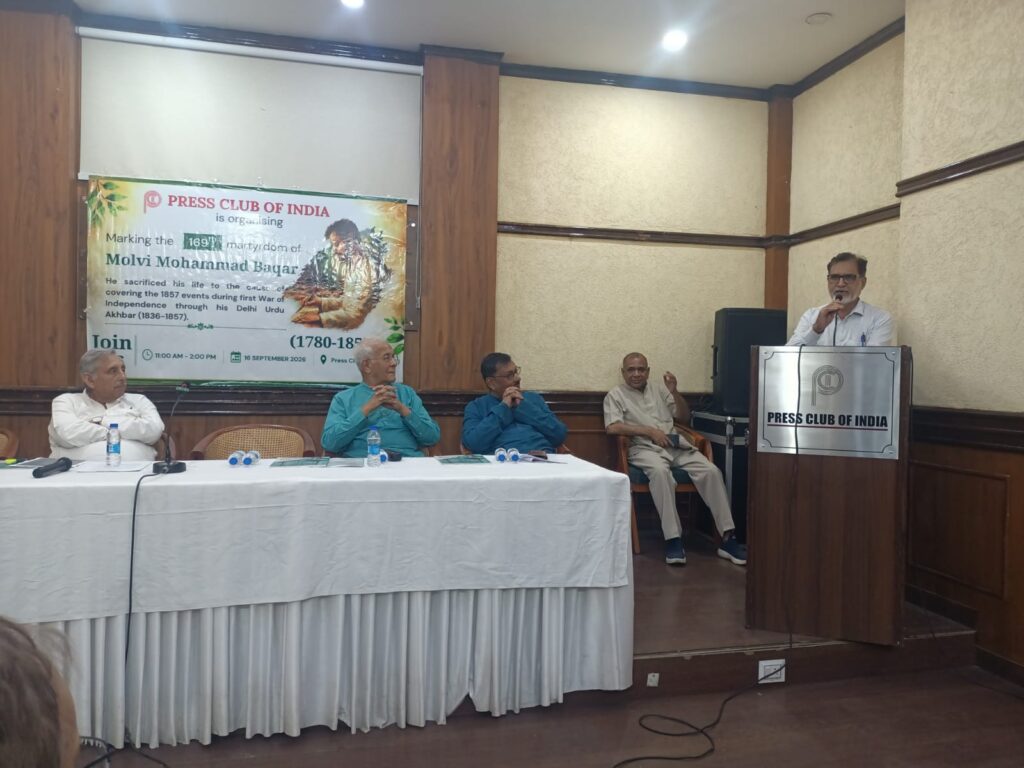




The Press Club of India on Wednesday organised a special programme to mark the 169th martyrdom anniversary of Maulvi Muhammad Baqar, one of the pioneers of Indian journalism. Baqar was martyred on September 16, 1857, outside Delhi’s historic Delhi Gate during the uprising against British rule.
Journalists, former public officials and senior personalities gathered to reflect on Baqar’s contributions to journalism, nationalism and communal harmony, while drawing connections between his legacy and present-day challenges to press freedom, transparency and citizens’ access to information. The programme was moderated by senior journalist A.U. Asif.
Former Chief Information Commissioner Wajahat Habibullah spoke about the continuing relevance of the Right to Information (RTI) Act.
“Many people today feel that RTI has lost much of the power it once had, but despite the amendments and the attempts to narrow its reach, this law remains one of our most powerful democratic instruments,” he said.
He argued that the original purpose of RTI was to enable ordinary citizens to question public authorities and hold them accountable, describing it as “a practical mechanism through which citizens could actually exercise their democratic rights.”
Recalling debates from the Rajiv Gandhi era, Habibullah said there had long been an uneasy recognition that “India could call itself one of the world’s largest democracies, and yet the benefits of that democracy did not always reach the poorest and most marginalised citizens.”
“The amendments should not make us conclude that RTI has become irrelevant,” he added. “What we need is to understand the power that still remains within this law and use it.”
Former Union Minister Mani Shankar Aiyar spoke about Baqar’s role as an editor, field reporter and nationalist journalist.
“Baqar did not sit behind an editorial desk,” Aiyar said. “He walked the streets and lanes of Delhi himself to witness events, and he did this despite the real dangers of that time.”
Aiyar traced an evolution in Baqar’s idea of nationalism, from writings that carried religious references in his early career to a broader, unifying vision as he came to believe that resistance to British rule demanded unity across India’s religious communities.
“His newspaper began carrying references to Ram and Krishna alongside the Quran, to the Ramayan alongside Tulsidas and the Ganga,” he said. “That was a wider, more inclusive idea of Indian nationalism.”
He said Baqar’s courage as both an editor and field reporter “deserves far greater recognition in the history of Indian journalism.”
Gautam Lahiri, President of the Federation of Press Clubs of India, spoke about efforts to preserve Baqar’s memory and organise journalists nationally.
“In 2016, we could not even find a photograph of Baqar,” Lahiri recalled. “That is when we had a small statue made in his memory, and journalists have gathered to commemorate him every year since.”
He called for greater inclusion of Urdu journalists within the Press Club of India.
“Urdu is an Indian language,” he said. “Our magazine, Scribes, publishes in English, Hindi and Urdu, and Urdu journalists deserve representation on the Managing Committee as well.”
Lahiri also spoke about collective efforts to respond to threats to press freedom.
“We have submitted a memorandum opposing the proposed amendments to the Digital Act, and it has the backing of 22 Press Clubs,” he said, adding that eight Press Clubs were working towards a national federation grounded in Article 19(1)(a) of the Constitution.
“This federation will also build a legal framework to stand by journalists facing attacks or arrest anywhere in the country,” he said, describing it as a continuation of the tradition Baqar represents.
Sangeeta Barooah Pisharoty, President of the Press Club of India, spoke about the need to rediscover lesser-known chapters of the 1857 uprising.

“I have lived in Delhi for more than three decades, and yet I only learned of several of these histories and locations recently, through photographs and archival records,” she said.
Calling journalists “daily historians,” she said they “record the language, the atmosphere, and the events of their own times,” adding that archives must be studied not only to understand the past but also “to identify who was responsible for violence and to preserve the memory of victims.”
Referring to Captain William Hodson’s role during the 1857 uprising, including the killing of Mughal princes, she said questions of historical responsibility remain connected to present-day concerns about transparency, including RTI.
“Attacks on journalists and the free press are not new,” she said, calling for wider documentation and greater public awareness of India’s journalistic heritage.
Syed Khalique Ahmed, Chief Editor of India Tomorrow (indiatomorrow.net), argued that Indian historians have failed to give Baqar his due.
“Baqar was a pioneer of investigative and on-the-spot journalism,” he said, contrasting him with James Augustus Hicky, generally credited as founder of India’s first newspaper. “Hicky criticised the colonial government, but Baqar went further, using journalism itself to challenge British rule and support the demand for freedom. He was the first journalist in India to be martyred for his professional and political convictions.”
Ahmed called on historians to “revise journalism textbooks and include a dedicated chapter on Baqar” and urged that research on him be translated into English, Hindi and other Indian languages “so his story reaches journalists, students and readers across the country.”
He noted that Urdu journalism was once a mainstream medium read across communities and said its decline was tied to a broader weakening of original, investigative reporting. “Lack of resources alone doesn’t explain it,” he said, calling on journalism schools and media colleges to include Baqar’s life and work in their curricula.
Shams Tabrez Qasmi, editor-in-chief of Millat Times, paid tribute to Baqar’s enduring influence on the profession.
“Baqar Sahab gave a new direction to journalism; we ought to learn from him and embrace his style of journalism,” he said. “I admire him and hope that he, and the sacrifices he made, will be remembered in the future,” he said.
The programme placed Maulvi Muhammad Baqar’s martyrdom in the broader context of journalism and its responsibilities to society. Speakers highlighted his practice of reporting events from the ground, documenting developments and advocating an inclusive vision of nationalism, saying these aspects of his work continue to hold relevance for journalists today.
The commemoration also highlighted that remembering Baqar goes beyond revisiting history. Speakers said his legacy serves as a reminder of the importance of an independent press, public access to information, accountability and journalism that remains connected to the people and their concerns.
Support Independent Media
Click Here and Join the Membership of Millat Times to Support Independent Media.
Support Millat Times