
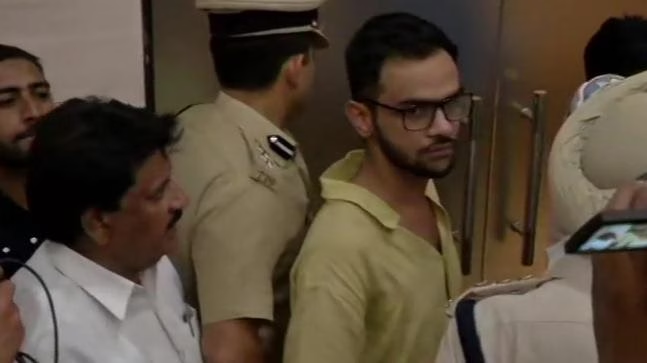



Screenings of a documentary about jailed activist Umar Khalid were cancelled in Pune and Nashik after police told organisers that showing the film without certification from India’s film censor board could violate the law, organisers said.
The cancellations came amid similar objections to screenings of Prisoner No: 626710 is Present, a documentary about Khalid, who has been in judicial custody for six years in connection with a conspiracy case linked to the 2020 communal riots in New Delhi. The trial has not yet begun.
The Central Board of Film Certification (CBFC) said in a social media post that publicly screening a film that had not been certified was a violation of the 1952 Cinematograph Act unless an exemption had been obtained under the law.
In Pune, the Working Title Film Club and Satyashodhak Vidyarthi Sanghatna had scheduled a screening for Saturday evening. A member of the film club said police had warned organisers that they and attendees could face consequences if the event went ahead.
The member, who asked not to be identified, said organisers’ lawyer had asked police to specify the legal provisions under which they could be charged but had not received a clear answer.
More than 100 people, including members of film clubs in Pune, were expected to attend the event, which was organised to mark six years since Khalid’s incarceration.
The organisers later said the cancellation was an example of the contradiction highlighted by the documentary, which examines the alleged use of legal mechanisms to restrict dissent. The film club member said the roughly one-hour documentary had already been screened in several countries.
In Nashik, the Indian People’s Theatre Association said police contacted its members on Thursday and told them that screening a film without a censor certificate could amount to a non-bailable offence.
Association president Mukta Kawale said the group had also learned that the Akhil Bharatiya Vidyarthi Parishad, or ABVP, had submitted a representation to Nashik’s mayor opposing the screening.
Nashik Mayor Himgauri Aher Adke said on social media on Thursday that ABVP members had met her and submitted a memorandum against what they described as a documentary “glorifying” Khalid. She said she had instructed the administration to prevent the screening.
The ABVP is the student wing of the Rashtriya Swayamsevak Sangh, which is associated with India’s ruling Bharatiya Janata Party.
The theatre association said the intervention raised concerns about the scope for dissent and public discussion. After cancelling the screening, organisers said they would instead hold an event focused on democracy and freedom.
Association member Talha Shaikh said organisers had received messages from BJP members opposing the film. He also said police personnel visited the venue and sought contact details of those organising the event.
Shaikh said organisers had told police that the event was private and that attendees were choosing to participate voluntarily. Police, however, argued that a screening advertised on social media and open to people without charge could not be treated as a private viewing, he said.
The controversy has extended beyond Maharashtra. The Law and Society Committee at the National Law School of India University in Bengaluru told The Hindu on Sunday that it had cancelled its planned screening because the documentary had not been certified by the CBFC.
Two days earlier, the International Institute of Information Technology, Hyderabad, had also cancelled a screening following an objection from the censor board.
Separately, two Mumbai residents said a private screening they had arranged on Sept. 19 was cancelled after police intimidated managers at two venues that had been approached to host it.
Khalid was among several activists arrested between January and September 2020 in connection with the violence that erupted in northeast Delhi in February that year. The clashes, involving supporters and opponents of the Citizenship Amendment Act, killed 53 people and injured hundreds, with most of those killed being Muslims.
Police have alleged that the violence formed part of a wider conspiracy aimed at discrediting the government of Prime Minister Narendra Modi and that organisers of protests against the citizenship law were involved.
Khalid, activist Sharjeel Imam and others face charges under the Unlawful Activities (Prevention) Act, the Prevention of Damage to Public Property Act, the Arms Act and provisions of the Indian Penal Code.
Khalid has denied the allegations. The case remains pending before the courts.
Support Independent Media
Click Here and Join the Membership of Millat Times to Support Independent Media.
Support Millat Times