
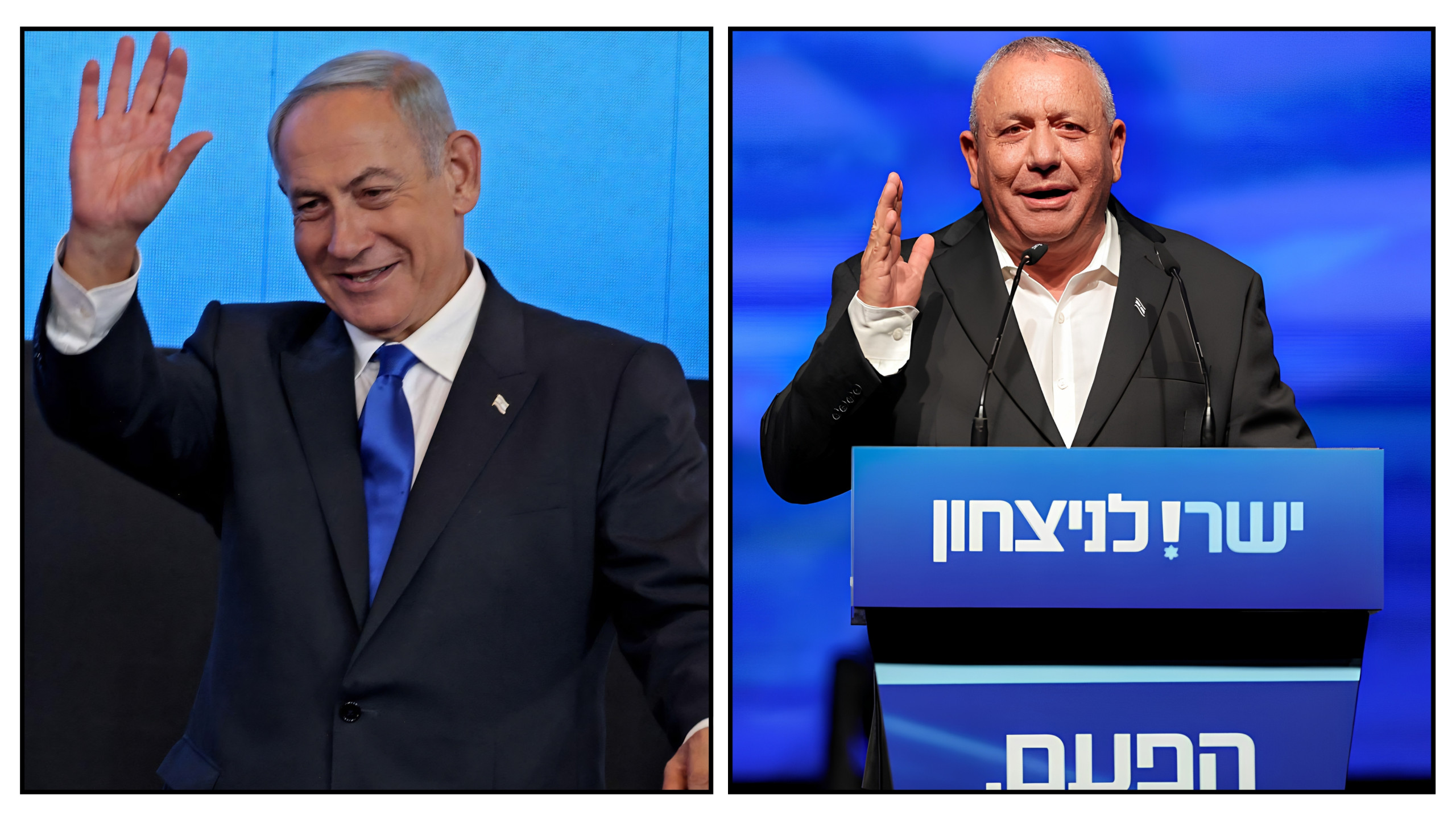


Israel’s 2026 parliamentary election has left the country facing another difficult battle over the formation of its next government, with Prime Minister Benjamin Netanyahu holding the lead in early seat projections but falling short of the majority required to govern independently.
The Netanyahu-led bloc has been projected to win 54 seats in the 120-member Knesset, Israel’s parliament, while the opposition camp led by former military chief Gadi Eisenkot has been reported at 49 seats in one snapshot. Arab-led parties have emerged as a potentially decisive force, with projections putting their combined representation at 17 seats in an earlier count.
| 54 seats – Netanyahu bloc | 49 seats – opposition bloc | 17 seats – Arab-led parties |
The central question is no longer simply which camp has the most seats. It is whether either side can secure the support needed to form a government, and what political compromises that process might require.
October 28 placed the opposition at 49 seats and Arab-led parties at 17, while Netanyahu’s bloc remained at 54. The figures below distinguish the headline snapshot from the later reported breakdown.
1. Israel election results at a glance
Netanyahu bloc
54
Opposition bloc
49
Arab-led parties
17
Majority needed
61
Of 120 Knesset seats
Israel’s parliament has 120 seats, which means a government generally needs the support of at least 61 lawmakers to command a majority. With 54 seats, Netanyahu’s bloc remains seven seats short of that threshold.
The opposition also cannot form a government through its own seats alone. Even if the 47-seat figure in the headline snapshot holds, it would need additional support from other parties or lawmakers.
That makes the Arab-led parties especially important. Their seats could determine whether an alternative government becomes possible, although political disagreements over cooperation could prevent that arithmetic from turning into a workable coalition.
2. Party-wise seat chart: who is leading?
The following chart uses a later reported snapshot of the individual party projections, when approximately 77.6% of votes had been counted. It should not be confused with the earlier 54–47 headline snapshot.

The chart shows that Likud, Netanyahu’s party, is the largest individual party in this projection, followed by Yashar, led by Eisenkot. However, being the largest party is not the same as commanding a parliamentary majority.
The other parties matter because Israel’s electoral system commonly requires several parties to negotiate a coalition. Their ideological positions, policy priorities and willingness to work with particular leaders can be as important as the seat totals themselves.
3. Understanding the three main political groupings
 Netanyahu’s right-wing and religious bloc
54 seats
This grouping centres on Netanyahu’s Likud party and includes right-wing, far-right and ultra-Orthodox religious parties. In the reported breakdown, Likud holds 27 seats, while Shas, United Torah Judaism and Otzma Yehudit have seven each, and Religious Zionism has six. Together, those figures add up to 54.
 Eisenkot-led opposition and change bloc
47 seats in the headline snapshot
The opposition includes Eisenkot’s Yashar, the alliance associated with Naftali Bennett and Yair Lapid, Yair Golan’s Democrats, and Avigdor Liberman’s Yisrael Beytenu. The parties do not all share the same political outlook, but they are grouped around the effort to replace Netanyahu’s leadership. Later reports placed this bloc at 49 seats.
 Arab-led parties
19 seats in an earlier snapshot
The Joint List and Ra’am represent Arab-led political currents within Israel. Their combined seat projections have fluctuated during counting. Their support could be decisive in a parliamentary vote, but cooperation with them remains a politically sensitive question for rival parties.
4. Why Netanyahu is ahead but still faces a challenge
Netanyahu’s lead gives him a significant position in the negotiations that follow the election. However, the projected 54 seats fall short of the 61 required for a majority.
The result illustrates a recurring feature of Israeli politics: the largest political bloc does not automatically have enough support to govern. Parties must negotiate with potential partners, agree on policy priorities and secure sufficient parliamentary backing.
Netanyahu has called for a strong right-wing government. His political position depends not only on Likud’s performance but also on whether his existing partners remain committed to working together and whether other lawmakers can be persuaded to support a coalition.
The election has also exposed differences within the right-wing camp. Reports indicate that some of Netanyahu’s far-right allies have performed less strongly than they had hoped, even as Likud remains the largest individual party. Such differences could influence negotiations over security, religious policy and the government’s future priorities.
For now, the seat projections provide Netanyahu with a lead, not a guarantee of a stable government.
5. Who is Gadi Eisenkot, and what does his position mean?
Gadi Eisenkot, a former chief of staff of the Israel Defence Forces, has emerged as the principal rival to Netanyahu in this election.
His Yashar party is projected to be the second-largest individual party in the reported breakdown. The broader opposition grouping includes parties with different political backgrounds, from centrist and liberal forces to nationalist parties that disagree with one another on several issues.
Their shared objective of replacing Netanyahu does not necessarily mean they agree on every aspect of governing Israel.
Eisenkot has rejected serving under Netanyahu, including through a proposed rotation arrangement, according to Israeli media reporting. He has also called for the leader of the largest party in the opposition bloc to become its candidate for prime minister.
These positions could complicate negotiations. The opposition needs to maintain cooperation among its constituent parties while deciding how to secure additional parliamentary support.
If its leaders cannot agree on a common approach, the opposition could struggle to translate its combined seats into a viable alternative government.
6. Arab-led parties could hold the balance of power
One of the most significant developments in the election is the projected representation of Arab-led parties.
The Joint List and Ra’am have emerged as important players in the parliamentary arithmetic. At one stage of counting, reports placed their combined total at 19 seats. Other later updates showed 17, underlining the provisional nature of the figures.
Their position matters because neither major Jewish-led political bloc has independently reached 61 seats.
In mathematical terms, the opposition could potentially reach a majority with support from some or all Arab-led lawmakers. But parliamentary arithmetic is only one part of the equation. The parties must also decide whether they are willing to cooperate, under what conditions, and on which policies.
Yair Golan, leader of the Democrats, has publicly urged opposition leaders to work with Arab parties to form a government of change. Netanyahu, meanwhile, has ruled out cooperation with Arab parties, according to reports.
This creates a difficult choice for the opposition: seek support from Arab-led lawmakers despite political resistance within its broader camp, explore another arrangement, or accept the possibility of continued deadlock.
For Arab citizens of Israel, the election is also significant because their elected representatives may have greater influence over coalition negotiations. Whether that influence translates into policy commitments will depend on the negotiations that follow.
7. What the results mean for Israel’s next government
The outcome could lead to several different political scenarios.

Scenario one: Netanyahu forms a coalition
Netanyahu could remain prime minister if he secures enough support from existing allies or other lawmakers to reach the required majority. His current projected seats mean he would need additional support.

Scenario two: An opposition-led government
Eisenkot’s bloc could attempt to assemble an alternative government with support from Arab-led parties or other lawmakers. This would require political agreements that are not yet guaranteed.

Scenario three: A broader unity arrangement
A wider agreement involving political rivals is another theoretical possibility. However, Eisenkot’s reported refusal to serve under Netanyahu makes such an arrangement difficult under the positions currently stated.

Scenario four: Prolonged deadlock or another election
If the parties cannot agree on a coalition, Israel could face an extended period of political uncertainty. Another election is a possible outcome if efforts to form a government fail, although it is not inevitable.
The next phase will depend on negotiations, the final seat distribution and the ability of political leaders to reach agreements. None of these scenarios should be treated as a confirmed outcome at this stage.
8. What happens after vote counting?
The Central Elections Committee continues to process ballots and update the results. Votes cast through double envelopes, including those of eligible soldiers and other voters outside their assigned polling stations, can affect the final distribution.
The process will determine the final number of seats won by each party. That distribution will then shape the options available to the political leaders seeking to form a government.
Israel’s president has a role in the government-formation process, including consulting political representatives and assigning a member of parliament the task of forming a government under the country’s constitutional framework.
The negotiations can involve discussions over ministerial positions, legislation, budgets, security priorities and other policy commitments. A party’s willingness to join a coalition may depend on whether it receives assurances on issues important to its voters.
Consequently, the coming days and weeks could be as politically significant as election night itself.
9. Key questions answered
Has Netanyahu won the election?
Netanyahu’s bloc is leading in the reported seat projections, but the figures remain provisional. More importantly, 54 seats are insufficient for an independent parliamentary majority.
How many seats are needed to form a government?
A majority in the 120-seat Knesset generally requires 61 seats.
Can Eisenkot become prime minister?
He could potentially lead an alternative government if he secures sufficient parliamentary support and an agreement can be reached among the relevant parties. The current projections do not guarantee that outcome.
Why are Arab-led parties important?
Their combined projected seats could provide the additional support needed by an opposition-led coalition. Whether such an arrangement is politically achievable remains uncertain.
Are the results final?
No. The figures cited in this report come from partial results and media projections published on October 28, 2026. The distribution may change as counting progresses.
Israel’s 2026 election has produced a complicated parliamentary picture. Netanyahu’s bloc is ahead with 54 projected seats, while the opposition led by Gadi Eisenkot is short of the majority needed to form a government independently. Arab-led parties could play a decisive role in determining the outcome.
The election’s significance lies not only in the competition between Netanyahu and Eisenkot but also in the political negotiations that will follow. The final result will depend on the distribution of seats, the relationships between the parties and their willingness to compromise.
For now, Israel faces an uncertain path to its next government. Netanyahu holds the lead in the reported projections, but the crucial test will be whether either side can assemble the parliamentary support required to govern.
Support Independent Media
Click Here and Join the Membership of Millat Times to Support Independent Media.
Support Millat Times