
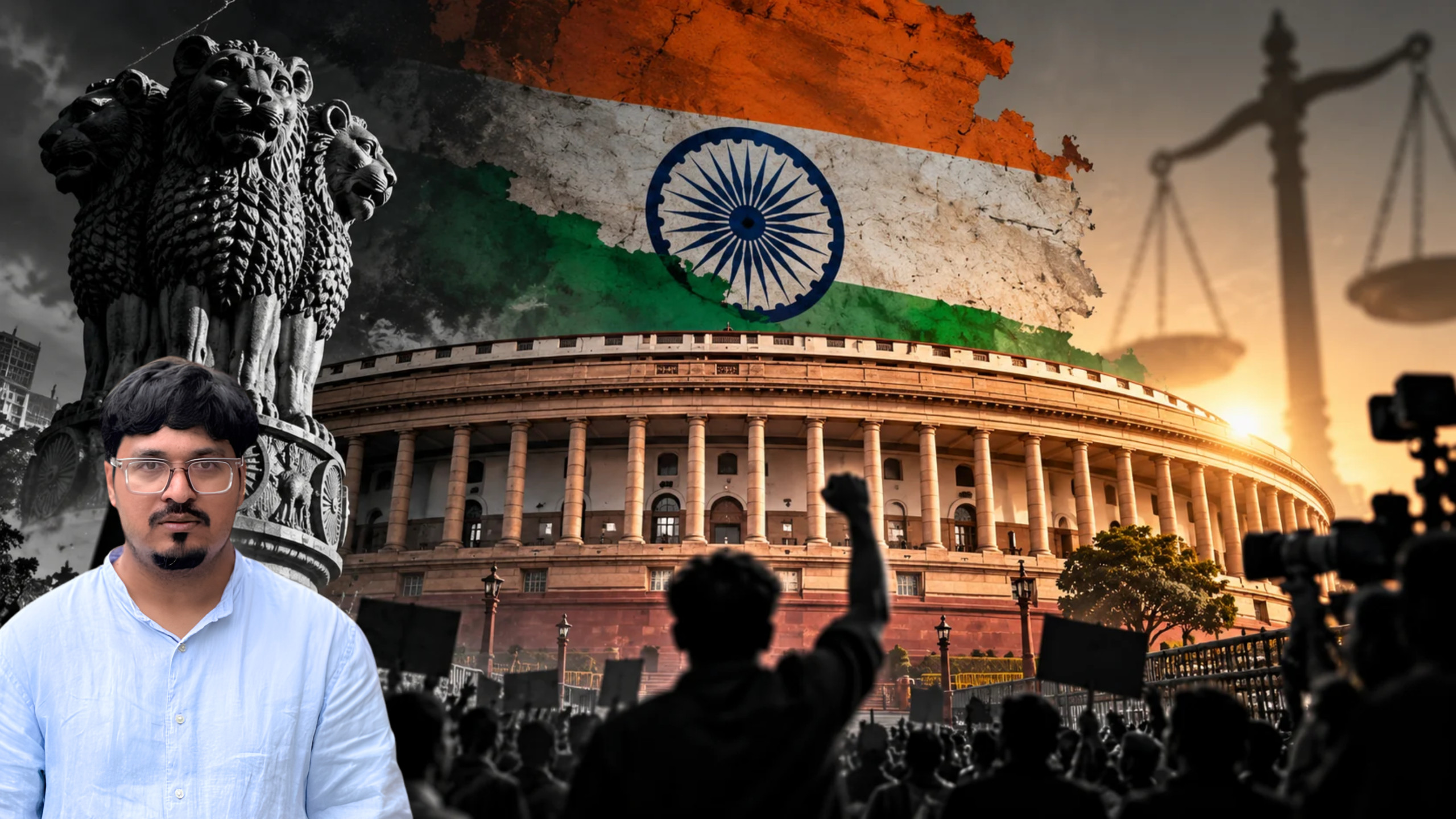


By Shams Tabrez Qasmi
India is the world’s largest democracy. Its Constitution promises justice, liberty, equality and fraternity to every citizen. But a fundamental question confronts the country: what value do constitutional guarantees have if the institutions responsible for upholding them cannot act independently and citizens begin to fear the very system meant to protect their rights?
Under Prime Minister Narendra Modi’s BJP-led government, concerns about institutional independence, electoral transparency, restrictions on peaceful protests and media freedom have become central to India’s democratic debate. Critics argue that power is becoming increasingly concentrated while the institutions meant to hold the government accountable face growing pressure.
The danger is not simply that one political party may become too powerful. It is that democracy may be reduced to elections while the safeguards that make those elections meaningful are gradually weakened.
Democracy does not stand on elections alone. It depends on institutions working independently: Parliament, the Election Commission of India (ECI), the judiciary, a free media, an impartial administration and independent investigative agencies.
Each has a distinct responsibility. Parliament must hold the government accountable. The ECI must conduct free and fair elections. Courts must protect constitutional rights. The media must question those in power. Investigative agencies must investigate crimes without political discrimination.
When these institutions perform their duties independently and impartially, public confidence grows. When their decisions raise credible questions about political influence, that confidence can erode.
The issue is not whether these institutions should oppose the government, but whether they can perform their constitutional duties independently of political power.
When the BJP came to power in 2014, it benefited from widespread public dissatisfaction with the Congress-led government. Corruption allegations, including those surrounding the 2G spectrum allocation, had damaged the Congress government’s credibility. Narendra Modi promised better governance, accountability and a new political direction.
The 2G controversy also illustrates the need to distinguish political allegations from judicial findings: a special court acquitted the accused in the main criminal case in 2017.
After more than a decade in power, questions about accountability have returned with renewed force.
Opposition parties, civil society organisations, journalists and legal experts have raised concerns about the independence of constitutional institutions. The government has defended its record and rejected allegations of institutional misuse.
These concerns merit scrutiny, but allegations must be assessed on the evidence. Winning an election gives a government the authority to govern; it does not give it unlimited power over the institutions that hold it accountable.
Electoral integrity and the right to vote
The Election Commission is one of the most important pillars of Indian democracy. Its responsibility is to ensure that every eligible citizen can exercise the right to vote and that elections are conducted fairly.
Yet the Commission’s handling of electoral-roll revisions has generated serious controversy. The Special Intensive Revision (SIR) process has raised concerns about voter deletions, transparency and the possibility of eligible citizens being excluded from electoral rolls.
Reuters reported on October 9, 2026, that about 130 million names had been deleted from electoral rolls during the revision exercise, citing data used by the BJP. The reported deletions included people who had relocated and people who could not be traced. The figure covered deletions across the exercise and should not be interpreted as the number of eligible voters wrongly excluded.
The Election Commission has said the exercise is intended to remove deceased, duplicate, relocated and otherwise ineligible entries. Opposition parties and other critics have questioned the process, arguing that documentation requirements, administrative errors and short deadlines could exclude eligible voters, particularly among poor, migrant and marginalised communities.
On October 20, Reuters reported that United Nations human rights experts had called for an independent investigation into the authorities’ handling of recent protests against the Election Commission. The experts raised concerns about alleged excessive force, restrictions on peaceful assembly and the treatment of demonstrators. The government has defended the actions of law enforcement agencies, while the Election Commission has said people wrongly excluded from electoral rolls can seek to have their names restored.
The central question is whether the revision process provides adequate safeguards against wrongful exclusion and whether affected citizens can obtain timely remedies. If eligible voters cannot be confident that their names will remain on electoral rolls, their democratic rights may be undermined.
The government must not dismiss every question about electoral fairness as an opposition conspiracy. Equally, allegations of deliberate manipulation must be supported by evidence. The appropriate response is transparency, independent scrutiny and effective remedies for wrongly excluded voters.
A vote is not a favour granted by the government. It is a democratic right.
Investigative agencies and accountability
The National Investigation Agency (NIA), the Enforcement Directorate (ED), the Central Bureau of Investigation (CBI) and other investigative bodies are established to investigate offences and enforce the law.
Their authority is necessary. But that authority becomes a source of concern if citizens believe investigations are selective, politically motivated or used to intimidate opponents.
Opposition parties and critics have repeatedly accused central investigative agencies of disproportionately targeting political opponents. The government has rejected allegations that the agencies are being misused and maintains that investigations are conducted according to law.
The test of impartiality is whether the same legal standards apply regardless of political affiliation. Investigations involving opposition leaders must be supported by evidence and withstand judicial scrutiny. Allegations involving members or associates of the ruling party must be investigated with the same rigour.
The NIA’s national-security responsibilities must also be distinguished from political disagreement and peaceful dissent. Security concerns cannot, by themselves, justify treating legitimate criticism as a criminal offence.
No government should be allowed to turn investigative power into a political weapon. The law must apply equally to supporters of the BJP, its opponents and citizens with no political affiliation.
The judiciary and constitutional remedies
The judiciary is a crucial constitutional safeguard when citizens believe their rights have been violated. If public confidence in the courts declines, the consequences extend beyond individual cases.
The handling of electoral-roll disputes and restrictions on protests has intensified debate over access to judicial remedies. On October 11, 2026, senior advocate and Rajya Sabha MP Kapil Sibal expressed frustration with the Supreme Court over the handling of these concerns.
Sibal said, “I am tired of keeping on going to the Supreme Court.” The exact wording and context of the quotation should be checked against the original recording or transcript before publication.
His remarks reflect frustration with the legal process, but they do not, on their own, establish that the judiciary has lost its independence. The broader question is whether citizens can obtain timely and effective remedies when they believe their constitutional rights have been violated.
A government cannot be exempt from scrutiny because legal proceedings are slow or because citizens face difficulties obtaining relief. Courts, for their part, must remain willing to examine government action independently and without fear or favour.
The independence of the courts is not a privilege enjoyed by judges. It is a safeguard for the people.
Peaceful protest and freedom of expression
Peaceful protest is not an attack on democracy. It is one of its essential instruments.
When citizens gather to question a policy, demand electoral transparency or criticise a constitutional authority, the government must respect their legal rights while maintaining public order.
Reuters reported on October 10 that police detained more than 2,000 people in Delhi as authorities moved to prevent a planned rally demanding the resignation of Chief Election Commissioner Gyanesh Kumar. Security forces sealed off the planned protest site, and mobile internet services were suspended in parts of the capital.
On October 20, UN experts called for an independent investigation into alleged abuses during the protests and urged Indian authorities to stop using excessive force against demonstrators. These were allegations requiring investigation, rather than judicial findings of wrongdoing.
The government has a responsibility to maintain law and order, but that responsibility cannot justify indiscriminate restrictions on peaceful political expression. Restrictions on assembly must be lawful, necessary and proportionate to a legitimate public-order concern.
Young Indians, students and ordinary citizens must be free to ask difficult questions. Their criticism may be uncomfortable for those in power, but discomfort alone is not a legitimate reason to suppress dissent.
Media freedom and public accountability
A free media is essential because citizens cannot hold the government accountable without access to reliable information.
When news organisations fail to scrutinise those in power or amplify official claims without adequate examination, their ability to serve the public interest is weakened. Independent journalism is necessary to investigate corruption, challenge official statements and represent marginalised communities.
Social media has provided an alternative platform for public discussion. Yet digital expression also faces pressure through account suspensions, content-removal orders and government restrictions.
Authorities may legitimately act against unlawful content. But such powers must be exercised transparently and proportionately, with safeguards against political censorship.
Claims of politically motivated censorship should be assessed through documented cases, including the reasons given for restrictions, the legal basis for official orders and the availability of appeals. If citizens fear that criticising the government could result in their accounts being restricted or their voices being silenced, freedom of expression may be weakened in practice even when it remains protected in law.
Protecting the constitutional order
The BJP continues to enjoy significant electoral support, and its political opponents must compete through democratic means. But electoral success does not remove the need for institutional checks and balances.
India’s democratic future depends on whether the Election Commission can command public confidence, investigative agencies can act impartially, courts can protect constitutional rights, Parliament can hold the executive accountable and journalists can question those in power without fear.
The Constitution is not the property of the BJP, the Congress or any other political party. It belongs to the people of India.
The performance of any government must be judged not only by its electoral victories but also by its willingness to tolerate criticism, respect institutional independence and protect the rights of citizens who disagree with it.
A government that claims to be democratic must be willing to face questions. An institution that serves the people must not become answerable to political power. And a Constitution that promises freedom must be defended not only in speeches but through action.
India’s democracy depends on more than constitutional guarantees on paper. It requires independent institutions, a free media, peaceful protest and the protection of citizens’ rights, regardless of their political affiliations.
The strength of Bharat’s democracy will ultimately be measured by whether its constitutional safeguards remain effective under every government.
This article is written by Shams Tabrez Qasmi, Editor-in-Chief of Millat Times
Support Independent Media
Click Here and Join the Membership of Millat Times to Support Independent Media.
Support Millat Times