
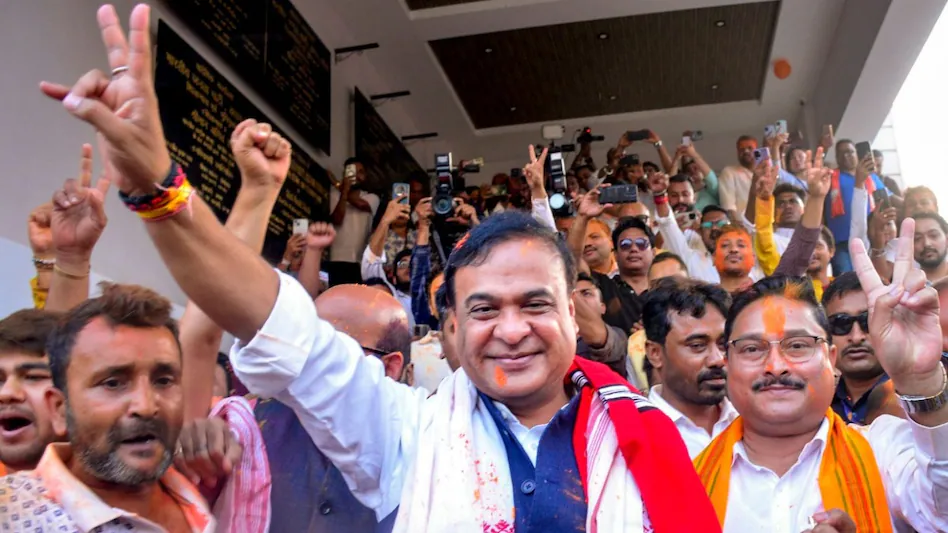




The delimitation exercise carried out in Assam in 2023 has emerged as a key factor behind the sweeping victory of the Bharatiya Janata Party (BJP) and its allies in the 2026 Assam Assembly elections, according to results and analysis of constituency-wise changes.
Chief Minister Himanta Biswa Sarma said after the results that the redrawing of assembly constituencies had significantly improved the ruling alliance’s electoral prospects. He said the BJP-led National Democratic Alliance (NDA) had already assessed that a large number of seats would tilt in its favour after delimitation.
“We knew that at least 102–103 seats were winnable for us,” Sarma said, referring to the 126-member Assam Assembly.
The NDA ultimately secured 102 seats, with the BJP winning 82, while its allies the Asom Gana Parishad (AGP) and the Bodo Peoples Front (BPF) won 10 seats each. The performance marks a major jump for the BJP, which had won a maximum of 60 seats in the last two Assembly elections.
Opposition parties have, however, strongly criticised the delimitation process, alleging that it altered constituency boundaries in a way that benefited the ruling party. They have described it as a form of political gerrymandering, a charge the BJP has rejected.
The delimitation exercise, carried out by the Election Commission of India in 2023, was officially intended to reflect population changes and ensure balanced representation, particularly for indigenous communities of Assam. However, multiple political observers and party leaders say its implementation significantly changed the electoral arithmetic in several regions.
One of the most visible impacts was on constituencies with high Muslim populations. Before delimitation, around 30 Assembly seats had a significant Muslim electorate and often elected Muslim MLAs. After the exercise, this number reportedly fell to about 23.
This shift happened through a combination of redrawing boundaries, merging Muslim-majority seats, redistributing minority-populated villages into other constituencies, and reserving certain seats for Scheduled Castes and Scheduled Tribes.
As a result, the overall representation of Muslim legislators in the Assam Assembly has fallen. While 31 Muslim MLAs were elected in 2021 from opposition parties such as the Congress and AIUDF, the number has now dropped to 22 in 2026. The BJP did not field any Muslim candidates in this election.
Several constituencies in Lower Assam saw major demographic restructuring. In Barpeta and Goalpara West, where Bengali-origin Muslim voters traditionally formed a majority, portions of these constituencies were redistributed, increasing the share of Hindu voters. Both seats were also reserved for SC and ST categories, effectively disallowing minority candidates from contesting. These seats, earlier held by the Congress, were won by the BJP and AGP this time.
In Barak Valley, Hailakandi constituency saw one of the most significant changes. The seat was broken into multiple parts, with Muslim-majority areas redistributed into neighbouring constituencies. According to estimates by local observers, the Muslim population share in the seat fell from nearly 60% to around 37%. The BJP won the seat in 2026, overturning decades of opposition dominance.
Similar changes were seen in Katigorah and Barkhola, where boundary adjustments and voter redistribution increased Hindu voter share, helping the BJP secure victories in both seats, which were earlier held by the Congress.
In Dhubri district, constituencies such as Golakganj and Bilasipara also saw a reduction in Muslim voter concentration after delimitation. Both seats were won by the NDA, with the AGP narrowly winning Bilasipara.
The exercise also created new seats in tribal-dominated regions, including the Karbi Anglong Autonomous Council and Bodoland Territorial Region. All five newly created constituencies were won by the BJP and its allies.
In several areas, two older constituencies were merged or significantly redrawn. For example, Bhowanipur and Sorbhog in Barpeta district were merged into a single seat. Changes in boundaries, including the addition of Hindu-majority areas like Howly town, altered the demographic balance in favour of the NDA. The BJP’s Ranjeet Kumar Dass won this new seat.
In Upper Assam’s Titabor constituency, the delimitation increased the share of tea garden worker voters while reducing the influence of the Ahom community, traditionally aligned with the Congress. The BJP candidate won the seat with a margin of over 23,000 votes.
While the BJP and its allies credit delimitation for ensuring better representation of indigenous and tribal communities, opposition parties argue that the exercise has significantly altered the political balance in Assam in favour of the ruling alliance.
The Election Commission has maintained that delimitation was conducted as per constitutional provisions and demographic data.
Support Independent Media
Click Here and Join the Membership of Millat Times to Support Independent Media.
Support Millat Times