
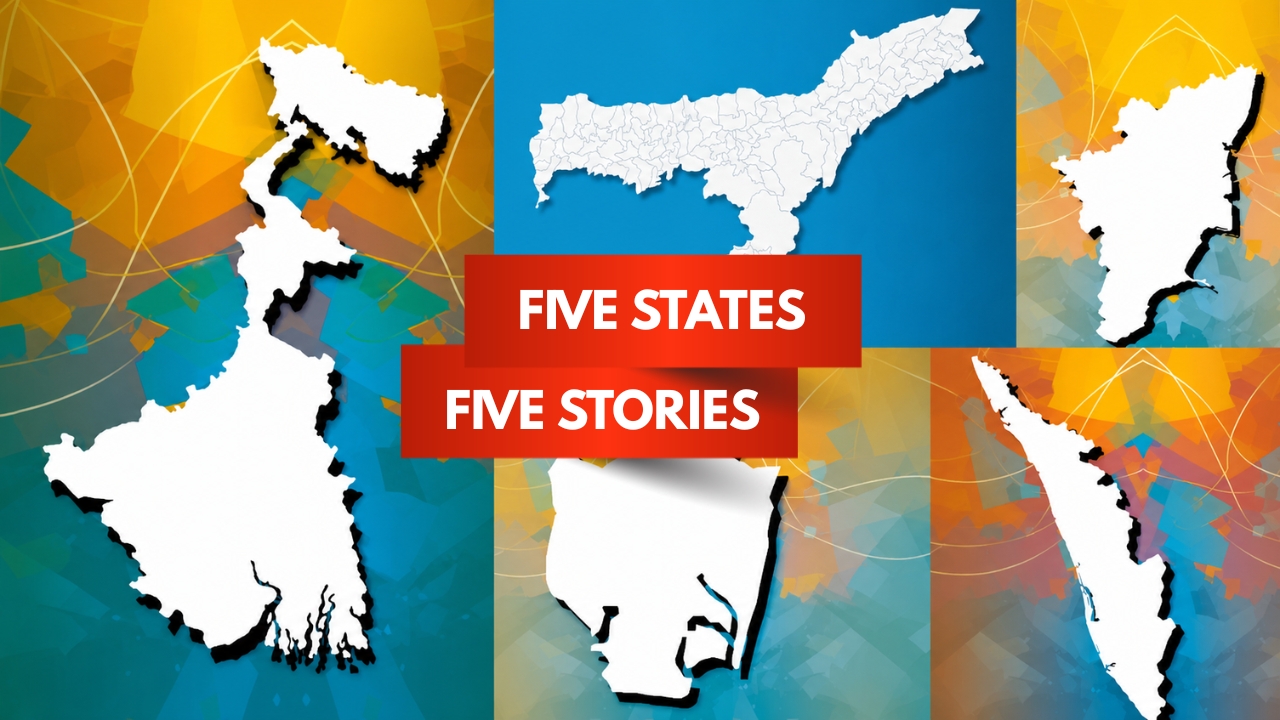




India woke up on May 4, 2026 to one of its most dramatic election days in recent memory. Five states and union territories – West Bengal, Assam, Tamil Nadu, Kerala, and Puducherry – declared their verdicts together. With over 820 constituencies counting simultaneously, the day had something for every kind of political observer: a historic upset, a star’s rise, a strongman’s re-election, a silent revolution, and a cliffhanger.
Here is what happened (state by state)
- West Bengal – The Biggest Upset of the Day

Result: BJP wins 207 seats out of 294. TMC reduced to 80 seats.
This was the story that dominated headlines all day – and for good reason.
West Bengal had been governed by Chief Minister Mamata Banerjee and her party, the Trinamool Congress (TMC), since 2011. For 15 years, she had managed to keep the BJP out of Bengal despite repeated attempts. That chapter officially ended on May 4.
The Bharatiya Janata Party crossed the halfway mark comfortably, winning 206 seats in the 294-member assembly. But the most shocking moment of the day came from Mamata Banerjee’s own constituency – Bhabanipur – where she lost to BJP’s Suvendu Adhikari by over 15,000 votes. A sitting Chief Minister losing her own seat is an extremely rare event in Indian politics.
Voter turnout in the state crossed 92%, one of the highest ever recorded in any Indian state election.
The election was not without controversy. Before polling, over nine million people were removed from the voter list through a process called the Special Intensive Revision. Opposition parties, including the TMC, accused the Election Commission of India of conducting this exercise unfairly, claiming it disproportionately affected certain communities. The ECI maintained it was a routine exercise. Additionally, BJP ran an aggressive identity-based campaign that resonated with a section of Hindu voters.
- Assam – The Hat-Trick

Result: BJP wins 82 out of 126 seats. Himanta Biswa Sarma continues as Chief Minister.
Assam was the most predictable result of the day – but no less significant.
Chief Minister Himanta Biswa Sarma led the BJP and its allies (known as the NDA) to a third consecutive victory in the state. The NDA crossed the majority mark comfortably, securing 82 seats in the 126-member assembly. The Congress-led opposition managed 19 seats.
Sarma himself won from his Jalukbari constituency by a staggering margin of over 89,000 votes against his Congress opponent. The NDA also secured over 50% of the total votes cast – a figure that is considered a very strong mandate in a multi-party democracy.
Voter turnout stood at 85.38%, reflecting high public participation.
A third consecutive victory in Assam firmly establishes the BJP’s dominance in the Northeast. It also strengthens Himanta Biswa Sarma’s position as one of the most powerful regional leaders within the BJP.
- Tamil Nadu – The Superstar’s Surprise

Result: TVK (Tamilaga Vettri Kazhagam) wins 108 seats, DMK reduced to second place. MK Stalin loses his own seat.
No one who followed Tamil Nadu politics expected this.
Tamil Nadu had been governed by the DMK under Chief Minister MK Stalin since 2021, after they defeated the AIADMK. The DMK is one of the most established parties in the state, with deep roots going back decades.
But a brand-new party – TVK, founded by actor-turned-politician Vijay just two years ago in 2024 – stormed into the Tamil Nadu assembly with 108 seats in the 234-member house. TVK fell 10 seats short of an outright majority, meaning Tamil Nadu now has a hung assembly, and coalition talks have begun.
The most dramatic personal result came when MK Stalin – the sitting Chief Minister – lost his own Kolathur constituency to a TVK candidate. His son, Udhayanidhi Stalin, managed to hold his seat.
Vijay himself contested from two constituencies and won both. He won Perambur (North Chennai) by over 50,000 votes and Tiruchirappalli East by over 27,000 votes. Under Indian law, he will need to vacate one seat soon.
Voter turnout hit 85.1% – the highest ever recorded in a Tamil Nadu assembly election.
Tamil Nadu has a long tradition of film stars entering politics – from M.G. Ramachandran to Jayalalithaa. Vijay, one of the biggest names in Tamil cinema with blockbusters like Ghilli, Mersal, and Master to his name, formally stepped away from acting in 2024 to launch TVK. His mass popularity, combined with fresh faces, anti-incumbency against the DMK, and a clean campaign image, worked powerfully in his favour. The AIADMK, which allied with the BJP this time, did not perform well enough to emerge as the main opposition either.
Tamil Nadu now has a hung assembly. TVK is the single largest party, and Vijay is positioned to become Chief Minister – potentially with support from smaller parties. If that happens, Tamil Nadu will see its third film star become Chief Minister, following MGR and Jayalalithaa.
- Kerala – The Congress Comeback

Result: Congress-led UDF wins comfortably. LDF (Left) voted out after decade-long rule.
Kerala tells a different story from the rest – one where the Congress and its alliance (called the United Democratic Front or UDF) made a strong comeback.
The state had been governed by the Left Democratic Front (LDF) under Chief Minister Pinarayi Vijayan since 2016. The LDF had managed a rare back-to-back win in 2021, but anti-incumbency caught up with them in 2026.
The Congress won 63 seats in the 140-member assembly. Its alliance partner, the Indian Union Muslim League (IUML), won 22 seats. The ruling CPI(M) – the main Left party – was reduced to just 26 seats, a sharp fall. The CPI held 8 seats.
In a notable development, the BJP’s Rajeev Chandrasekhar won the Nemom constituency, giving the BJP a foothold in Kerala’s assembly – a state where they had historically struggled to win even a single seat.
Chief Minister Pinarayi Vijayan managed to retain his own seat but presided over his party’s worst performance in years.
Voter turnout was 79.63%.
A combination of anti-incumbency after ten years of Left rule, concerns over the economy and governance, and a resurgent Congress party that put together a disciplined campaign. The BJP’s performance, though limited to one seat, signals a slow but growing presence in the state.
Kerala returns to Congress-led governance. It is also a rare bright spot for the Congress party, which has been struggling nationally. The party’s victory here will give it some political momentum ahead of future elections.
- Puducherry – The Small Stage with Big Drama

Result: NDA led by AINRC retains power. Congress-DMK alliance falls short.
Puducherry – a small union territory of just 30 assembly seats – has always punched above its weight in Indian political drama, and 2026 was no different.
The AINRC (All India N.R. Congress), led by Chief Minister N. Rangaswamy, contested as part of the BJP-led NDA alliance. The NDA secured a majority and will continue in power. Rangaswamy himself won his seat from Thattanchavady by a margin of over 4,400 votes.
The Congress-DMK alliance contested strongly but could not dislodge the ruling combine. Actor Vijay’s TVK also fielded candidates in all 30 seats but did not significantly break through here.
Voter turnout stood at 89.87% – the highest ever for a Puducherry assembly election.
What it means: A stable result for Puducherry. For the BJP, retaining Puducherry through its alliance is part of the broader story of holding ground in southern India, where it has traditionally been weaker.
Support Independent Media
Click Here and Join the Membership of Millat Times to Support Independent Media.
Support Millat Times