
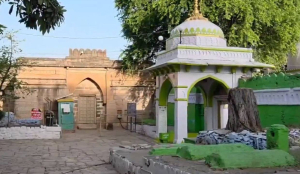




The Madhya Pradesh High Court on Thursday declared the disputed Bhojshala-Kamal Maula complex in Dhar as a temple dedicated to Goddess Saraswati and quashed a 2003 order that had allowed Muslims to offer namaz at the site.
A division bench of Justices Vijay Kumar Shukla and Alok Awasthi held that the religious character of the protected monument was that of “Bhojshala with a temple of Goddess Saraswati”.
The court struck down the Archaeological Survey of India’s (ASI) 2003 order permitting Muslim prayers at the complex and restricting Hindu worship rights.
“The religious character of the disputed area of the Bhojshala complex and Kamal Maula Mosque is held to be Bhojshala with a temple of Goddess Saraswati,” the bench said.
The verdict came on a batch of petitions filed by Hindu groups seeking exclusive worship rights at the complex and a ban on namaz on the premises.
Relying on archaeological evidence, ASI survey reports and historical literature, the court said the site had historically functioned as a centre of Sanskrit learning and contained a temple dedicated to Goddess Saraswati.
The bench also referred to principles laid down by the Supreme Court in the Ayodhya- Babri Masjid case case while evaluating archaeological and historical evidence.
The court directed the Centre and the ASI to decide the future administration and management of the complex. It said the ASI would continue to exercise supervisory control over preservation and regulation of religious practices at the protected monument.
While ruling in favour of Hindu worship rights, the court said the Muslim side could approach the Madhya Pradesh government for allotment of suitable land in Dhar district for construction of a mosque or prayer site, and the state may consider such a request in accordance with law.
On a plea seeking the return of an idol of Goddess Saraswati allegedly taken away during British rule, the court said the Union government may consider a representation for bringing the idol back from a museum in London and reinstalling it at the complex.
Justice Shukla had personally visited the Bhojshala complex in March during the hearing of the case.
Support Independent Media
Click Here and Join the Membership of Millat Times to Support Independent Media.
Support Millat Times