
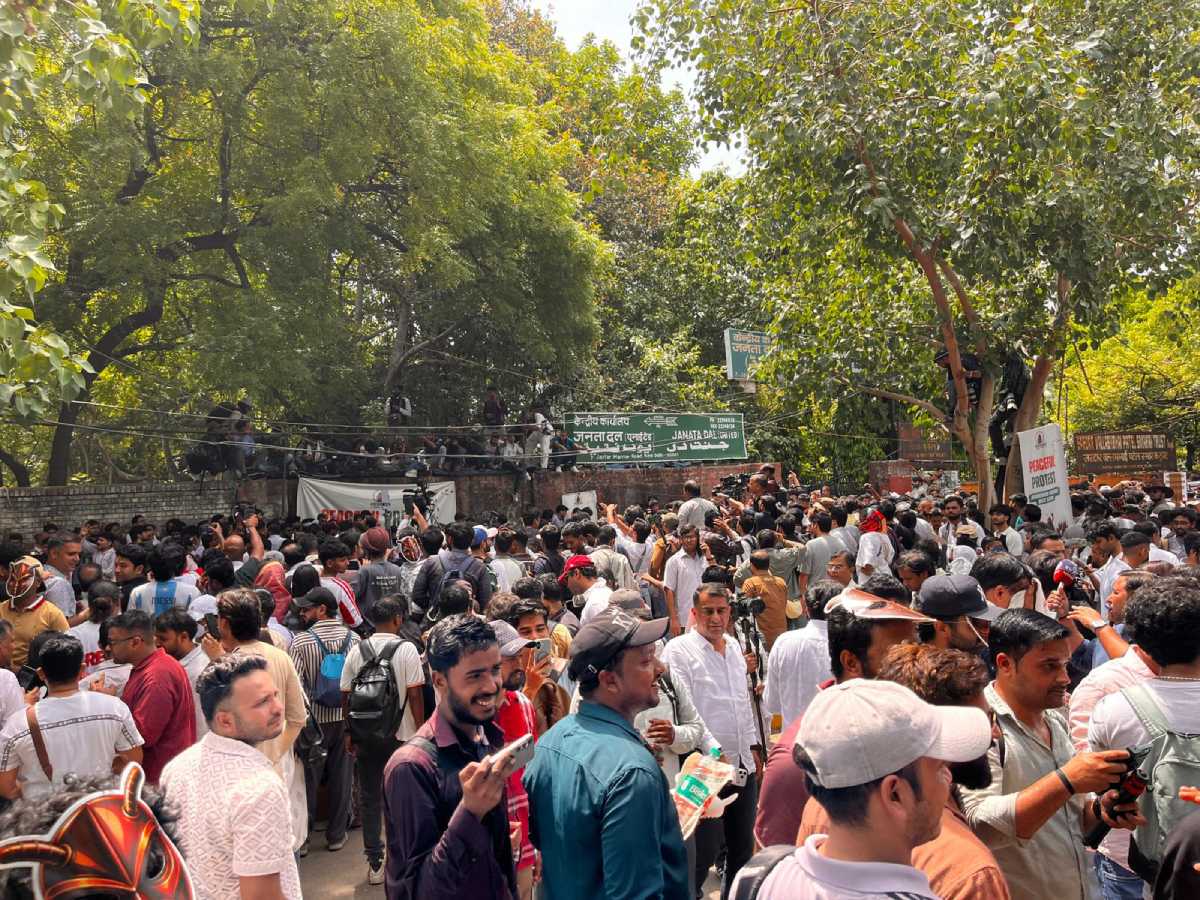




Some Muslims have been advising the community’s youth to stay away from the ongoing Gen Z protests led by the Cockroach Janta Party. This caution stems not from indifference but from historical experience.
It is also shaped by the fear that if the movement faces a state crackdown, Muslims could find themselves among the first in the line of fire. In the current political climate, such concerns are widely viewed as a matter of prudence rather than paranoia.
At the same time, social media has been flooded with poorly substantiated conspiracy theories that the movement is being backed by forces associated with the Sangh Parivar, the BJP and its ideological parent, the RSS, much like allegations that have long surrounded movements such as those led by Jayaprakash Narayan and Anna Hazare. Others argue that the purpose of the present mobilisation is to weaken the opposition alliance and damage the Congress. Whether or not these claims are true, they raise a broader question: what has been the role of Muslims in such movements, and what have they gained from them?
If the movement led by Jayaprakash Narayan succeeded in challenging Indira Gandhi, how significant was Muslim participation in it? When Anna Hazare’s anti-corruption campaign transformed the political landscape in 2011–12 and marked the beginning of Congress’s decline, did Muslims play a decisive role? To my knowledge, they did not. Muslims certainly participated as individuals, but neither movement produced visible Muslim leadership nor drew substantial mobilisation from Muslim organisations.
The same pattern appears visible today. Muslims are neither leading the Gen Z protests nor participating in them in large numbers. Occasional social media endorsements do not amount to meaningful political involvement. Whether the movement succeeds or fails, Muslims do not appear to be a decisive force within it. This observation mirrors earlier moments of political upheaval, where the community largely remained on the margins rather than shaping events directly.
What concerns me more, however, is not the current protest but the broader condition of Muslim political engagement. For decades, Muslims have increasingly become spectators in national politics rather than active participants. Political discourse is abundant, analysis is constant, and electoral outcomes are closely followed, but sustained political action remains limited.
This did not happen by accident. A combination of factors has contributed to the decline of independent Muslim political participation. Economic insecurity has compelled many families to prioritise immediate survival over civic engagement. The absence of credible and sustained leadership has left many politically directionless. Repeated experiences of marginalisation have fostered the perception that political outcomes are decided without meaningful Muslim influence. Above all, fear of legal repercussions, social stigma, or political targeting has discouraged open and sustained organisation. Whatever the relative weight of these factors, the outcome has been a steady retreat from collective political action.
The result is evident. Many Muslims today struggle to mobilise even on issues that directly affect their own community. The Shaheen Bagh movement briefly disrupted this trajectory. It generated confidence, courage, and a sense of collective purpose. For a moment, it created the impression that Muslims could help shape the national conversation rather than merely respond to it. Its significance lay not only in opposition to a particular policy, but in demonstrating that ordinary citizens could organise peacefully, articulate political demands, and command national attention.
Yet Shaheen Bagh also exposed the limits of protest politics. The subsequent arrests, legal cases, and wider state response created an atmosphere of fear, and much of the momentum dissipated. More importantly, the networks and energy generated during that period did not translate into durable institutions capable of sustaining long-term civic engagement. The lesson, therefore, is not that mobilisation is futile, but that protest must eventually be converted into structured and lasting forms of organisation.
Meanwhile, reports of mob lynchings continue to emerge with disturbing regularity. Mosques and madrasas face demolition drives. Religious symbols and practices are increasingly contested in the public sphere. Yet Muslim leadership remains fragmented, and many activists describe a sense of constraint and political helplessness. In such a context, it is striking that greater concern is sometimes expressed over Muslims being “misled” by the Gen Z protests than over the deeper crisis of political inactivity within the community itself.
My assessment is that Muslim youth are already maintaining distance from the protests, and such caution is not without basis. There is nothing wrong in observing political developments before taking a position. But observation cannot become a permanent political strategy. Limited participation in broader civic struggles, particularly those concerning corruption, unemployment, and institutional accountability, can also serve longer-term community interests by building solidarities across groups that are not inherently hostile. Historical experience also suggests that political alliances are not static, and today’s protesters may well become tomorrow’s supporters in struggles that concern other communities.
At some point, it must be recognised that no political party or coalition is going to consistently fight Muslim political battles on their behalf. Electoral change may bring temporary relief, but it cannot substitute for independent political organisation, leadership, and civic engagement, nor can it resolve the deeper structural issues facing the community.
What might such engagement look like? It does not necessarily require the formation of a new political party. It can begin with greater participation in student unions, local governance, civil society organisations, legal advocacy initiatives, professional associations, and issue-based campaigns. It requires cultivating leadership, strengthening institutions, supporting community organisations, and building the capacity to influence public life beyond electoral cycles. Political agency is not spontaneous; it is built gradually through sustained participation.
That, ultimately, is the real challenge before Indian Muslims today, not whether to join one particular protest, but whether to move beyond the role of spectators and become active participants in shaping their own political future.
Support Independent Media
Click Here and Join the Membership of Millat Times to Support Independent Media.
Support Millat Times