
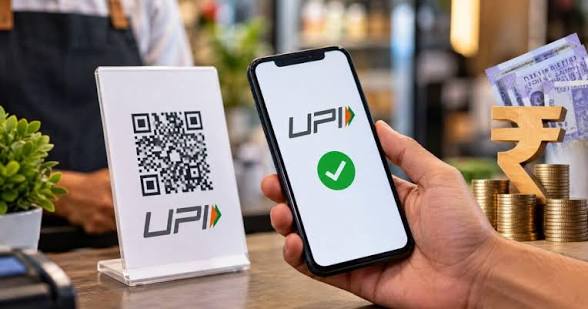




The Modi government’s decision to introduce fees on some Unified Payments Interface (UPI) transactions could give the country’s two dominant digital payment platforms hundreds of millions of dollars in new revenue, widening their lead over smaller rivals and raising concerns about market concentration, Reuters reported.
Walmart-backed PhonePe and Google Pay accounted for about 80% of UPI payment values last month. From Oct. 15, merchants will pay up to 0.4% on UPI transactions above 2,000 rupees ($21), ending six years of largely fee-free payments.
The Modi government says the move will create a revenue stream for payment companies and help cover the costs of operating the rapidly expanding digital payments network.
Critics and investors, however, say the policy could disproportionately benefit the largest platforms, whose extensive merchant networks and transaction volumes give them the greatest ability to capture the new revenue.
Brokerage Bernstein estimates the fee could generate up to $1.1 billion annually for payment apps by March 2028. Based on current market shares, PhonePe and Google Pay could receive about $900 million of that amount.
“The introduction of MDR is a positive step towards offsetting substantial operational costs and liabilities,” PhonePe co-founder Rahul Chari said.
The change marks a significant departure for UPI, whose growth has been central to the Modi government’s push towards a less-cash economy.
More than 500 million people use UPI for payments ranging from roadside purchases to high-value transactions. Adoption accelerated after the Modi government’s 2016 demonetisation programme removed much of India’s high-denomination currency from circulation and received another boost during the COVID-19 pandemic.
Keeping UPI largely free for consumers and merchants helped drive its adoption. The new fee structure, however, could strengthen platforms that already dominate the network and make it more difficult for smaller companies to gain market share.
BIG PLAYERS GAIN NEW FIREPOWER
The additional revenue could help PhonePe and Google Pay invest in harder-to-monetise areas such as rural India, according to two industry sources familiar with internal discussions.
Rural transactions are typically smaller, making them less attractive when payment companies earn little or nothing directly from each transaction. Payment data can nevertheless help companies offer credit and other financial services.
PhonePe and Google Pay did not provide details of their expansion plans. Google Pay did not respond to a request for comment, while PhonePe declined to provide specifics.
The change could intensify concentration in India’s digital payments market. The National Payments Corporation of India, which operates UPI, has twice postponed a decision on a proposed 30% market-share cap for individual payment apps, leaving the two leading platforms with a dominant position while smaller rivals struggle to build scale.
Industry executives said smaller companies were likely to focus on higher-value transactions, including ticket bookings, utility payments and business transactions, while expanding credit services linked to UPI.
Bipin Preet Singh, co-founder of MobiKwik, which ranks 15th among UPI apps by transaction frequency, said the fee gave his company a clearer commercial reason to continue investing in the network.
The policy could push payment companies towards merchant payments and online commerce rather than low-value person-to-person transfers, he said.
Some investors said the reform could come too late to substantially change the competitive balance.
“It might on the margins help smaller players with existing distribution, but the largest benefits are likely to accrue to large firms like PhonePe or Google Pay,” said Joseph Sebastian, vice president for investments at Blume Ventures.
MERCHANTS FACE THE COST
The charges could ultimately affect consumers, although regulations prohibit merchants from passing them on as a separate UPI fee.
Industry executives expect some merchants to absorb the cost and others to reflect it indirectly in prices.
The Reserve Bank of India, Bernstein analysts, industry executives and several merchants interviewed by Reuters in Mumbai said a significant return to cash was unlikely.
Govind Rawal, manager at clothing retailer Suvidha in Mumbai’s Dadar area, said about 80% of the store’s daily revenue of roughly 2 million rupees came through UPI.
The retailer did not plan to pass the fee directly to customers because UPI was too widely used, he said.
The charge has nevertheless revived concerns that the Modi government’s digital-payments push could create new costs for businesses while strengthening dominant platforms.
For 31-year-old Mahendra Vishnoi, who was shopping for household goods in Mumbai, the immediate cost may be small.
“The fees shouldn’t keep rising in the future though,” he said. “If it stays where it is for a few years, it should be fine.”
Support Independent Media
Click Here and Join the Membership of Millat Times to Support Independent Media.
Support Millat Times